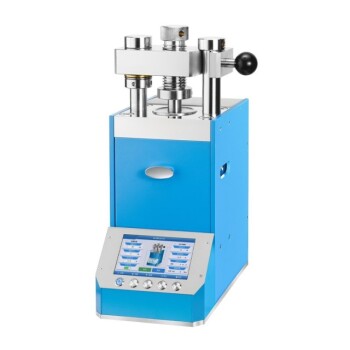
Hot Isostatic Pressing (HIP) significantly enhances Al-LLZ performance by acting as a powerful densification tool. By subjecting the sintered ceramic sheets to simultaneous high temperature and isotropic gas pressure, HIP provides the necessary driving force to eliminate residual micropores and fuse grain boundaries. This process increases the relative density of the material to over 98 percent, directly translating to improved physical and electrochemical properties.
The core value of HIP lies in its ability to perfect the microstructure of the ceramic. While initial sintering forms the sheet, HIP eliminates the microscopic defects that impede performance, unlocking high optical transparency and superior lithium-ion conductivity.
How the HIP Process Alters Microstructure
Simultaneous Heat and Pressure
The HIP process places the Al-LLZ material into a specialized pressure vessel.
Unlike standard sintering, this environment applies heat and high gas pressure (typically utilizing an inert gas like argon) at the same time.
Isostatic Application
The pressure applied is isostatic, meaning it exerts force equally from all directions.
This uniform compression ensures that the ceramic densifies evenly without warping or creating directional stress points.
Eliminating Residual Voids
Standard vacuum hot pressing often leaves behind sub-micron pores.
The extreme driving force of HIP collapses these residual micropores, effectively squeezing out the empty space within the material structure.
Promoting Grain Boundary Fusion
Beyond simply closing holes, HIP promotes the fusion of grain boundaries.
This creates a continuous, cohesive structure where the individual crystal grains are tightly bonded, reducing the internal resistance of the sheet.
The Impact on Material Performance
Superior Total Lithium-Ion Conductivity
For Al-LLZ ceramics used in energy applications, conductivity is paramount.
By increasing density and fusing grain boundaries, HIP creates a smoother pathway for ions to travel. This significantly enhances the total lithium-ion conductivity of the ceramic sheet.
High Optical Transparency
Porosity is the enemy of transparency because voids scatter light.
Because HIP raises the relative density to over 98 percent and removes internal defects, the resulting ceramic sheet achieves high optical transparency, a key indicator of structural purity.
Understanding the Trade-offs
Process Complexity and Equipment
Implementing HIP introduces an additional, sophisticated processing step.
It requires specialized machinery capable of managing high temperatures (e.g., up to 1700°C) and extreme pressures (e.g., 200 MPa), along with gas management systems for argon.
Balancing Cost and Quality
While HIP adds to the processing timeline, it can reduce overall waste.
The supplementary data suggests that HIPing can "recover" castings that might otherwise fail inspection due to porosity, potentially offsetting the added operational costs by reducing scrap rates.
Making the Right Choice for Your Goal
To maximize the potential of Al-LLZ ceramics, consider your specific performance requirements:
- If your primary focus is electrochemical efficiency: Rely on HIP to maximize grain boundary fusion, which is essential for achieving superior total lithium-ion conductivity.
- If your primary focus is structural integrity and clarity: Use HIP to drive relative density above 98 percent, ensuring the elimination of light-scattering micropores and internal voids.
Ultimately, HIP transforms a standard sintered sheet into a high-density, high-performance component suitable for advanced applications.
Summary Table:
| Feature | Standard Sintering | Hot Isostatic Pressing (HIP) |
|---|---|---|
| Relative Density | Often < 95% | > 98% (High Density) |
| Microstructure | Contains residual micropores | Pore-free, fused grain boundaries |
| Conductivity | Moderate ion pathway | Superior lithium-ion conductivity |
| Visual Quality | Opaque or translucent | High optical transparency |
| Pressure Type | Uniaxial or atmospheric | Isostatic (equal from all directions) |
Elevate Your Advanced Material Research with KINTEK
Unlock the full potential of your Al-LLZ ceramics and lithium-ion research. KINTEK specializes in precision laboratory equipment, offering industry-leading isostatic presses (hot and cold), high-temperature furnaces, and specialized battery research tools designed to eliminate defects and maximize conductivity.
Whether you are working with solid-state electrolytes or high-performance crushing and milling systems, our expert team is ready to provide the custom solutions you need for 98%+ density and structural perfection. Contact us today to optimize your lab's performance!
Related Products
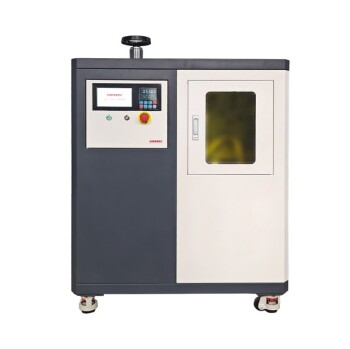
- Warm Isostatic Press for Solid State Battery Research
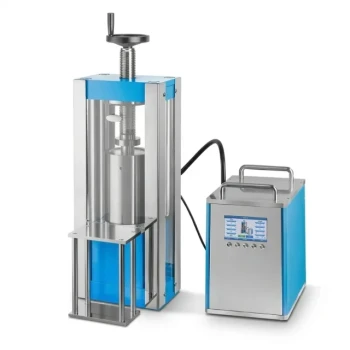
- Electric Split Lab Cold Isostatic Press CIP Machine for Cold Isostatic Pressing
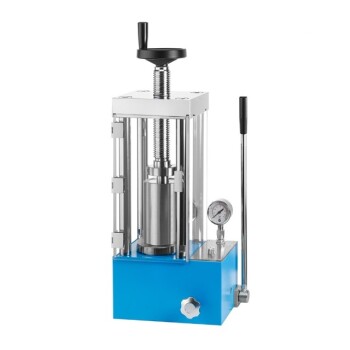
- Manual Cold Isostatic Pressing Machine CIP Pellet Press
- Automatic High Temperature Heated Hydraulic Press Machine with Heated Plates for Lab
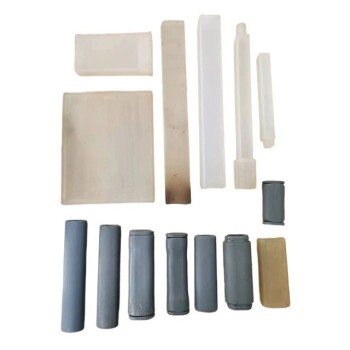
- Isostatic Molding Pressing Molds for Lab
People Also Ask
- What is the temperature of a warm isostatic press? Achieve Optimal Densification for Your Materials
- What is the function of a Warm Isostatic Press (WIP) in all-solid-state pouch cells? Optimize Battery Density
- Why are Warm Isostatic Presses (WIP) necessary for solid-state batteries? Achieve Atomic-Level Contact
- What advantages does a warm isostatic press offer over a traditional uniaxial press for Li6PS5Cl electrolyte sheets?
- How do warm isostatic presses improve dry electrode performance? Enhance ASSB Conductivity with Heat & Pressure