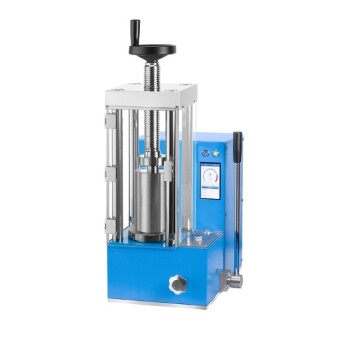
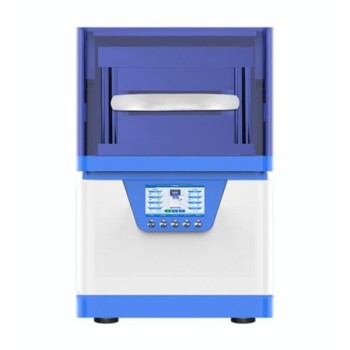
The Hot Isostatic Press (HIP) machine improves AlFeTiCrZnCu high-entropy alloys by subjecting them to uniform, ultra-high pressure (up to 1 GPa) at high temperatures (800°C). This process eliminates residual micro-pores that standard sintering methods miss, creating a highly dense, uniform microstructure. As a result, the alloy achieves superior mechanical performance, specifically a hardness of 10.04 GPa and compressive strength of 2.83 GPa.
Core Insight: While standard hot pressing applies pressure from a single direction, HIP applies extreme pressure from every direction. This "isotropic" force creates a nearly perfectly dense material, unlocking the full mechanical potential of the high-entropy alloy that cannot be achieved through vacuum hot pressing alone.
The Mechanism of Densification
Isotropic vs. Axial Pressure
Standard Vacuum Hot Pressing (VHP) typically applies roughly 30 MPa of axial pressure (one direction). In contrast, the HIP process utilizes a gas environment to apply isotropic pressure (all directions) up to 1 GPa. This massive increase in pressure magnitude and uniformity is the primary driver of superior properties.
Elimination of Micro-Pores
The extreme condition of 1 GPa pressure effectively crushes internal voids. This maximizes the elimination of residual micro-pores that often survive lower-pressure processing. The result is a microstructure that is significantly more uniform and dense than what is possible with conventional sintering.
The Role of the Stainless Steel Can
To make this process work, the pre-compacted alloy is vacuum-sealed inside a stainless steel can. This can isolates the sample from the high-pressure gas and transmits the force through plastic deformation. This prevents gas from infiltrating the material, ensuring the pressure is used purely for densification.
Quantifiable Improvements in Properties
Reaching Peak Hardness
By removing porosity, the material's resistance to deformation increases drastically. The HIP-processed AlFeTiCrZnCu alloy achieves a hardness of 10.04 GPa. This is a significant improvement over samples processed via vacuum hot pressing alone.
Enhanced Compressive Strength
The elimination of micro-defects also removes stress concentration points within the alloy. Consequently, the material exhibits a compressive strength of 2.83 GPa. This metric confirms that the material is not just harder, but structurally more robust under load.
Understanding the Trade-offs
Process Complexity
Achieving these superior properties requires a more complex workflow than standard sintering. The use of the stainless steel can is a consumable necessity; it must be fabricated, sealed under vacuum, and essentially sacrificed to form the alloy.
Efficiency vs. Perfection
Vacuum Hot Pressing (VHP) is effective for promoting grain diffusion and restricting grain growth to maintain nanocrystalline properties. However, it cannot match the densification capabilities of HIP. If the goal is absolute maximum density and pore closure, the additional complexity of HIP is required.
Making the Right Choice for Your Project
While both methods utilize high temperatures (800°C), the choice depends on your specific mechanical requirements:
- If your primary focus is maximum mechanical performance: Choose HIP processing to achieve peak hardness (10.04 GPa) and compressive strength (2.83 GPa) through total densification.
- If your primary focus is process simplicity: Standard Vacuum Hot Pressing (VHP) offers a simpler pressure-assisted sintering mechanism, though it will leave residual porosity that HIP would otherwise eliminate.
Ultimate material performance in high-entropy alloys is dictated not just by composition, but by the successful elimination of microscopic voids.
Summary Table:
| Feature | Vacuum Hot Pressing (VHP) | Hot Isostatic Pressing (HIP) |
|---|---|---|
| Pressure Direction | Axial (Single Direction) | Isotropic (All Directions) |
| Max Pressure | ~30 MPa | Up to 1 GPa (1000 MPa) |
| Hardness Achieved | Lower/Standard | 10.04 GPa |
| Compressive Strength | Standard | 2.83 GPa |
| Micro-Pores | Residual pores remain | Effectively eliminated |
| Resulting Density | High | Near-Theoretical (Maximum) |
Unlock the Full Potential of Your High-Entropy Alloys
Maximize your material performance with KINTEK’s precision-engineered Hot Isostatic Press (HIP) systems. Whether you are developing advanced AlFeTiCrZnCu alloys or specialized aerospace components, our equipment ensures the elimination of micro-defects to reach peak mechanical properties like never before.
Why choose KINTEK?
- Comprehensive Laboratory Range: From high-pressure reactors and hydraulic presses to advanced muffle and vacuum furnaces.
- Expertise in Densification: Specialized tools for battery research, crushing, milling, and high-temperature material processing.
- Reliable Performance: Superior durability and uniform heating for consistent, high-density results.
Ready to elevate your material research? Contact KINTEK today to find the perfect HIP or hydraulic press solution for your lab!
Related Products
- Warm Isostatic Press for Solid State Battery Research
- 600T Vacuum Induction Hot Press Furnace for Heat Treat and Sintering
- Isostatic Molding Pressing Molds for Lab
- Automatic High Temperature Heated Hydraulic Press Machine with Heated Plates for Lab
- Manual High Temperature Heated Hydraulic Press Machine with Heated Plates for Lab
People Also Ask
- What is the temperature of a warm isostatic press? Achieve Optimal Densification for Your Materials
- What is the function of a Warm Isostatic Press (WIP) in all-solid-state pouch cells? Optimize Battery Density
- Why are Warm Isostatic Presses (WIP) necessary for solid-state batteries? Achieve Atomic-Level Contact
- What advantages does a warm isostatic press offer over a traditional uniaxial press for Li6PS5Cl electrolyte sheets?
- How do warm isostatic presses improve dry electrode performance? Enhance ASSB Conductivity with Heat & Pressure