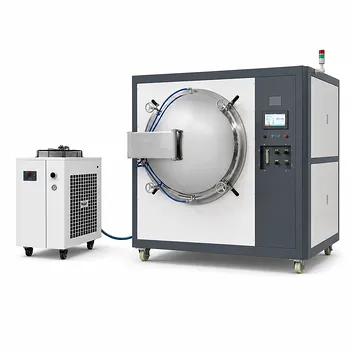
A Hot Pressing Furnace promotes densification by applying mechanical pressure to powder samples simultaneously with high-temperature heating. Unlike traditional techniques that rely solely on thermal energy to fuse particles, the addition of physical force significantly enhances the driving force for densification, allowing for the removal of pores and voids more efficiently.
By introducing mechanical pressure as a variable, hot pressing decouples densification from extreme temperatures. This allows engineers to achieve near-theoretical density in advanced ceramics while preserving critical microstructural properties that are often lost in pressureless sintering.
The Mechanics of Enhanced Densification
Increasing the Driving Force
In traditional pressureless sintering, the primary driver for densification is the reduction of surface energy through capillary forces. This is a relatively passive process.
Hot pressing adds an active external force. By physically compressing the powder compact while it is hot and plastic, the furnace forces particles to rearrange and flow into void spaces, accelerating the densification process significantly.
Reducing Thermal Requirements
Because mechanical pressure assists in closing pores, the system relies less on thermal diffusion to achieve density.
This effectively reduces the required sintering temperature. Furthermore, it shortens the overall sintering time, as the target density is reached much faster when heat and pressure work in tandem.
Impact on Microstructure and Material Quality
Preventing Excessive Grain Growth
One of the greatest risks in traditional sintering is that the high temperatures required for densification also cause grains to grow excessively large. Large grains often lead to reduced mechanical strength and toughness.
Because hot pressing allows for lower temperatures and shorter cycle times, it minimizes the window for grain growth. This results in a fine-grained microstructure with superior mechanical properties.
Enabling "Difficult" Materials
Certain advanced ceramics exhibit low self-diffusion rates and are notoriously difficult to sinter to full density using only heat (pressureless methods).
Hot pressing is ideal for these scenarios. It provides the necessary extra energy to achieve high density in refractory materials that would otherwise remain porous or require distinct sintering aids to process traditionally.
Understanding the Constraints
While hot pressing offers superior material properties, the requirement for mechanical pressure introduces specific limitations compared to pressureless sintering.
Geometric Limitations
Because the pressure is applied uniaxially (usually via a ram and die set), the shapes are generally limited to simple geometries like flat plates, discs, or cylinders. Complex, net-shape components are difficult to produce directly.
Tooling Dependencies
The process requires robust die materials (often graphite) capable of withstanding both high heat and high pressure. This adds a layer of complexity to the setup that is not present in free-standing, pressureless sintering.
Making the Right Choice for Your Goal
The decision between hot pressing and pressureless sintering depends on whether your priority is material performance or geometric complexity.
- If your primary focus is Maximum Density and Strength: Choose hot pressing to achieve full densification and fine grain structures, especially for difficult-to-sinter materials.
- If your primary focus is Complex Geometry: Choose pressureless sintering, as it allows for the processing of intricate shapes without the constraints of a die.
Hot pressing is the definitive solution when the material's performance limits cannot be compromised by the physics of standard thermal processing.
Summary Table:
| Feature | Hot Pressing Furnace | Pressureless Sintering |
|---|---|---|
| Primary Driving Force | Thermal Energy + Mechanical Pressure | Thermal Energy (Surface Tension) |
| Sintering Temperature | Lower temperatures required | Higher temperatures required |
| Grain Growth Control | Excellent (prevents excessive growth) | Difficult (risk of large grains) |
| Material Density | Near-theoretical (maximum) | Variable (often retains pores) |
| Geometric Flexibility | Limited (Simple discs, plates, cylinders) | High (Complex, net-shape parts) |
| Ideal Application | High-performance refractory ceramics | Intricate parts & mass production |
Elevate Your Material Performance with KINTEK Precision
Unlock the full potential of your advanced ceramics with KINTEK’s high-performance hot pressing systems. Whether you are working on refractory materials that resist standard sintering or require a fine-grained microstructure for maximum mechanical strength, our engineering team provides the tools you need to succeed.
Why choose KINTEK?
- Comprehensive Range: From high-temperature vacuum and atmosphere furnaces to specialized hydraulic presses and crushing systems.
- Advanced Research Tools: We support your entire workflow with everything from high-pressure reactors and autoclaves to battery research consumables.
- Tailored Solutions: Our equipment is designed for precision, durability, and superior thermal control to ensure consistent, high-density results.
Ready to optimize your densification process? Contact our laboratory specialists today to find the perfect furnace solution for your research or production needs!
Related Products
- 600T Vacuum Induction Hot Press Furnace for Heat Treat and Sintering
- Vacuum Hot Press Furnace Heated Vacuum Press Machine Tube Furnace
- Vacuum Hot Press Furnace Machine for Lamination and Heating
- Vacuum Hot Press Furnace Machine Heated Vacuum Press
- Vacuum Heat Treat and Pressure Sintering Furnace for High Temperature Applications
People Also Ask
- What role does an induction vacuum hot pressing furnace play in sintering? Achieve 98% Density in Carbide Blocks
- What advantages does a vacuum hot press furnace provide for LSLBO ceramic electrolytes? Achieve 94% Relative Density
- What role does a Vacuum Hot Press (VHP) furnace play in the densification of austenitic stainless steel 316 composites?
- What are the advantages of a vacuum hot press furnace for W-50%Cu? Achieve 99.6% Density at Lower Temperatures
- What role does mechanical pressure play during the vacuum diffusion bonding of tungsten and copper? Keys to Solid Bonding