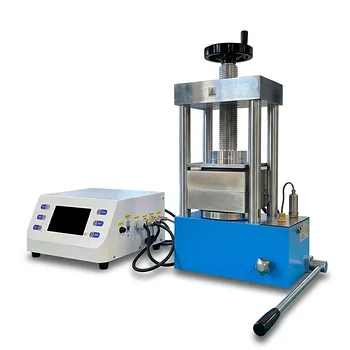
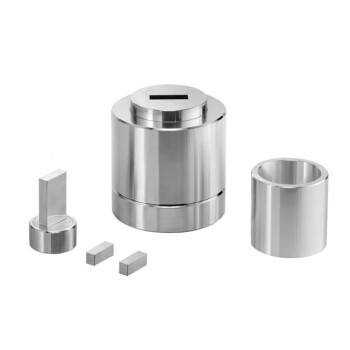
The laboratory hydraulic press is the definitive tool for determining the density, structural integrity, and electrical performance of graphite blocks during the pre-forming stage. By applying high uniaxial pressure—often reaching 100 MPa—it forces filler particles and binders into intimate contact, eliminating the internal voids that would otherwise compromise the material's final properties. This stage essentially dictates the success of all subsequent thermal treatments, including carbonization and graphitization.
Core Takeaway: A laboratory hydraulic press transforms loose carbonaceous mixtures into high-density "green bodies" by eliminating porosity and establishing a robust particle-to-particle network. This mechanical consolidation is the single most critical factor in achieving the high bulk density and mechanical strength required for industrial-grade graphite.
Achieving Maximum Material Density
The Elimination of Internal Voids
The primary role of the hydraulic press is the mechanical expulsion of air and the closure of internal gaps within the mixture of coke powder and binder. By applying intense pressure, the press overcomes the internal friction of the particles, forcing them to pack into a tighter configuration.
This process is vital because any residual voids left during the pre-forming stage will remain or even expand during high-temperature sintering. Minimizing these voids at the start ensures the final block possesses a uniform, dense microstructure.
Maximizing Bulk Density and Reducing Porosity
High-quality graphite requires high bulk density and low porosity to withstand mechanical stress and chemical erosion. The laboratory press enables the precise control of these parameters by allowing operators to apply specific pressure levels tailored to the material's composition.
When the filler and binder are compressed under high loads, the resulting preform achieves a solid-state density that provides the necessary physical foundation for high-performance applications.
Optimizing the Filler-Binder Interface
Enhanced Particle Rearrangement
In many graphite formulations, binders like phenolic resin or coal-based pitch are used to glue the filler particles together. The hydraulic press, especially when equipped with heating elements, softens these binders, allowing them to flow and coat the coke or graphite filler more effectively.
This rearrangement of particles in a softened state ensures that the binder is distributed evenly. This leads to a more homogenous green body with fewer weak points.
Creation of Conductive Networks
For applications requiring high electrical or thermal conductivity, the press is used to establish an effective contact network. High-intensity axial pressure causes plastic deformation of the particles, increasing the surface area of contact between them.
This tight packing is essential for reducing electrical resistance. Without sufficient pressing force, the graphite particles remain isolated, resulting in poor conductivity and mechanical instability in the final device.
Shaping the Pre-Sintering Foundation
Structural Integrity of the Green Body
The "green body" is the term for the compressed material before it is fired. A laboratory hydraulic press provides the mechanical fixation and structural stability needed for the green body to be handled and processed further.
A well-pressed green body maintains its predetermined geometric shape and resists crumbling. This stability is critical for ensuring that the dimensions of the final graphite block remain within tolerance after the shrinkage that occurs during sintering.
Facilitating Solid-Phase Reactions
By forcing particles into extreme proximity, the hydraulic press significantly shortens the distance for atomic diffusion. This enhancement of the solid-phase reaction efficiency allows for more uniform grain growth and higher mechanical strength during the subsequent sintering phase.
Understanding the Trade-offs
Residual Stress and Anisotropy
While high pressure is beneficial for density, it can introduce residual stresses within the block. Because the pressure is typically uniaxial (applied in one direction), the graphite flakes may align perpendicularly to the force, creating anisotropic properties where the block is stronger in one direction than the other.
The Risk of Pressure-Induced Cracking
Exceeding the optimal pressure for a specific mixture can lead to internal laminations or cracks. If the air trapped within the powder cannot escape during compression, it may expand rapidly when the pressure is released, causing the green body to "cap" or split.
How to Apply This to Your Project
Choosing the Right Pressing Strategy
To achieve the best results for your specific graphite application, consider the following recommendations:
- If your primary focus is maximum mechanical strength: Use a high-pressure setting (near 100 MPa) to ensure the highest possible bulk density and the smallest possible grain distance.
- If your primary focus is uniform electrical conductivity: Utilize a heating hydraulic press (150°C–180°C) to ensure the binder flows perfectly, creating a seamless conductive network between filler particles.
- If your primary focus is dimensional precision: Ensure the mold is heated uniformly and apply pressure slowly to allow air to escape, preventing internal stresses and cracking.
Proper control of the hydraulic pressing stage is the foundation upon which all high-performance graphite characteristics are built.
Summary Table:
| Parameter | Impact on Graphite Quality | Mechanism of Action |
|---|---|---|
| Bulk Density | Increases mechanical strength | Eliminates internal voids and air gaps via high uniaxial pressure. |
| Porosity | Reduces chemical & mechanical vulnerability | Forces particles into a tight configuration to minimize residual gaps. |
| Conductivity | Enhances electrical/thermal performance | Creates a conductive network through plastic deformation of particles. |
| Green Body Stability | Ensures dimensional precision | Establishes mechanical fixation and structural integrity for handling. |
| Binder Interface | Ensures a homogenous microstructure | Softens and redistributes binders to coat filler particles effectively. |
Maximize Your Graphite Performance with KINTEK Precision
Achieving the perfect high-density green body requires more than just force—it requires precision. KINTEK specializes in advanced laboratory equipment, offering a comprehensive range of manual, electric, and heated hydraulic presses designed specifically for pelletizing and material consolidation.
Our high-pressure systems empower researchers to:
- Eliminate Porosity: Reach pressures up to 100 MPa for superior density.
- Optimize Conductivity: Utilize our heated pressing solutions to create seamless binder-filler networks.
- Ensure Consistency: Maintain structural integrity for high-performance carbonaceous materials.
Whether you are refining battery research or industrial graphite blocks, KINTEK provides the tools and consumables you need for excellence. Contact our experts today to find the ideal pressing solution for your lab!
References
- Jong-Hwan Ko, Jae‐Seung Roh. Improved Oxidation Resistance of Graphite Block by Introducing Curing Process of Phenolic Resin. DOI: 10.3390/ma16093543
This article is also based on technical information from Kintek Solution Knowledge Base .
Related Products
- Automatic Laboratory Hydraulic Press for XRF & KBR Pellet Press
- Laboratory Hydraulic Pellet Press for XRF KBR FTIR Lab Applications
- Laboratory Hydraulic Press Split Electric Lab Pellet Press
- Automatic Laboratory Hydraulic Pellet Press Machine for Lab Use
- Laboratory Manual Hydraulic Pellet Press for Lab Use
People Also Ask
- What is the significance of applying 200 MPa of pressure with a laboratory hydraulic pellet press for composite ceramics?
- What is the role of a laboratory hydraulic pellet press and stainless steel molds in the fabrication of RuO2/NbC anodes?
- What is the necessity of using a laboratory hydraulic pellet press in the preparation of biomass fuel pellets? Guide
- How does a laboratory hydraulic pellet press contribute to SiCw/2024 aluminum composite preforms? Optimize Densification
- What role does a laboratory hydraulic pellet press play in fly ash utilization? Enhancing Adsorption and Flow Control