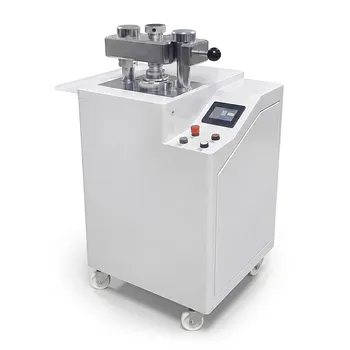
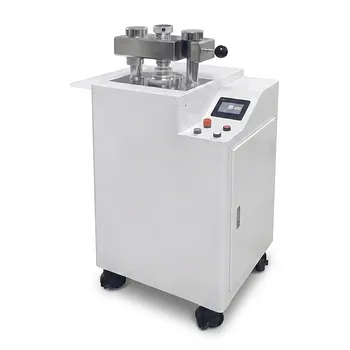
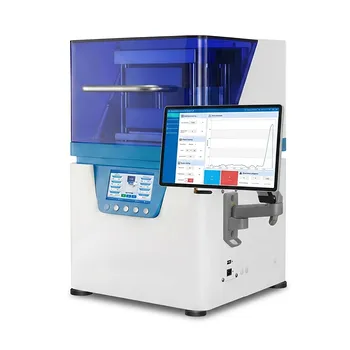
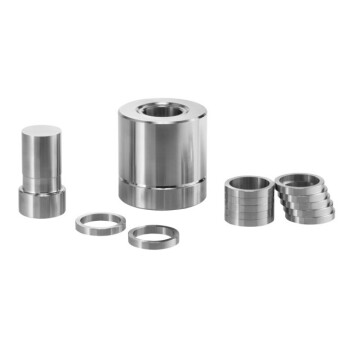
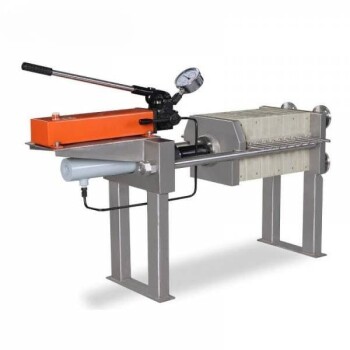
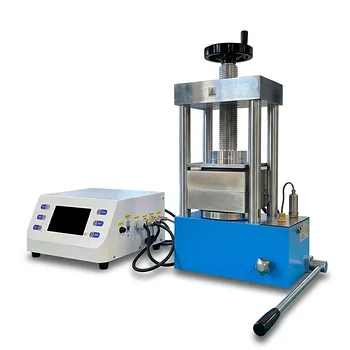
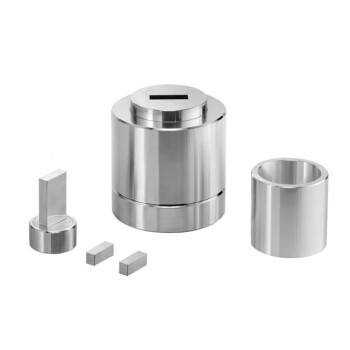
A laboratory hydraulic press is the critical tool for transforming loose slag powder into a standardized solid medium suitable for X-ray Fluorescence (XRF) analysis. By applying high axial pressure, the press creates a dense, flat pellet with uniform density and a smooth surface. This process eliminates internal pores and surface irregularities, which directly reduces X-ray scattering and matrix effects to ensure highly accurate and reproducible quantitative data.
The laboratory hydraulic press ensures analytical precision in XRF by standardizing sample geometry and density. This minimizes physical interference and optimizes the fluorescence signal, allowing for reliable quantification of the elemental composition of slag powder.
The Physical Transformation of Slag Powder
Eliminating Internal Voids and Porosity
A hydraulic press applies stable, high-intensity pressure—often up to 15 tons—to induce plastic deformation in the slag particles. This force effectively collapses internal voids and air pockets, resulting in a pellet with consistent density throughout its structure.
Precise pressure control is essential because it eliminates density gradients. Without this uniformity, the X-ray beam would penetrate the sample inconsistently, leading to erratic fluorescence intensity and skewed results.
Standardizing Surface Geometry
The press utilizes a precision-machined 32mm die (or similar size) to shape the powder into a circular pellet with a perfectly flat and smooth surface. This flat interface is necessary for the XRF spectrometer to receive a clear, unobstructed signal.
A smooth surface ensures that the incident X-ray beam hits the sample at a uniform angle. Surface irregularities found in loose powder can cause shadows or "shielding," where some particles block others from the detector.
Enhancing XRF Signal Integrity
Reducing Matrix and Particle Size Effects
One of the greatest challenges in slag analysis is the matrix effect, where the physical form of the sample interferes with the chemical signal. Pelletization effectively "resets" the physical state of the material, making the analysis dependent on chemistry rather than how the powder was poured.
By compressing the powder into a solid mass, the press eliminates particle size effects. This ensures that the XRF spectrometer detects fluorescence signals that are truly representative of the slag’s elemental concentration.
Improving Excitation Efficiency
Dense pellets reduce X-ray scattering losses that typically occur on the surface of loose materials. When scattering is minimized, the excitation efficiency of the fluorescence signal is significantly improved.
This enhanced signal strength is particularly vital for heavy metal analysis or detecting trace elements in slag. A stronger, more stable characteristic fluorescence signal results in a higher signal-to-noise ratio and more reliable quantitative data.
Understanding the Trade-offs
The Necessity of Binders
While high pressure is powerful, slag powder often lacks sufficient natural cohesion to remain a solid pellet. In many cases, a binding agent must be added to ensure structural integrity, which introduces a slight dilution factor that must be accounted for in the final calculation.
Risk of Pressure-Induced Errors
Applying too much pressure can occasionally cause mineral phase transitions or lead to sample cracking upon pressure release (decompression). Conversely, insufficient pressure leaves the pellet fragile and prone to crumbling, which can contaminate the delicate internal components of the XRF spectrometer.
Speed vs. Consistency
While manual hydraulic presses offer high flexibility and lower costs, they rely on the operator to maintain dwell time (how long the pressure is held). Variations in dwell time can lead to subtle density differences between pellets, making automated presses the preferred choice for high-volume, high-precision laboratories.
How to Apply This to Your Project
When integrating a hydraulic press into your slag analysis workflow, your choice of equipment and settings should align with your specific analytical requirements.
- If your primary focus is maximum analytical precision: Use an automated hydraulic press with programmable dwell times to ensure every pellet has identical density and surface finish.
- If your primary focus is trace element detection: Ensure the use of high-purity binders and ultra-clean die sets to prevent cross-contamination that could mask low-level signals.
- If your primary focus is high-throughput screening: Invest in a system with easy-load dies and fast-return hydraulics to reduce the cycle time between sample preparations.
Standardizing your pelletization process is the single most effective way to eliminate physical variables and unlock the full quantitative potential of XRF slag analysis.
Summary Table:
| Key Feature | Physical Transformation | Benefit for XRF Analysis |
|---|---|---|
| High-Pressure Compression | Eliminates internal voids and porosity | Ensures consistent density and X-ray penetration |
| Precision Die Shaping | Creates a perfectly flat, smooth surface | Minimizes X-ray scattering and signal "shielding" |
| Matrix Standardization | Homogenizes the physical state of powder | Reduces particle size effects and matrix interference |
| Signal Enhancement | Increases sample density | Improves excitation efficiency for trace element detection |
Elevate Your XRF Analysis with KINTEK Precision
Achieving reliable quantitative data starts with perfect sample preparation. KINTEK specializes in high-performance laboratory equipment, including manual and automated hydraulic presses (pellet, hot, isostatic) and precision die sets specifically designed to ensure the uniform density and smooth surfaces required for accurate XRF analysis.
Our comprehensive portfolio also features crushing and milling systems for powder preparation, high-temperature furnaces, and specialized consumables like PTFE and ceramics to support your entire material research workflow.
Ready to optimize your slag powder analysis and ensure reproducible results? Contact our experts today to find the ideal pressing solution for your laboratory!
References
- Md Khairul Islam, Nawshad Haque. Experimental Phase Equilibria and Liquidus of CaO-Al2O3-SiO2-Na2O-B2O3 Slags Relevant to E-waste Processing. DOI: 10.1007/s11663-023-02952-9
This article is also based on technical information from Kintek Solution Knowledge Base .
Related Products
- Automatic XRF Pellet Press 40 Ton Hydraulic Sample Preparation Press for Fluorescent Spectroscopy Analysis
- Automatic Fluorescent Pellet Press for XRF Sample Preparation
- Automatic Laboratory Hydraulic Press for XRF & KBR Pellet Press
- Laboratory Hydraulic Pellet Press for XRF KBR FTIR Lab Applications
- Fully Automatic Heated Hydraulic Lab Press for Materials Sintering and Sample Preparation
People Also Ask
- Why is a laboratory hydraulic pellet press essential for the FTIR characterization of lignite and its pyrolysis products?
- How does a manual hydraulic pellet press contribute to the formation of biomass fuels? Optimize Your Fuel Densification
- What is the purpose of using a laboratory hydraulic press to form pellets? Maximize Weberite Na2Fe2F7 Phase Purity
- What is the necessity of using a laboratory hydraulic pellet press in the preparation of biomass fuel pellets? Guide
- Why is a manual pellet press required for NiCe/Lay catalyst FTIR analysis? Unlock High-Resolution Spectral Data