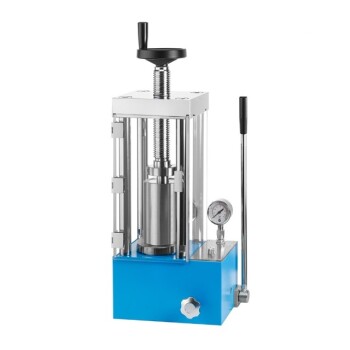
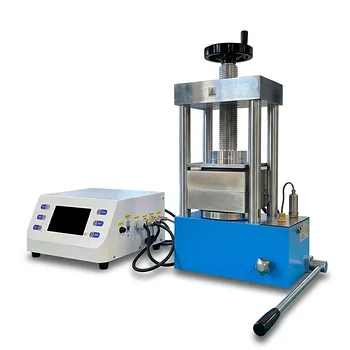
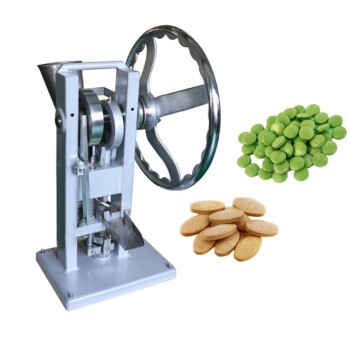
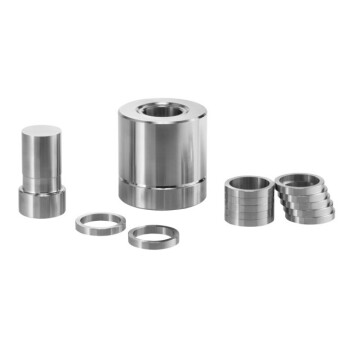
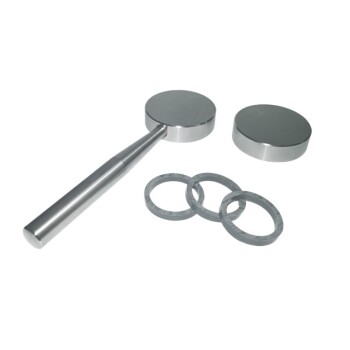
A laboratory manual pellet press is essential for NiCe/Lay catalyst analysis because it transforms opaque powder into a transparent medium suitable for infrared light transmission. By compressing the catalyst with potassium bromide (KBr), the press creates a uniform, thin pellet that allows the FTIR beam to penetrate the sample directly. This process is the only way to obtain the high-resolution vibration peaks necessary to verify the catalyst’s structural integrity and the success of metal loading.
The manual pellet press overcomes the natural light-scattering properties of powdered catalysts by creating a solid, transparent optical path. This standardization ensures that the resulting FTIR spectra accurately reflect the chemical bonds of the NiCe/Lay framework rather than physical interference from the sample's powder state.
The Physics of Infrared Transmission
Eliminating Light Scattering
Powdered catalysts, like NiCe/Lay, naturally scatter infrared radiation, which leads to "noisy" or unreadable spectra. High-pressure molding in a pellet press forces the potassium bromide (KBr) and catalyst particles into a unified, semi-transparent disk. This eliminates the internal voids and air pockets that cause scattering, allowing the infrared beam to pass through the sample effectively.
Standardizing the Optical Path Length
Consistency is vital for accurate spectroscopic analysis. The pellet press ensures a uniform thickness across the entire circular pellet, providing a stable optical path for the FTIR beam. This uniformity allows for higher signal-to-noise ratios, which are required to identify subtle functional groups.
Facilitating Plastic Flow
Under the high pressure exerted by the manual press, KBr undergoes plastic flow. This physical change allows the KBr to act as a transparent matrix that "locks" the trace NiCe/Lay catalyst particles in place. The result is a bubble-free, translucent disc that captures the specific vibration frequencies of the sample.
Chemical Characterization of NiCe/Lay Catalysts
Monitoring the Zeolite Framework
The pelletizing process enables researchers to observe the characteristic vibration peaks of the zeolite framework. This is critical for confirming that the structural integrity of the catalyst remains intact after the metal loading process. Clear signals allow for the detection of shifts in the framework, such as those near 1025 cm⁻¹.
Identifying Metal Oxide and Hydroxyl Bonds
For NiCe/Lay catalysts, it is essential to monitor the state of metal oxides and surface hydroxyl groups. The clear spectra produced by the pellet press allow for the precise identification of Ni-O bonding vibrations. These signals confirm that nickel and cerium ions have been successfully embedded or interacted with the catalyst support.
Evaluating Adsorbed Water
The press ensures that the infrared beam can detect vibrations from adsorbed water on the catalyst surface. Because the pellet is thin and transparent, researchers can distinguish between water bound to the surface and the structural components of the catalyst. This helps in understanding the catalyst's hydrophilicity and active site availability.
Understanding the Trade-offs and Technical Challenges
Pressure Stability and Sample Integrity
While high pressure is necessary for transparency, excessive or unstable pressure can damage the catalyst's crystalline structure. If the pressure is not controlled properly during the manual pressing, the pellet may crack or become opaque. Achieving the "sweet spot" of pressure is a manual skill that impacts the repeatability of the data.
The Risk of Moisture Contamination
KBr is highly hygroscopic, meaning it rapidly absorbs moisture from the air. If the pellet-making process is too slow or performed in a humid environment, water peaks will overwhelm the catalyst’s signals. This requires the sample to be prepared and pressed quickly to maintain the purity of the spectral analysis.
Particle Size Limitations
For the best results, the catalyst and KBr must be ground to a fine, homogenous powder before pressing. If the particles are too large, the pellet will remain cloudy, leading to poor light transmission. This pre-processing step is labor-intensive but non-negotiable for high-quality FTIR results.
How to Apply This to Your Project
Making the Right Choice for Your Goal
To achieve the best results with your NiCe/Lay catalyst analysis, follow these strategic recommendations based on your specific research focus:
- If your primary focus is Structural Validation: Ensure the pellet is pressed to a high degree of transparency to capture the subtle vibration shifts in the zeolite framework.
- If your primary focus is Metal Loading Efficiency: Use a highly precise manual press to eliminate scattering, which allows for the clear identification of Ni-O and other metal-oxide bonds.
- If your primary focus is Surface Chemistry: Prepare the KBr-catalyst mixture in a controlled, low-humidity environment to prevent moisture peaks from masking surface hydroxyl groups.
Proper use of a laboratory manual pellet press is the foundational step in converting a raw catalyst powder into a data-rich optical medium.
Summary Table:
| Feature/Function | Technical Benefit | Impact on Catalyst Analysis |
|---|---|---|
| Light Scattering | Eliminates internal voids/air pockets | Produces noise-free, readable infrared spectra |
| Optical Path | Standardizes pellet thickness | Ensures repeatable signal-to-noise ratios |
| Plastic Flow | Creates a transparent KBr matrix | Enables detection of Ni-O and metal-oxide bonds |
| Structural Validation | Maintains zeolite framework integrity | Confirms catalyst stability after metal loading |
| Surface Chemistry | Distinguishes adsorbed water peaks | Identifies surface hydroxyl groups and active sites |
Optimize Your Catalyst Research with KINTEK Precision
At KINTEK, we understand that high-quality FTIR data starts with perfect sample preparation. Our laboratory manual hydraulic presses are engineered to deliver the stable, precise pressure required to transform opaque powders into transparent KBr pellets, ensuring your NiCe/Lay catalyst analysis is accurate and repeatable.
As specialists in laboratory equipment, KINTEK offers a comprehensive range of tools designed for advanced material science, including:
- Hydraulic Presses: Pellet, hot, and isostatic presses for consistent sample preparation.
- High-Temperature Furnaces: Muffle, tube, vacuum, CVD, and PECVD systems for catalyst synthesis.
- Crushing & Milling: Systems to ensure the fine, homogenous powder required for high-quality pellets.
- Reactors & Autoclaves: High-temperature and high-pressure solutions for catalyst testing.
- Consumables: High-purity ceramics, crucibles, and PTFE products to maintain sample purity.
Whether you are validating zeolite frameworks or monitoring complex metal-oxide vibrations, KINTEK provides the reliability, OEM/ODM support, and technical expertise your laboratory demands.
Ready to enhance your lab's analytical precision? Contact our experts today to find the perfect solution for your research goals!
References
- Kai Zhang, Zhanhu Guo. Bimetallic NiCe/Lay catalysts facilitated co-pyrolysis of oleic acid and methanol for efficiently preparing anaerobic hydrocarbon fuels. DOI: 10.1039/d3nj01359f
This article is also based on technical information from Kintek Solution Knowledge Base .
Related Products
- Laboratory Manual Hydraulic Pellet Press for Lab Use
- Laboratory Manual Hydraulic Pellet Press for Lab Use
- Manual Cold Isostatic Pressing Machine CIP Pellet Press
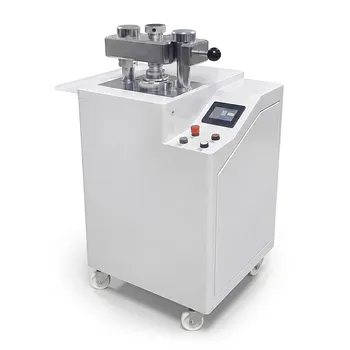
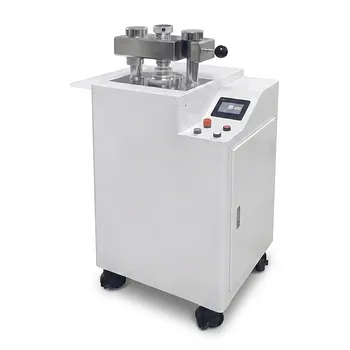
- Automatic XRF Pellet Press 40 Ton Hydraulic Sample Preparation Press for Fluorescent Spectroscopy Analysis
- Automatic Fluorescent Pellet Press for XRF Sample Preparation
People Also Ask
- What is the role of a laboratory hydraulic pellet press and stainless steel molds in the fabrication of RuO2/NbC anodes?
- What is the necessity of using a laboratory hydraulic pellet press in the preparation of biomass fuel pellets? Guide
- What is the significance of applying 200 MPa of pressure with a laboratory hydraulic pellet press for composite ceramics?
- How does a laboratory hydraulic pellet press contribute to SiCw/2024 aluminum composite preforms? Optimize Densification
- Why use laboratory manual hydraulic presses for semiconductor pellets? Optimize Annealing & Crystalline Quality