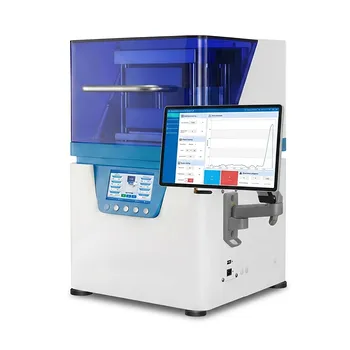
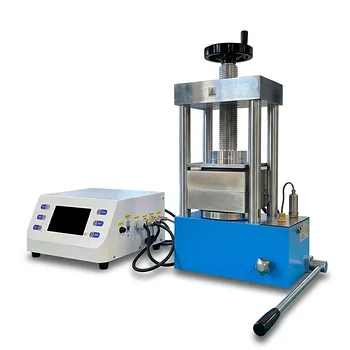
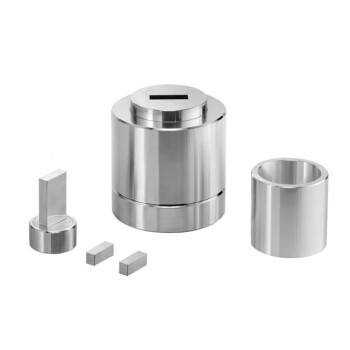
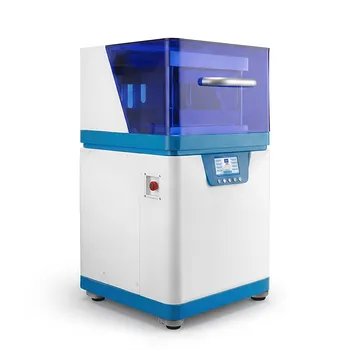
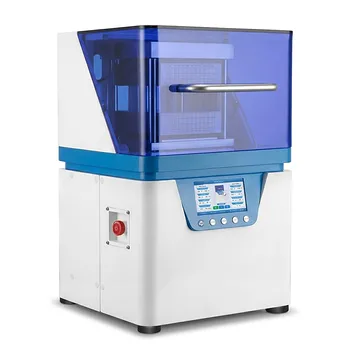
A laboratory hydraulic press is the critical tool for sealing CR2032 coin cells and ensuring internal component connectivity. It applies precise, uniform mechanical force to deform the battery casing into an airtight seal while simultaneously compressing the active materials, separator, and sodium metal disc. This process minimizes internal contact resistance and prevents electrolyte leakage, which is essential for obtaining accurate and reproducible electrochemical data during sodium storage evaluation.
The hydraulic press acts as the bridge between raw battery components and a functional electrochemical cell. By providing controlled pressure, it ensures both the physical safety of the cell and the scientific integrity of the resulting test data.
Ensuring Structural Integrity and Safety
Achieving a Hermetic Seal
The press deforms the stainless steel casing against a sealing gasket to create a liquid-tight, airtight environment. This prevents the volatile electrolyte from leaking out and, more importantly, blocks moisture and oxygen from entering the cell. Protecting the sodium metal anode is vital, as it is highly reactive and degrades instantly when exposed to ambient air.
Uniform Internal Compression
High, monitorable pressure—often reaching 500 psi or more—compresses the internal stack, including spring sheets and current collectors. This constant pressure ensures that the internal "sandwich" of materials remains stable and properly aligned. Without this mechanical stability, the battery's internal structure could shift during electrochemical cycling.
Regulating Component Density
The press helps regulate the porosity of the electrode and the overall density of the battery structure. By controlling the force applied, researchers can ensure that the active material layers are sufficiently compacted. This compaction is necessary to achieve high volumetric energy density in the test cell.
Maximizing Electrochemical Performance
Reducing Contact Resistance
Tight physical contact between the cathode, separator, and sodium disc is required for efficient ion transport. The hydraulic press eliminates microscopic gaps between these layers, significantly lowering interfacial contact resistance. This allows researchers to measure the inherent storage performance of the material rather than losses caused by a poor setup.
Optimizing Electrolyte Wetting
Controlled pressure facilitates the electrolyte’s ability to fully "wet" or penetrate the pores of the electrode material. This ensures that the entire surface area of the active material is accessible for sodium ion intercalation. Proper wetting is essential for obtaining accurate specific capacity data and stable cycling results.
Ensuring Data Reproducibility
Because the press provides constant and repeatable pressure, it allows for high consistency across multiple samples. Researchers can compare different fluorinated graphene or sodium-storage materials with confidence, knowing the assembly variables are identical. This standardization is the foundation of reliable laboratory research.
Understanding the Trade-offs
Risks of Excessive Pressure
Applying too much pressure can lead to internal short circuits if the separator is punctured or excessively thinned. It may also cause the mechanical deformation of active material particles, which can artificially alter their electrochemical behavior.
Dangers of Insufficient Pressure
Insufficient crimping pressure results in a "loose" cell with high ohmic internal resistance. This often leads to erratic voltage profiles and premature battery failure due to electrolyte evaporation. A weak seal is the primary cause of oxygen infiltration, which compromises the chemistry of the sodium metal.
How to Apply This to Your Project
When assembling CR2032 cells for sodium storage evaluation, your technical approach should align with your specific research objectives:
- If your primary focus is high-rate performance: Maximize uniform pressure to minimize contact resistance, ensuring that sodium ions can move rapidly across interfaces without impedance.
- If your primary focus is long-term cycling stability: Prioritize the integrity of the hermetic seal to prevent any moisture ingress that would degrade the sodium anode over hundreds of cycles.
- If your primary focus is material comparison: Use a digital pressure gauge on your hydraulic press to ensure every cell is crimped at the exact same force for perfect reproducibility.
Precise mechanical assembly via a hydraulic press is the only way to transform experimental powders into a reliable, measurable electrochemical system.
Summary Table:
| Feature | Function in CR2032 Assembly | Impact on Battery Evaluation |
|---|---|---|
| Hermetic Sealing | Deforms casing against gasket | Prevents electrolyte leakage and oxidation of sodium metal. |
| Internal Compression | Eliminates gaps between layers | Minimizes interfacial contact resistance for better ion transport. |
| Uniform Pressure | Standardizes component density | Ensures consistency and reproducibility across multiple samples. |
| Digital Gauges | Precise force monitoring | Prevents separator damage while maximizing electrochemical performance. |
Elevate Your Battery Research with KINTEK Precision
Precise assembly is the foundation of reliable electrochemical data. At KINTEK, we specialize in high-performance laboratory equipment designed to meet the rigorous demands of material science. Our range includes:
- Precision Hydraulic Presses: Manual and automatic systems for pellet pressing, hot pressing, and isostatic applications, perfect for CR2032 coin cell crimping.
- Comprehensive Battery Research Tools: Including high-temperature high-pressure reactors, autoclaves, and specialized consumables like PTFE products and ceramics.
- Advanced Thermal & Processing Systems: Muffle, tube, and vacuum furnaces, alongside high-efficiency crushing and milling systems.
Whether you are evaluating sodium storage performance or developing next-generation energy materials, KINTEK provides the consistency and safety your lab requires. Contact us today to find the perfect equipment for your project!
References
- Wan-Ling Liao, Tai‐Feng Hung. In Situ Construction of Nitrogen-Doped and Zinc-Confined Microporous Carbon Enabling Efficient Na+-Storage Abilities. DOI: 10.3390/ijms24108777
This article is also based on technical information from Kintek Solution Knowledge Base .
Related Products
- Fully Automatic Heated Hydraulic Lab Press for Materials Sintering and Sample Preparation
- Manual Lab Heat Press
- Assemble Square Lab Press Mold for Laboratory Applications
- Laboratory Manual Hydraulic Pellet Press for Lab Use
- Laboratory Hydraulic Press Lab Pellet Press for Button Battery
People Also Ask
- How is a laboratory hydraulic press used in the preparation of modified biochar samples for FTIR analysis? Expert Guide
- How does a laboratory heating hydraulic press contribute to the preparation of recycled graphite green bodies? - Optimize Density.
- How does the laboratory hydraulic press contribute to the preparation of solid targets for laser ablation?
- What role does a laboratory hydraulic press play in perovskite-MOF glass fabrication? Master Material Densification
- Why use a laboratory hydraulic press for Fe2O3-CoP conductivity? Achieve Precise Material Characterization