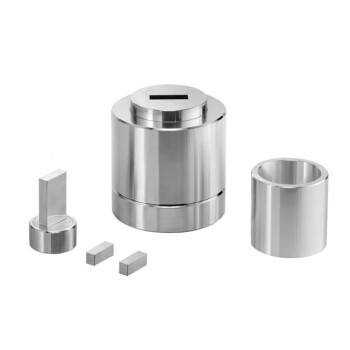
The laboratory powder hydraulic press is a critical tool for optimizing mass transfer and reaction kinetics. By compressing raw material mixtures into dense, shaped pellets, the press shortens diffusion paths between particles and ensures intimate physical contact. This preparation is essential for facilitating efficient chemical transformations during high-temperature reduction roasting.
Core Takeaway: A laboratory hydraulic press transforms loose powders into high-density green compacts to maximize particle-to-particle contact. This physical consolidation is the primary driver for improving reaction rates and ensuring experimental repeatability in reduction roasting processes.
Optimizing Reaction Kinetics and Mass Transfer
Shortening Diffusion Paths
In reduction roasting, reactants must interact at a molecular level, often across solid interfaces. By applying constant pressure, a hydraulic press increases the density of the mixture, effectively reducing the distance that atoms must travel to react. This is particularly vital in solid-state reactions where diffusion is the rate-limiting step.
Enhancing Initial Contact
Tight physical contact is critical during the early stages of a reaction, specifically before a liquid phase has formed. For instance, in the reduction of phosphates by Silicon Carbide (SiC), the press ensures the reactants are physically locked together. Without this mechanical forcing, the reaction may fail to initiate or proceed too slowly to be commercially or scientifically viable.
Facilitating Metallothermic Reactions
For processes like metallothermic reduction (e.g., using aluminum or magnesium as reducing agents), high-pressure shaping is a prerequisite. Compressing these mixtures into compact blocks ensures the close physical proximity required to initiate the reaction and improve metal evaporation efficiency. This consolidation allows the energy of the reaction to be contained and utilized effectively.
Ensuring Experimental Accuracy and Consistency
Standardizing Sample Geometry
Laboratory presses allow researchers to create specimens of regular, repeatable shapes, such as micro-cylinders or briquettes. This geometric consistency is vital for obtaining repeatable heat exchange data during kinetic experiments. When samples have identical dimensions, researchers can more accurately attribute changes in results to chemical variables rather than physical inconsistencies.
Controlling Internal Porosity
The use of precise, uniform pressure significantly reduces internal pores and density gradients within a sample. This level of control provides a stable physical foundation for subsequent thermogravimetric analysis (TGA). Uniform density ensures that hydrogen or other reducing gases can penetrate the sample at a predictable rate throughout the roasting process.
Simulating Industrial Conditions
Pressed specimens are frequently used in static layer tests to simulate the environment of industrial pellets or lump ores. By manipulating the pressing pressure, researchers can study the impact of molding on gas diffusion resistance. This data is essential for scaling up laboratory findings to industrial recycling and agglomeration processes.
Understanding the Trade-offs
The Risk of Excessive Density
While high density improves contact, over-compression can create a "choking" effect where the sample becomes too dense for reducing gases to penetrate. If gas diffusion resistance becomes too high, the internal sections of the pellet may remain unreacted. Researchers must find the "sweet spot" where contact is maximized without sealing off the internal pore structure.
Density Gradients and Internal Stress
Standard hydraulic pressing can sometimes result in non-uniform density, where the edges of a pellet are denser than the core. These density gradients can lead to uneven roasting and structural failure (cracking) when the sample is subjected to high temperatures. Proper mold design and lubrication are often required to mitigate these internal stresses.
Potential for Contamination
The high pressures required for pelletizing can cause the sample material to interact with the steel surfaces of the mold. In sensitive analytical or high-purity reduction studies, this can introduce metallic contaminants. It is often necessary to use specialized liners or to thoroughly clean molds between samples to maintain the integrity of the reduction roasting data.
Applying This to Your Reduction Roasting Project
Making the Right Choice for Your Goal
- If your primary focus is maximizing reaction speed: Use higher pressures to ensure maximum particle-to-particle contact and minimize the diffusion distance between reactants.
- If your primary focus is simulating industrial-scale pellets: Choose a mold shape and pressure setting that mimics the density and gas permeability of commercial briquettes or sinters.
- If your primary focus is accurate kinetic modeling: Prioritize geometric consistency by using a high-precision press that guarantees identical dimensions for every specimen.
- If your primary focus is gas-solid interaction studies: Carefully calibrate your pressure to maintain sufficient internal porosity, allowing the reducing gas to reach the center of the pellet.
Proper sample preparation via hydraulic pressing is the foundation upon which reliable, scalable, and efficient reduction roasting experiments are built.
Summary Table:
| Feature | Benefit for Reduction Roasting | Key Consideration |
|---|---|---|
| High-Density Compaction | Shortens diffusion paths; accelerates reaction kinetics | Avoid "choking" (excessive gas resistance) |
| Geometric Standardization | Ensures repeatable heat exchange and experimental data | Accurate simulation of industrial pellets |
| Enhanced Physical Contact | Facilitates solid-state and metallothermic reactions | Proper mold lubrication to prevent gradients |
| Porosity Control | Balances contact area with gas permeability | Critical for efficient gas-solid interactions |
Elevate Your Material Research with KINTEK Precision
Achieving the perfect balance of density and porosity is critical for successful reduction roasting. KINTEK specializes in high-performance laboratory equipment designed to deliver the consistency your research demands.
From our precision hydraulic presses (pellet, hot, and isostatic) for flawless sample preparation to our advanced high-temperature furnaces (muffle, tube, and vacuum) and high-pressure reactors, we provide the tools you need to simulate industrial conditions and optimize reaction kinetics. Whether you are focused on metallothermic reduction or gas-solid interaction studies, KINTEK offers a comprehensive range of consumables—including crucibles, ceramics, and PTFE products—to ensure contamination-free results.
Ready to optimize your lab’s efficiency? Contact our technical experts today to find the ideal equipment solution for your reduction roasting project!
References
- Guoping Luo, Xiang-Hui Ji. Study on gasification dephosphorization of phosphorus magnetite reduced by SiC. DOI: 10.1007/s42452-022-05264-w
This article is also based on technical information from Kintek Solution Knowledge Base .
Related Products
- Laboratory Hydraulic Press Split Electric Lab Pellet Press
- Laboratory Hydraulic Press Lab Pellet Press Machine for Glove Box
- Laboratory Hydraulic Press Lab Pellet Press for Button Battery
- Automatic Laboratory Hydraulic Pellet Press Machine for Lab Use
- Laboratory Hydraulic Pellet Press for XRF KBR FTIR Lab Applications
People Also Ask
- What role does a laboratory hydraulic press play in platinum recovery research? Enhancing Sample Precision
- What are the specific applications of a lab hydraulic press in biochar evaluation? Optimize density and data accuracy.
- What are the roles of a laboratory hydraulic press and stainless steel molds in the preparation of graphite samples?
- What is the role of a laboratory hydraulic press in electrode prep? Maximize Energy Density & Sealing Precision
- Why must a laboratory hydraulic press equipped with cylindrical molds be used when preparing BZY green bodies? High Density