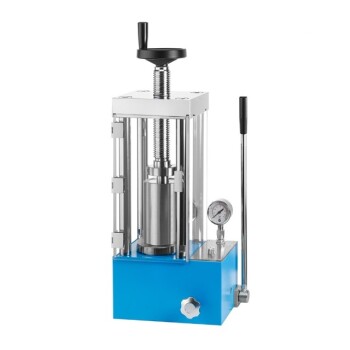
The application of a laboratory-scale hot isostatic pressing (HIP) system serves as a definitive densification step. By subjecting high-entropy alloy green bodies or castings to simultaneous high temperature and omnidirectional high-pressure gas, the system effectively heals internal defects. This process eliminates microscopic pores, shrinkage cavities, and micro-cracks, transforming a porous pre-form into a structurally sound, homogeneous material.
The primary value of the HIP process is its ability to produce material that is essentially 100% of its true density. By removing internal porosity and establishing a uniform grain structure, HIP ensures the alloy exhibits the consistent properties required for advanced scientific analysis, such as radiation damage experiments.
The Mechanism of Densification
Omnidirectional Pressure Application
Unlike standard hydraulic presses that apply force from a single direction (axial), a HIP system utilizes omnidirectional, balanced gas pressure.
This "isostatic" pressure ensures that force is applied equally to every surface of the complex high-entropy alloy structure.
Elimination of Internal Defects
The combination of pressure and heat targets the microscopic imperfections inherent in casting and powder compaction.
The process forces the material to collapse inward on voids, effectively closing microscopic pores and shrinkage cavities.
Single-Step Sintering and Pressing
HIP simultaneously applies temperature and pressure, allowing it to press and sinter the part in a single operation.
This consolidation ensures complete bonding throughout the material's structure, rather than just surface adhesion.
Impact on Mechanical Properties
Increased Strength and Ductility
By removing the internal voids that act as stress concentrators, the HIP process significantly enhances the alloy's mechanical performance.
Treated materials exhibit increased tensile strength, impact strength, and ductility, often achieving properties comparable to wrought alloys.
Extended Fatigue Life
The elimination of micro-cracks and porosity has a direct correlation with the longevity of the component.
HIP treatment significantly increases fatigue life, extending the service duration of the part under cyclic loading conditions.
Superior Surface Finish
Because the internal structure is densified, the resulting exterior surfaces are smoother and more uniform.
This enables the creation of pore-free wear surfaces, which is critical for components subjected to friction or contact.
Critical Considerations and Trade-offs
The Necessity of Pre-Processing
While HIP enhances the green body, it relies on the quality of the initial compaction.
As noted in standard powder metallurgy, a green body must already possess sufficient strength (often achieved via a hydraulic press) to withstand handling before it enters the HIP vessel.
Homogeneity vs. Geometry
HIP is excellent for internal uniformity, but it results in shrinkage as the density increases.
Designers must account for this volume reduction to ensure the final component meets geometric specifications after the pores are closed.
Making the Right Choice for Your Goal
- If your primary focus is basic research and validity: HIP is essential for creating high-quality, homogeneous samples that yield accurate data in sensitive tests like radiation damage experiments.
- If your primary focus is structural integrity and lifespan: HIP is the critical step for maximizing fatigue life and tensile strength, ensuring the alloy performs like a wrought material.
By resolving internal defects and maximizing density, hot isostatic pressing reveals the true mechanical potential of high-entropy alloys.
Summary Table:
| Feature | Mechanism of Action | Impact on High-Entropy Alloys |
|---|---|---|
| Pressure Type | Omnidirectional Gas Pressure | Ensures uniform densification across complex geometries |
| Defect Healing | Pore & Micro-crack Closure | Eliminates stress concentrators for 100% true density |
| Material State | Sintering & Pressing | Simultaneous consolidation for complete molecular bonding |
| Mechanical Gain | Structural Homogenization | Enhanced tensile strength, ductility, and fatigue life |
Unlock the Full Potential of Your Material Research with KINTEK
Precision in densification is the difference between a failed sample and a breakthrough. KINTEK specializes in high-performance laboratory equipment, providing the advanced hot isostatic presses, isostatic hydraulic systems, and high-temperature furnaces necessary to transform high-entropy alloy green bodies into structurally sound materials.
Our comprehensive range—from vacuum and atmosphere furnaces to crushing systems and ceramic consumables—is designed to meet the rigorous demands of advanced metallurgy and scientific analysis. Whether you are conducting radiation damage experiments or fatigue testing, our solutions ensure your materials achieve peak performance and homogeneity.
Ready to elevate your lab's capabilities? Contact our experts today to find the perfect HIP solution for your research.
References
- A. V. Levenets, O.V. Nemashkalo. HIGH-ENTROPY ALLOYS AS A PROSPECTIVE CLASS OF NEW RADIATION-TOLERANT MATERIALS RESEARCH DEVELOPMENT ANALYSIS BASED ON THE INFORMATION DATABASES. DOI: 10.46813/2021-132-003
This article is also based on technical information from Kintek Solution Knowledge Base .
Related Products
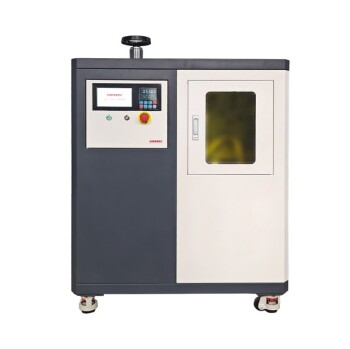
- Warm Isostatic Press for Solid State Battery Research
- Automatic High Temperature Heated Hydraulic Press Machine with Heated Plates for Lab
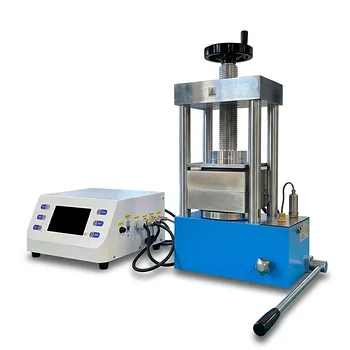
- Manual High Temperature Heated Hydraulic Press Machine with Heated Plates for Lab
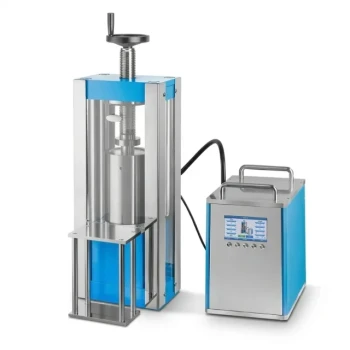
- Heated Hydraulic Press Machine with Heated Plates Split Manual Laboratory Hot Press
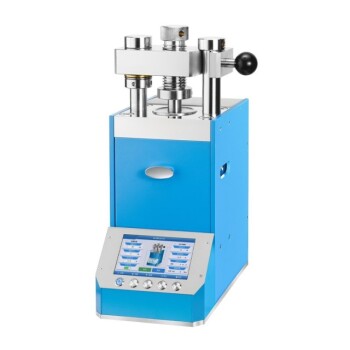
- Automatic Heated Hydraulic Press Machine with Heated Plates for Laboratory Hot Press
People Also Ask
- What is the temperature of a warm isostatic press? Achieve Optimal Densification for Your Materials
- What is the function of a Warm Isostatic Press (WIP) in all-solid-state pouch cells? Optimize Battery Density
- Why are Warm Isostatic Presses (WIP) necessary for solid-state batteries? Achieve Atomic-Level Contact
- What advantages does a warm isostatic press offer over a traditional uniaxial press for Li6PS5Cl electrolyte sheets?
- How do warm isostatic presses improve dry electrode performance? Enhance ASSB Conductivity with Heat & Pressure