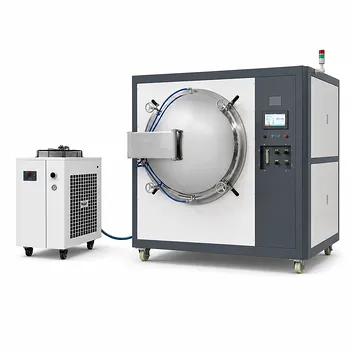
A vacuum hot pressing sintering furnace acts as the critical enabler for achieving near-theoretical density in Al2O3-TiCN/Co-Ni composites. By integrating high mechanical pressure (typically 25 MPa) with high thermal energy (up to 1650°C) in an oxygen-free environment, it forces densification where standard methods fail. This process specifically protects the oxidation-sensitive TiCN and metallic Co-Ni phases while mechanically closing pores to achieve a relative density of 99.6%.
The core challenge in fabricating Al2O3-TiCN/Co-Ni ceramics is that pressureless sintering often lacks the drive to fully densify the material without degrading the metallic and carbide components. Vacuum hot pressing solves this by mechanically forcing particle rearrangement under vacuum protection, ensuring the material achieves high structural integrity without oxidation.
Overcoming the Density Barrier
The primary function of this furnace is to provide a "densification drive" that thermal energy alone cannot supply for this specific composite.
The Role of Mechanical Pressure
In standard sintering, particles fuse solely due to heat. However, Al2O3-TiCN composites are notoriously difficult to densify this way.
The vacuum hot press applies an axial pressure of 25 MPa during the heating process. This mechanical force is essential for promoting particle rearrangement.
Inducing Plastic Flow
Beyond simple rearrangement, the pressure induces plastic flow at the microscopic level.
This mechanism forces the material to fill voids that would otherwise remain as pores. It compensates for the insufficient sintering drive of the ceramic matrix, pushing the relative density to an exceptional 99.6%.
The Critical Function of the Vacuum Environment
High temperatures usually accelerate degradation in non-oxide ceramics. The vacuum system is the safeguard that allows high-heat processing without chemical failure.
Preventing Oxidation of TiCN
Titanium Carbonitride (TiCN) is sensitive to oxygen at high temperatures.
If sintered in air, TiCN would oxidize, degrading the hardness and wear resistance of the final tool or component. The vacuum environment effectively eliminates oxygen, preserving the stoichiometry of the TiCN phase.
Protecting the Metallic Binder (Co-Ni)
The Cobalt-Nickel (Co-Ni) phases act as metallic binders to improve toughness.
Like TiCN, these metals are prone to oxidation during the heating ramp. The vacuum ensures these metals remain in their elemental or alloyed state, allowing them to function correctly as a tough binding matrix.
Degassing and Pore Elimination
Trapped gases are a major cause of structural weakness in ceramics.
The negative pressure environment assists in the timely discharge of gases trapped between powder particles. It also removes volatile byproducts generated during heating, preventing them from forming pockets that would result in internal defects.
Understanding the Trade-offs
While vacuum hot pressing is superior for performance, it introduces specific constraints that must be managed.
Geometry Limitations
Unlike pressureless sintering, which can handle complex 3D shapes, hot pressing is generally limited to simple geometries like plates or discs.
The axial pressure is applied via rams, meaning the final part usually requires machining to achieve complex final net shapes.
Cycle Time and Efficiency
The process involves a "pump-down" phase to reach the required vacuum level before heating begins.
If the mechanical or Roots pumps are inefficient, the total cycle time increases significantly. This makes the process slower and more expensive per unit compared to continuous sintering methods.
Making the Right Choice for Your Goal
To maximize the potential of Al2O3-TiCN/Co-Ni ceramics, align your processing parameters with your performance targets.
- If your primary focus is Maximum Density (Mechanical Strength): Prioritize the application of the full 25 MPa axial pressure to induce plastic flow and achieve the 99.6% density benchmark.
- If your primary focus is Material Purity (Chemical Stability): Ensure the furnace maintains a high vacuum throughout the 1650°C hold time to prevent the degradation of the TiCN and Co-Ni phases.
Ultimately, the vacuum hot press turns a potentially porous, brittle composite into a dense, industrial-grade ceramic by substituting thermal time with mechanical force.
Summary Table:
| Feature | Function in Al2O3-TiCN/Co-Ni Fabrication | Key Performance Metric |
|---|---|---|
| Mechanical Pressure (25 MPa) | Drives particle rearrangement and plastic flow to eliminate voids. | 99.6% Relative Density |
| Vacuum Environment | Prevents oxidation of TiCN and Co-Ni metallic binders. | Phase Purity & Hardness |
| High Thermal Energy (1650°C) | Provides the necessary heat for sintering and matrix fusion. | Structural Integrity |
| Degassing Capacity | Removes trapped gases and volatile byproducts during heating. | Zero Internal Defects |
Elevate Your Advanced Ceramic Manufacturing with KINTEK
Achieving near-theoretical density in complex composites like Al2O3-TiCN/Co-Ni requires the perfect synergy of pressure, temperature, and atmospheric control. KINTEK specializes in high-performance vacuum hot pressing systems and high-temperature furnaces designed to meet the rigorous demands of material science research and industrial production.
Whether you are focusing on battery research, crushing and milling, or precision hydraulic pressing, our comprehensive range of laboratory equipment—from vacuum and CVD furnaces to isostatic presses and high-pressure reactors—delivers the reliability your lab deserves.
Ready to optimize your densification process? Contact KINTEK today to find the perfect sintering solution for your application.
Related Products
- 600T Vacuum Induction Hot Press Furnace for Heat Treat and Sintering
- Vacuum Heat Treat and Sintering Furnace with 9MPa Air Pressure
- Vacuum Heat Treat and Pressure Sintering Furnace for High Temperature Applications
- 2200 ℃ Tungsten Vacuum Heat Treat and Sintering Furnace
- Vacuum Hot Press Furnace Heated Vacuum Press Machine Tube Furnace
People Also Ask
- What role does an induction vacuum hot pressing furnace play in sintering? Achieve 98% Density in Carbide Blocks
- What advantages does a vacuum hot press furnace provide for LSLBO ceramic electrolytes? Achieve 94% Relative Density
- What role does a Vacuum Hot Press (VHP) furnace play in the densification of austenitic stainless steel 316 composites?
- What are the advantages of a vacuum hot press furnace for W-50%Cu? Achieve 99.6% Density at Lower Temperatures
- What role does mechanical pressure play during the vacuum diffusion bonding of tungsten and copper? Keys to Solid Bonding