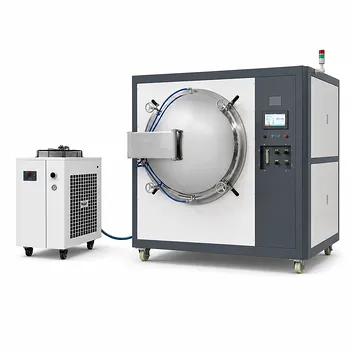
The primary function of a vacuum hot press furnace is to transform loose Beryllium powder into a solid, high-density bulk material known as VHP-Be. This equipment achieves consolidation by simultaneously applying high heat and mechanical pressure within a controlled vacuum environment, ensuring the particles bond without chemically degrading.
Core Insight: The critical challenge in processing Beryllium is its high reactivity to oxygen. Vacuum hot pressing solves this by isolating the material from air to prevent oxidation, while using axial pressure to force particle diffusion, creating a dense billet with structural integrity.
The Mechanics of Consolidation
To understand why this specific furnace is required for Beryllium, one must look at how the environmental control interacts with mechanical force.
The Critical Role of the Vacuum
Beryllium is highly susceptible to severe oxidation when exposed to high temperatures.
Heating Beryllium powder in an atmospheric environment would result in a material compromised by oxides, rendering it brittle or unusable.
The vacuum environment eliminates oxygen from the processing chamber, preserving the chemical purity of the Beryllium during the heating phase.
Driving Densification via Axial Pressure
Heat alone is often insufficient to fully densify Beryllium powder into a solid block.
The furnace applies axial pressure to the powder compact. This mechanical force mechanically reduces pore space between particles.
By compressing the material while it is hot, the process promotes diffusion and bonding at the atomic level, effectively welding the powder particles together.
Achieving Fine Grain Structure
The ultimate goal of this process is not just a solid shape, but a material with specific mechanical properties.
The combination of pressure and temperature results in a Beryllium blank characterized by high density.
Furthermore, this rapid consolidation helps maintain a fine grain structure, which is essential for the material's final strength and machinability.
Understanding the Process Constraints
While vacuum hot pressing is the standard for high-quality Beryllium, it involves managing specific engineering trade-offs.
Complexity of Parameter Control
The process relies on the precise coupling of thermal and mechanical forces.
If the temperature is too high without adequate pressure, you risk abnormal grain growth, which weakens the material.
Conversely, insufficient vacuum integrity leads to immediate contamination, as the "degassing" function of the furnace cannot keep up with atmospheric leaks.
Making the Right Choice for Your Goal
When evaluating the output of a vacuum hot press furnace, your priorities will dictate how you tune the process parameters.
- If your primary focus is Material Purity: Prioritize the integrity of the vacuum system to ensure the complete elimination of residual internal gases and prevention of oxidation.
- If your primary focus is Mechanical Strength: Focus on the optimization of axial pressure to maximize density and ensure a fine, uniform grain structure.
Vacuum hot pressing remains the definitive method for converting reactive Beryllium powder into a structurally sound, high-performance engineering material.
Summary Table:
| Feature | Function in VHP-Be Preparation | Key Benefit |
|---|---|---|
| Vacuum Environment | Eliminates oxygen and atmospheric gases | Prevents oxidation and ensures chemical purity |
| High Temperature | Softens powder particles for bonding | Facilitates atomic diffusion |
| Axial Pressure | Mechanically compresses powder compact | Eliminates pore space for maximum density |
| Process Synergy | Simultaneous heat and pressure control | Results in fine grain structure and high strength |
Elevate Your Material Science with KINTEK Precision
High-performance materials like Beryllium demand uncompromising processing environments. KINTEK specializes in advanced laboratory equipment designed for the most rigorous industrial applications. Whether you are performing high-pressure consolidation or complex thermal treatments, our comprehensive range of vacuum hot presses, isostatic presses, and high-temperature furnaces ensures your materials achieve peak density and structural integrity.
From high-temperature high-pressure reactors to specialized crushing and milling systems, KINTEK provides the end-to-end solutions researchers and engineers need to push the boundaries of metallurgy and chemistry. Our expertise in battery research tools and ceramic consumables further empowers your lab to deliver consistent, high-purity results.
Ready to optimize your powder metallurgy workflow? Contact our technical experts today to find the perfect furnace solution for your specific application.
Related Products
- Vacuum Hot Press Furnace Heated Vacuum Press Machine Tube Furnace
- 600T Vacuum Induction Hot Press Furnace for Heat Treat and Sintering
- Vacuum Hot Press Furnace Machine Heated Vacuum Press
- Vacuum Hot Press Furnace Machine for Lamination and Heating
- Vacuum Heat Treat and Pressure Sintering Furnace for High Temperature Applications
People Also Ask
- What advantages does a vacuum hot press furnace provide for LSLBO ceramic electrolytes? Achieve 94% Relative Density
- What role does a Vacuum Hot Press (VHP) furnace play in the densification of austenitic stainless steel 316 composites?
- What are the advantages of using a vacuum hot pressing furnace? Superior Densification for 2024Al/Gr/SiC Composites
- What are the advantages of a vacuum hot press furnace for LTPO solid electrolytes? Boost Density and Conductivity
- What core processing conditions does a vacuum hot press furnace provide? Achieve High-Density Cu-SiC/Diamond Composites