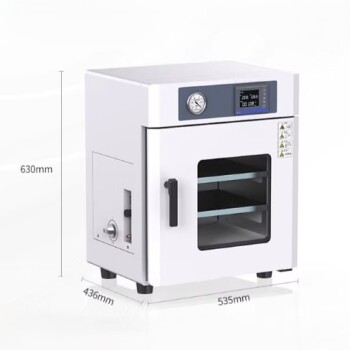
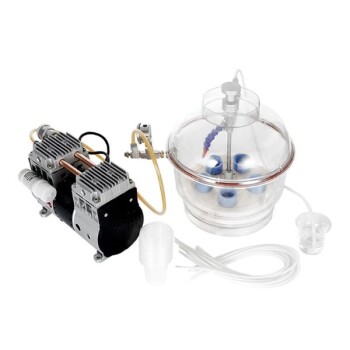
A laboratory vacuum oven serves as the critical final step in verifying the integrity of UV-cured silicone rubber films. It facilitates gel content testing by performing constant weight drying on film samples after they have undergone solvent extraction. By heating the sample under controlled vacuum conditions, the oven ensures the complete removal of volatile solvents, such as toluene, that have been adsorbed into the material's crosslinked network.
Core Insight: The vacuum oven is not merely a drying tool; it is an analytical instrument that isolates the crosslinked polymer network. By eliminating trapped solvents that standard heating often misses, it enables the precise mass calculations required to determine crosslinking density and UV curing efficiency.
The Role of Vacuum Drying in Gel Content Analysis
To understand why the vacuum oven is indispensable, one must look at the specific requirements of quantifying a crosslinked network.
Post-Extraction Solvent Removal
In gel content testing, a UV-cured film is first soaked in a solvent (often toluene) to dissolve any unreacted monomers or oligomers.
The remaining solid structure is the crosslinked network, but it is heavily swollen with the extraction solvent. The vacuum oven is utilized specifically to remove this absorbed solvent from the complex polymer matrix.
Achieving Constant Weight
The goal of the process is "constant weight drying." This means the sample is dried until its mass stops changing, confirming that all volatile components are gone.
Without the negative pressure applied by the vacuum oven, solvents trapped deep within the silicone rubber lattice would be difficult to extract fully, leading to artificially high weight readings.
Calculation of Crosslinking Density
The accuracy of the entire test hinges on the final mass measurement.
By ensuring the sample is completely dry, the vacuum oven allows researchers to accurately calculate the ratio of the crosslinked component. This ratio is the direct indicator of how well the UV curing process worked and the density of the resulting chemical bonds.
Why Vacuum Technology is Required
Standard thermal ovens are often insufficient for this specific application due to the nature of silicone rubber and organic solvents.
Lowering Solvent Boiling Points
The vacuum environment lowers the boiling point of solvents like toluene.
This allows the solvent to vaporize and migrate out of the film at lower temperatures, reducing the thermal stress placed on the silicone rubber sample itself.
Facilitating Volatile Migration
As noted in broader polymer applications, vacuum conditions accelerate the migration of residual agents from within the film.
The negative pressure helps pull volatiles from the internal structure to the surface, overcoming the physical resistance of the crosslinked network that might otherwise trap solvent molecules.
Critical Considerations and Trade-offs
While the vacuum oven is essential, improper usage can compromise the validity of the gel content test.
Potential for Thermal Degradation
Temperature control is paramount. While vacuum lowers boiling points, setting the temperature too high in an attempt to speed up the process can degrade the silicone rubber. This would result in mass loss unrelated to solvent evaporation, skewing the calculation.
The Illusion of Dryness
A common pitfall is stopping the drying process too early.
Because the solvent is trapped within a crosslinked mesh, surface dryness does not indicate internal dryness. Users must strictly adhere to a "constant weight" protocol—weighing, drying again, and re-weighing—to ensure the process is complete.
Ensuring Precision in Your Testing Protocol
To obtain reliable data on UV curing efficiency, you must tailor your drying protocol to the specific solvent and polymer used.
- If your primary focus is Accuracy: strictly enforce a constant weight protocol where the sample is re-weighed at intervals until the mass fluctuates by less than a specific tolerance (e.g., 0.001g).
- If your primary focus is Sample Integrity: utilize the highest vacuum setting possible to allow for lower thermal settings, thereby protecting the chemical structure of the silicone rubber.
Ultimately, the laboratory vacuum oven transforms a swollen, solvent-laden gel into a measurable data point, bridging the gap between chemical processing and analytical verification.
Summary Table:
| Feature | Role in Gel Content Testing | Benefit to Analysis |
|---|---|---|
| Vacuum Environment | Lowers solvent boiling points | Prevents thermal degradation of silicone |
| Negative Pressure | Facilitates volatile migration | Removes solvents trapped in crosslinked networks |
| Constant Weight Drying | Ensures complete removal of toluene/solvents | Provides accurate mass for crosslinking density |
| Precise Temperature Control | Maintains sample stability during drying | Eliminates skewing of data from mass loss |
Elevate Your Material Analysis with KINTEK
Precision is non-negotiable when calculating crosslinking density and UV curing efficiency. KINTEK specializes in high-performance laboratory equipment designed for the most demanding research applications. Whether you need advanced vacuum ovens for precise constant weight drying, high-temperature furnaces, or specialized crushing and milling systems, our solutions ensure your data is accurate and reproducible.
From high-pressure reactors to essential laboratory consumables like PTFE products and crucibles, KINTEK provides the tools necessary for cutting-edge polymer and battery research.
Ready to optimize your testing protocol? Contact us today to find the perfect equipment for your lab!
References
- Dan Du, Hong Dong. The Preparation of Acryloxyl Group Functionalized Siloxane Polymers and the Study of Their Ultra Violet Curing Properties. DOI: 10.3390/polym16040465
This article is also based on technical information from Kintek Solution Knowledge Base .
Related Products
- 56L Vertical Laboratory Vacuum Drying Oven
- 23L Laboratory Vacuum Drying Oven
- Vacuum Heat Treat Sintering Brazing Furnace
- 2200 ℃ Graphite Vacuum Heat Treat Furnace
- Dental Porcelain Zirconia Sintering Ceramic Vacuum Press Furnace
People Also Ask
- Why is a laboratory vacuum drying oven recommended for rice straw residues? Protect Your Biomass Integrity
- What role does a laboratory vacuum drying oven play in the preparation of modified multi-walled carbon nanotubes?
- What is the importance of using a laboratory vacuum drying oven? Preserving Slow-Release Microcapsule Integrity
- Why is a Laboratory Vacuum Drying Oven recommended for PBAT microspheres? Protect Sensitive Polymer Integrity
- What role does a laboratory vacuum drying oven play in processing nanoparticle powder samples? Protect Sample Integrity