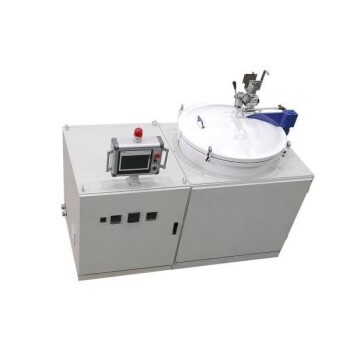
The laboratory vacuum tube furnace is the critical vessel that converts chrome-containing leather scraps into useful porous carbon by maintaining a strictly inert environment. This equipment prevents the material from burning (oxidation) while executing a precise programmed temperature ramp, allowing the collagen fibers in the leather to carbonize into structured, high-performance materials.
By combining an oxygen-free atmosphere with high-precision heat control, the vacuum tube furnace facilitates the catalytic formation of hierarchical pore structures, ensuring consistent results essential for energy storage and adsorption applications.
The Role of the Inert Environment
Preventing Oxidation
The most fundamental contribution of the vacuum tube furnace is the creation of a strictly inert atmosphere.
Without this oxygen-free environment, the leather scraps would simply combust (burn to ash) rather than undergoing pyrolysis. The vacuum capability ensures that the organic material decomposes thermally without reacting with air.
Protecting Collagen Transformation
By eliminating reactive gases, the furnace creates a stable setting for the carbonization of collagen fibers.
This protection is vital for preserving the underlying structure of the leather. It allows the natural fibrous network to evolve into a carbon framework rather than being destroyed by chemical attack.
Precision Temperature Control
Programmed Temperature Ramps
The reference highlights the importance of a precise programmed temperature ramp.
The furnace does not simply blast the material with heat; it follows a specific, controlled increase in temperature. This gradual heating is necessary to manage the release of volatiles and the structural rearrangement of the carbon.
Ensuring Consistency
High-precision temperature control leads to consistent carbonization levels.
Uniformity is critical when producing materials for high-performance applications. Whether the goal is energy storage or adsorption, the material properties must be predictable across the entire batch.
Developing the Hierarchical Structure
Facilitating Catalytic Influence
The furnace conditions are designed to support carbonization under catalytic influence.
While the furnace itself is the vessel, its ability to maintain stable temperatures allows the chrome naturally present in the leather (or added catalysts) to effectively direct the reaction.
Forming Hierarchical Pores
The ultimate output of this controlled process is the formation of hierarchical pore structures.
These are not random holes; they are organized networks of pores that give the carbon its high surface area. This structure is what makes the final product valuable for industrial applications.
Understanding the Trade-offs
Batch Size Limitations
Laboratory vacuum tube furnaces are generally designed for precision, not volume.
The sample size is limited by the diameter of the tube. This makes them excellent for research and development but less suitable for mass production without scaling up to different equipment.
Sensitivity to Parameters
The precision of the equipment cuts both ways; the outcome is highly sensitive to the programming.
An incorrect ramp rate or a breach in the vacuum seal can ruin the pore structure. The user must meticulously optimize the "programmed temperature ramp" to avoid structural collapse of the carbon.
Making the Right Choice for Your Goal
To maximize the quality of your porous carbon, you must tailor the furnace operation to your specific end-use application.
- If your primary focus is Energy Storage: Prioritize extremely slow and precise temperature ramps to maximize the development of hierarchical pores for better ion transport.
- If your primary focus is Adsorption Capacity: Ensure the atmosphere remains strictly inert to prevent surface oxidation that could block active sites on the carbon.
Ultimately, the vacuum tube furnace is not just a heater, but a precision instrument that dictates the structural integrity and performance of your final carbon product.
Summary Table:
| Feature | Contribution to Pyrolysis | Benefit for Porous Carbon |
|---|---|---|
| Inert Atmosphere | Prevents combustion and oxidation | Preserves carbon framework and collagen fibers |
| Vacuum Capability | Eliminates reactive gases | Ensures clean thermal decomposition without ash |
| Programmed Ramps | Precise, gradual heating | Manages volatile release for structural integrity |
| Catalytic Support | Stable thermal environment | Facilitates the formation of hierarchical pore structures |
| Temp. Precision | Uniform heat distribution | Ensures consistent carbonization and high surface area |
Elevate Your Materials Research with KINTEK Precision
Transform complex waste like leather scraps into high-performance carbon materials with KINTEK’s advanced laboratory vacuum tube furnaces. Our equipment is engineered to provide the strictly inert environments and precise programmed temperature ramps necessary for developing hierarchical pore structures in energy storage and adsorption applications.
Beyond pyrolysis, KINTEK specializes in a comprehensive range of laboratory solutions, including:
- High-Temperature Furnaces: Muffle, tube, rotary, and CVD/PECVD systems.
- Material Processing: Crushing, milling, and hydraulic presses (pellet, hot, isostatic).
- Reaction & Storage: High-temperature high-pressure reactors, autoclaves, and ULT freezers.
- Specialized Tools: Electrolytic cells, electrodes, and battery research consumables.
Ready to optimize your carbonization process? Contact our technical experts today to find the perfect furnace or lab equipment tailored to your research goals.
References
- Yanchun Li, Deyi Zhu. Research progress on resource utilization of leather solid waste. DOI: 10.1186/s42825-019-0008-6
This article is also based on technical information from Kintek Solution Knowledge Base .
Related Products
- Laboratory Vacuum Tilt Rotary Tube Furnace Rotating Tube Furnace
- Laboratory High Pressure Vacuum Tube Furnace
- Vertical Laboratory Tube Furnace
- 1200℃ Split Tube Furnace with Quartz Tube Laboratory Tubular Furnace
- 1700℃ Laboratory High Temperature Tube Furnace with Alumina Tube
People Also Ask
- What are the advantages of using a rotary tube furnace for MoVOx catalysts? Elevate Uniformity and Crystallinity
- What are the process advantages of using a rotary tube furnace for WS2 powder? Achieve Superior Material Crystallinity
- What is a rotary furnace used for? Achieve Unmatched Process Uniformity and Control
- How does a tube furnace facilitate the sulfidation process for Co9S8/MoS2 heterojunctions? Optimizing Catalytic Growth
- How does the activation temperature within a tube furnace affect the microstructure of nitrogen-doped biochar?