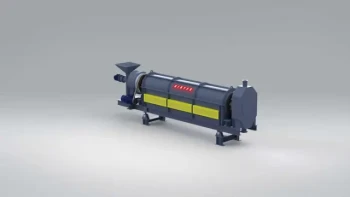
The reaction furnace functions as the primary containment and control system for synthesizing uranium nitride precursor ($U_2N_3$) powder. It facilitates a direct exothermic chemical reaction between hydrided uranium powder and high-purity nitrogen gas by maintaining a specific pressure of approximately 0.12 MPa and a thermal environment between 300 and 600°C.
The reaction furnace is not merely a heating element; it is a precision instrument designed to balance the fast kinetics of an exothermic reaction with the strict requirement for an oxidation-free atmosphere.
The Mechanics of Controlled Synthesis
Facilitating Direct Chemical Interaction
The primary role of the furnace is to create the conditions necessary for hydrided uranium powder to react with high-purity nitrogen gas.
This is a direct chemical synthesis that transforms the metallic powder into the desired ceramic precursor.
Regulating Thermal Conditions
The furnace must maintain a specific temperature window of 300 to 600°C.
This range provides enough thermal energy to drive the reaction forward without exceeding the parameters required for the specific phase formation of the $U_2N_3$ precursor.
Establishing the Pressure Environment
Beyond temperature, the furnace regulates the internal atmosphere to a controlled pressure of approximately 0.12 MPa.
This positive pressure ensures an adequate supply of nitrogen gas is available to permeate the uranium powder and sustain the reaction.
Critical Operational Constraints
Managing Exothermic Reaction Rates
The synthesis of uranium nitride is an exothermic reaction, meaning it generates its own heat once initiated.
The furnace must provide precise temperature control not just to heat the material, but to manage the reaction rate.
Without this regulation, the self-heating nature of the process could lead to inconsistent powder characteristics.
The Imperative of Airtightness
The most significant risk in this process is powder oxidation.
The furnace relies on absolute airtightness to maintain a high-purity reaction atmosphere.
If the seal is compromised, oxygen will enter the chamber, contaminating the uranium powder and resulting in a failed synthesis.
Ensuring Process Quality
If your primary focus is material purity:
Ensure the furnace maintains absolute airtightness to exclude oxygen and prevent the oxidation of the uranium powder.
If your primary focus is reaction consistency:
Prioritize precise thermal regulation to manage the exothermic energy release within the 300–600°C window.
The quality of the final precursor powder is ultimately determined by the furnace's ability to isolate the reactants from the outside environment while rigidly controlling the internal thermodynamics.
Summary Table:
| Parameter | Operational Requirement | Role in U2N3 Synthesis |
|---|---|---|
| Temperature Range | 300 - 600°C | Drives chemical reaction & manages exothermic heat |
| Internal Pressure | ~0.12 MPa | Ensures nitrogen permeation into hydrided uranium |
| Atmosphere Control | Airtight / High-Purity Nitrogen | Prevents powder oxidation & ensures material purity |
| Reaction Type | Direct Chemical Synthesis | Transforms metallic powder into ceramic precursor |
Elevate Your Material Research with KINTEK Precision
At KINTEK, we understand that synthesizing advanced materials like uranium nitride requires absolute environmental control and thermal stability. Our specialized high-temperature furnaces—including vacuum, atmosphere, and tube furnaces—are engineered to deliver the airtightness and precise 300–600°C regulation your laboratory demands.
Whether you are focusing on high-purity reactors, crushing and milling systems for powder preparation, or pellet hydraulic presses for ceramic forming, KINTEK provides the comprehensive equipment and consumables (crucibles, ceramics, and PTFE products) needed for success.
Ready to optimize your synthesis process? Contact our technical experts today to find the perfect solution for your lab.
Related Products
- Electric Rotary Kiln Small Rotary Furnace Biomass Pyrolysis Plant
- Electric Rotary Kiln Small Rotary Furnace for Activated Carbon Regeneration
- High Temperature Muffle Oven Furnace for Laboratory Debinding and Pre Sintering
- Lab-Scale Vacuum Induction Melting Furnace
- Vacuum Arc Induction Melting Furnace
People Also Ask
- What is the temperature of a rotating kiln? It Depends on Your Material and Process Goal
- What are the principles of a rotary kiln? Master the Mechanics of High-Temperature Processing
- What are the different types of calciners? A Guide to Selecting the Right Thermal Processing Equipment
- How are rotary kilns heated? Direct vs. Indirect Heating Methods Explained
- Is rotary kiln a furnace? Discover the Key Differences for Industrial Processing