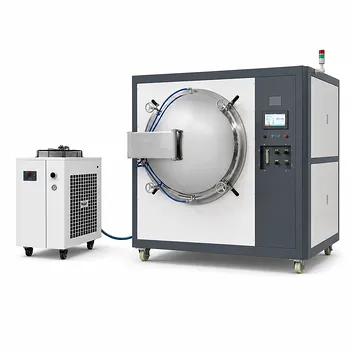
A vacuum hot-press furnace achieves densification through the simultaneous application of high uniaxial pressure and temperature. This dual-action process forces the softer copper matrix to plastically deform and flow into the voids between rigid diamond particles, overcoming the structural resistance created by the high volume of hard particles while the vacuum environment prevents oxidation.
The Core Insight High-volume fraction diamond composites suffer from a "bridging effect" where rigid diamond particles contact each other, preventing the copper matrix from naturally settling into gaps. The vacuum hot-press furnace solves this by mechanically forcing the copper into these microscopic voids, achieving near-full density at temperatures significantly lower than the melting point.
Overcoming Structural Resistance
Breaking the Rigid Skeleton
In composites with a high volume of diamond, the particles touch one another to form a rigid, load-bearing skeleton.
Standard sintering methods rely on surface tension or diffusion, which are too weak to collapse this skeleton.
The hot-press furnace applies external mechanical pressure (uniaxial force), which physically overcomes these rigid obstacles and forces particle rearrangement.
Promoting Plastic Flow
The primary mechanism for densification in this system is the plastic flow of the copper matrix.
Under heat, the copper softens; under pressure, it behaves like a viscous fluid.
This forced flow drives the copper into the interstitial spaces between diamond particles, effectively eliminating porosity even in complex geometries.
The Role of the Vacuum Environment
Prevention of Oxidation
Copper and diamond are both susceptible to oxidation at high sintering temperatures.
The vacuum environment (typically maintained between $10^{-3}$ and $10^{-2}$ Pa) removes oxygen from the chamber.
This preservation of surface purity is critical, as oxide layers inhibit densification and severely degrade the thermal conductivity of the final composite.
Removal of Adsorbed Gases
Powder particles often retain adsorbed gases and volatiles on their surfaces.
If trapped during sintering, these gases create "closed pores" that prevent full densification and weaken the material.
The vacuum extracts these gases before the pores seal off, allowing for significantly higher final density figures (up to 98.8%).
Optimizing Process Conditions
Lower Sintering Temperatures
Because mechanical pressure assists the process, full densification can occur at temperatures below the melting point of the metal matrix.
This solid-state or semi-solid approach avoids the unpredictability of liquid infiltration.
It also limits the thermal stress on the diamond, preventing the graphitization (degradation) of diamond surfaces that can occur at excessive temperatures.
Enhanced Interfacial Bonding
The combination of pressure and clean (oxide-free) surfaces promotes intimate contact between the copper and diamond.
Pressure increases the contact area, while the vacuum ensures atomic-level cleanliness.
This creates the thermodynamic conditions necessary for diffusion or reaction bonding, transforming a simple mechanical mixture into a robust, integrated composite.
Understanding the Trade-offs
Matrix Evaporation Risks
While vacuum is essential for cleanliness, it increases the vapor pressure of the metal matrix.
If the temperature is too high or the vacuum too deep, the matrix (e.g., copper or silver) may begin to evaporate.
Precise control is required to balance gas removal against the loss of matrix material.
Production Constraints
Vacuum hot pressing is inherently a batch process, constrained by the size of the die (usually graphite).
This limits the geometric complexity of the parts that can be produced compared to pressureless sintering.
It generally incurs higher operational costs due to the cycle times required for heating, pressing, and cooling under vacuum.
Making the Right Choice for Your Goal
To maximize the utility of a vacuum hot-press furnace for your specific application:
- If your primary focus is Thermal Conductivity: Prioritize high vacuum levels to eliminate all oxide barriers, as these are the primary bottleneck for heat transfer at the interface.
- If your primary focus is Mechanical Integrity: Focus on optimizing the pressure profile to ensure the copper matrix fully penetrates the deepest voids between diamond clusters without crushing the diamond particles.
Ultimately, the vacuum hot-press furnace is the definitive tool for forcing two disparate materials—one rigid and one ductile—to act as a single, cohesive solid.
Summary Table:
| Feature | Mechanism | Benefit to Diamond/Copper Composites |
|---|---|---|
| Uniaxial Pressure | Mechanical Force | Overcomes rigid diamond skeletons & forces plastic flow |
| Vacuum Environment | Oxygen Removal | Prevents oxidation & eliminates trapped gas pores |
| High Temperature | Matrix Softening | Allows copper to flow into voids below melting point |
| Process Control | Solid-state Sintering | Prevents diamond graphitization & enhances interface bonding |
Elevate Your Material Science with KINTEK Precision
Maximize the thermal conductivity and mechanical integrity of your advanced composites with KINTEK’s high-performance vacuum hot-press furnaces. Whether you are working on high-volume fraction diamond/copper heat sinks or complex ceramic-metal matrices, our specialized systems provide the precise pressure and atmospheric control required to achieve near-theoretical density.
Beyond hot pressing, KINTEK offers a comprehensive suite of laboratory solutions, including:
- High-Temperature Furnaces: Muffle, tube, and atmosphere-controlled systems.
- Material Processing: Crushing, milling, and hydraulic pellet presses.
- Battery & Chemical Research: Electrolytic cells, autoclaves, and high-pressure reactors.
Ready to eliminate porosity and optimize your sintering results? Contact our technical experts today to find the perfect equipment for your laboratory needs.
Related Products
- Vacuum Hot Press Furnace Heated Vacuum Press Machine Tube Furnace
- 600T Vacuum Induction Hot Press Furnace for Heat Treat and Sintering
- Vacuum Hot Press Furnace Machine Heated Vacuum Press
- Vacuum Hot Press Furnace Machine for Lamination and Heating
- Vacuum Heat Treat and Pressure Sintering Furnace for High Temperature Applications
People Also Ask
- What advantages does a vacuum hot press furnace provide for LSLBO ceramic electrolytes? Achieve 94% Relative Density
- What role does a Vacuum Hot Press (VHP) furnace play in the densification of austenitic stainless steel 316 composites?
- What are the advantages of using a vacuum hot pressing furnace? Superior Densification for 2024Al/Gr/SiC Composites
- What are the advantages of a vacuum hot press furnace for LTPO solid electrolytes? Boost Density and Conductivity
- What core processing conditions does a vacuum hot press furnace provide? Achieve High-Density Cu-SiC/Diamond Composites