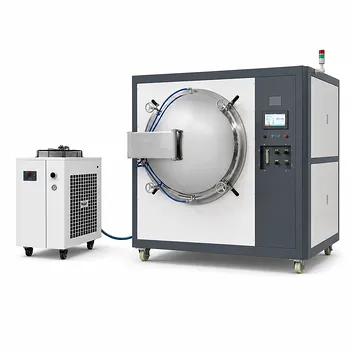
A vacuum hot press sintering furnace serves as a unified processing environment that integrates high temperatures, mechanical pressure, and a controlled atmosphere to produce high-performance composites. Specifically for TiCN-reinforced Ti-Fe matrix composites, it enables the in-situ synthesis of ceramic reinforcements while simultaneously applying physical force to close pores, ensuring the material reaches near-full theoretical density.
Core Takeaway The distinct advantage of this technology is the coupling effect of thermal energy and mechanical force within a vacuum. By driving chemical reactions and forcing material flow simultaneously, it transforms loose powder mixtures into fully dense, chemically bonded structural components in a single operational cycle, overcoming the porosity issues common in traditional sintering.
The Role of the Vacuum Environment
Preventing Oxidation of Reactive Metals
The primary function of the vacuum system is to create a pristine environment for processing. Titanium is a highly active metal that readily oxidizes at elevated temperatures, which degrades material performance.
By maintaining a high vacuum (often reaching levels around 0.1 Pa), the furnace prevents oxygen from reacting with the titanium or iron powders. This ensures that the metallic matrix retains its ductility and that the interface between the metal and the ceramic reinforcement remains clean.
Removal of Volatile Impurities
Before the critical sintering phase begins, the vacuum facilitates the extraction of contaminants.
The process often includes a holding stage (e.g., at 650°C) specifically designed to allow volatile impurities and gases to escape from the powder compact. Removing these gases prevents them from becoming trapped inside the material, which would otherwise form voids or defects in the final composite.
Mechanisms of In-Situ Synthesis
Driving the Chemical Reaction
The furnace provides the precise thermal energy required to trigger chemical reactions between the raw powders.
In the context of TiCN-reinforced composites, high temperatures (often exceeding 1200°C) promote the diffusion reaction between Titanium and Carbon sources. This results in the in-situ formation of the reinforcement phase, meaning the hard ceramic particles are grown directly within the matrix rather than being added externally.
Enhancing Interfacial Bonding
Because the reinforcement phase is created during the process, the bond between the ceramic (TiCN) and the metal matrix (Ti-Fe) is inherently stronger.
The combination of high temperature and a clean vacuum environment promotes atomic diffusion and wetting. This ensures the newly formed ceramic particles are tightly gripped by the steel or titanium matrix, leading to superior mechanical properties like hardness and wear resistance.
Densification via Mechanical Pressure
Forcing Plastic Flow
While temperature drives the chemistry, mechanical pressure is the engine of densification.
The furnace utilizes a hydraulic system to apply continuous uniaxial pressure, often as high as 50 MPa. This external force causes the metal matrix—softened by the heat—to undergo plastic flow, physically forcing it into the interstitial gaps between the hard ceramic particles.
Eliminating Residual Porosity
Pressureless sintering often leaves small voids in the material where powder particles did not fully merge.
The application of pressure actively squeezes out these residual pores during the formation of sintering necks. This mechanical action allows the composite to achieve high relative densities (frequently exceeding 99%), which is critical for structural integrity and fatigue resistance.
Understanding the Trade-offs
Geometry Limitations
The application of uniaxial pressure restricts the complexity of the shapes you can produce.
Because the pressure is applied from a single direction (top and bottom), this method is generally limited to simple geometries like plates, discs, or cylinders. Complex 3D shapes with overhangs or undercuts usually require secondary machining or different sintering methods.
Process Efficiency
Vacuum hot pressing is a batch process that can be time-consuming due to heating, cooling, and vacuum pumping cycles.
While it produces superior material properties compared to pressureless sintering, the throughput is generally lower. It is best reserved for high-value components where maximum density and material performance are non-negotiable.
Making the Right Choice for Your Project
To determine if vacuum hot press sintering is the correct approach for your TiCN-reinforced Ti-Fe composites, consider your specific performance targets.
- If your primary focus is Maximum Density and Strength: This is the ideal method. The combination of 50 MPa pressure and vacuum protection ensures virtually pore-free parts with optimal mechanical properties.
- If your primary focus is Complex Component Geometry: You may need to consider Hot Isostatic Pressing (HIP) or pressureless sintering followed by machining, as hot pressing is limited to simple shapes.
- If your primary focus is Material Purity: The ability to degas at 650°C and sinter under high vacuum makes this essential for reactive materials like Titanium that are sensitive to oxidation.
Summary: The vacuum hot press sintering furnace is not just a heating device; it is a densification tool that mechanically forces the complete integration of TiCN reinforcements into the Ti-Fe matrix, guaranteeing a material quality that pressureless methods cannot match.
Summary Table:
| Feature | Function in Ti-Fe/TiCN Synthesis | Impact on Composite Quality |
|---|---|---|
| High Vacuum | Prevents Ti oxidation & removes volatiles | High purity & clean interfacial bonding |
| Mechanical Pressure | Drives plastic flow (up to 50 MPa) | Eliminates pores; >99% relative density |
| Thermal Energy | Triggers in-situ chemical reactions | Stronger chemical bonding of ceramic phase |
| Uniaxial Pressing | Directs force into simple geometries | Uniform structural integrity for plates/discs |
Elevate Your Materials Research with KINTEK Precision
Maximize the density and performance of your TiCN-reinforced composites with KINTEK’s industry-leading vacuum hot press sintering furnaces. Our advanced systems offer the precise control over thermal energy and mechanical pressure required to achieve near-theoretical density and superior interfacial bonding for reactive materials.
Beyond sintering, KINTEK specializes in a comprehensive range of laboratory solutions, including high-temperature furnaces (vacuum, tube, and CVD), hydraulic pellet presses, crushing and milling systems, and high-pressure reactors. Whether you are developing next-generation battery materials or high-strength structural ceramics, our expert team is ready to provide the high-performance tools and consumables your lab needs.
Ready to optimize your densification process? Contact our technical specialists today to discuss the perfect solution for your research goals.
Related Products
- 600T Vacuum Induction Hot Press Furnace for Heat Treat and Sintering
- Vacuum Heat Treat and Sintering Furnace with 9MPa Air Pressure
- Vacuum Heat Treat and Pressure Sintering Furnace for High Temperature Applications
- 2200 ℃ Tungsten Vacuum Heat Treat and Sintering Furnace
- Vacuum Hot Press Furnace Heated Vacuum Press Machine Tube Furnace
People Also Ask
- What role does an induction vacuum hot pressing furnace play in sintering? Achieve 98% Density in Carbide Blocks
- What advantages does a vacuum hot press furnace provide for LSLBO ceramic electrolytes? Achieve 94% Relative Density
- What role does a Vacuum Hot Press (VHP) furnace play in the densification of austenitic stainless steel 316 composites?
- What are the advantages of a vacuum hot press furnace for W-50%Cu? Achieve 99.6% Density at Lower Temperatures
- What role does mechanical pressure play during the vacuum diffusion bonding of tungsten and copper? Keys to Solid Bonding