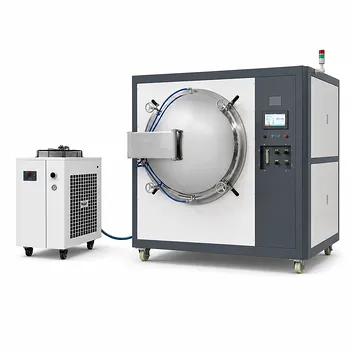
A vacuum hot pressing sintering furnace (VHPS) achieves densification by simultaneously applying high thermal energy (1000°C) and substantial axial pressure (30 MPa) to the CoCrFeNi(W1-xMox) alloy powder. This thermo-mechanical combination forces powder particles into intimate contact and accelerates atomic diffusion, resulting in a coating with a relative density exceeding 98%.
The core advantage of this process is the synergy between heat and pressure: while temperature activates atomic movement, physical pressure mechanically eliminates voids that heat alone cannot close, ensuring a dense, oxidation-free microstructure.
The Thermo-Mechanical Synergy
The effectiveness of VHPS lies in its ability to do two things at once: soften the material thermally and compact it mechanically.
Simultaneous Heat and Pressure
The furnace subjects the CoCrFeNi(W1-xMox) powder to a temperature of 1000°C and a uniaxial pressure of 30 MPa.
Unlike conventional sintering, which relies solely on thermal energy, this method uses mechanical force to drive the densification process actively.
Enhanced Atomic Diffusion
The application of pressure reduces the distance between powder particles, significantly increasing the contact area.
This proximity allows the high thermal energy to drive atomic diffusion across particle boundaries more efficiently, rapidly closing internal gaps.
Mechanical Void Elimination
The axial pressure physically forces the rearrangement of particles, overcoming the friction that typically prevents loose powders from settling.
This leads to the mechanical collapse of pores, pushing the material toward a near-full relative density of over 98%.
The Role of the Vacuum Environment
High-temperature processing of complex alloys poses a significant risk of chemical degradation, which the vacuum environment mitigates.
Prevention of High-Temperature Oxidation
The metallic elements in CoCrFeNi(W1-xMox) are susceptible to rapid oxidation when exposed to oxygen at 1000°C.
The vacuum environment removes oxygen from the chamber, preserving the metallic purity of the elements and ensuring the coating's chemical integrity.
Elimination of Trapped Gases
Sintering in a vacuum aids in evacuating gases that might otherwise be trapped within the powder pores.
By removing these gases, the process prevents the formation of gas-filled voids that would otherwise inhibit final densification and weaken the material structure.
Understanding the Trade-offs
While VHPS is highly effective for densification, it is important to recognize the limitations inherent in the process.
Geometrical Constraints
Because the pressure is applied axially (uniaxially), the process is generally limited to simple geometries like flat plates or discs.
Complex 3D shapes are difficult to manufacture using this method without significant post-processing or machining.
Process Efficiency
The requirement to pump the chamber to a high vacuum and ramp up to 1000°C makes this a batch process with relatively longer cycle times compared to continuous atmospheric sintering.
Making the Right Choice for Your Goal
To maximize the quality of your high entropy alloy coatings, align your process parameters with your specific metallurgical targets.
- If your primary focus is Maximum Density (>98%): Prioritize the maintenance of consistent axial pressure (30 MPa) throughout the high-temperature dwell time to mechanically close stubborn porosity.
- If your primary focus is Microstructural Purity: Ensure the vacuum system is capable of maintaining a deep vacuum throughout the heating cycle to prevent oxide inclusions that degrade mechanical performance.
Success in densifying CoCrFeNi(W1-xMox) relies on balancing thermal activation with sufficient mechanical force to overcome the material's resistance to deformation.
Summary Table:
| Feature | Parameter/Effect | Benefit for CoCrFeNi Alloys |
|---|---|---|
| Sintering Temp | 1000°C | Activates atomic diffusion for particle bonding |
| Axial Pressure | 30 MPa | Mechanically collapses pores to reach >98% density |
| Environment | High Vacuum | Prevents oxidation and eliminates trapped gases |
| Material Focus | CoCrFeNi(W1-xMox) | Ensures chemical purity and structural integrity |
| Mechanical State | Thermo-Mechanical Synergy | Overcomes friction to settle particles efficiently |
Elevate Your Material Research with KINTEK Precision
Are you struggling to achieve full densification in your high-performance alloy coatings? KINTEK specializes in advanced laboratory equipment designed for the most demanding metallurgical applications. From our industry-leading vacuum hot pressing sintering furnaces and high-temperature furnaces (muffle, tube, vacuum, CVD) to specialized crushing and milling systems and isostatic hydraulic presses, we provide the tools necessary to eliminate porosity and prevent oxidation.
Whether you are developing complex high entropy alloys or researching battery technologies, our expert team is ready to support your lab with reliable, high-purity solutions including PTFE products, ceramics, and crucibles.
Maximize your coating density and microstructural purity today.
Related Products
- 600T Vacuum Induction Hot Press Furnace for Heat Treat and Sintering
- Vacuum Heat Treat and Sintering Furnace with 9MPa Air Pressure
- Vacuum Heat Treat and Pressure Sintering Furnace for High Temperature Applications
- 2200 ℃ Tungsten Vacuum Heat Treat and Sintering Furnace
- Vacuum Hot Press Furnace Heated Vacuum Press Machine Tube Furnace
People Also Ask
- What role does an induction vacuum hot pressing furnace play in sintering? Achieve 98% Density in Carbide Blocks
- What advantages does a vacuum hot press furnace provide for LSLBO ceramic electrolytes? Achieve 94% Relative Density
- What role does a Vacuum Hot Press (VHP) furnace play in the densification of austenitic stainless steel 316 composites?
- What are the advantages of a vacuum hot press furnace for W-50%Cu? Achieve 99.6% Density at Lower Temperatures
- What role does mechanical pressure play during the vacuum diffusion bonding of tungsten and copper? Keys to Solid Bonding