An adjustable speed stirrer drives the chemical dissolution of iridium by generating mechanical forced convection that actively renews the contact point between the solid metal and the liquid reactant. This continuous movement strips away the depleted fluid layer surrounding the iridium particles, allowing fresh hydrochloric acid to attack the surface and significantly accelerating the overall reaction.
Core Takeaway Without agitation, a stagnant "boundary layer" forms around solid particles, acting as a shield that slows down chemical reactions. An adjustable stirrer uses forced convection to break this resistance, shortening dissolution times and ensuring the entire solution reaches a uniform consistency.
The Mechanism of Enhanced Dissolution
Mechanical Forced Convection
The primary function of the stirrer is to introduce mechanical energy into the leaching environment.
By physically moving the fluid, the stirrer creates forced convection currents throughout the tank. This ensures that the hydrochloric acid reactant does not remain stagnant but constantly flows over the solid iridium product.
Reducing Boundary Layer Resistance
In a static environment, a thin layer of fluid immediately surrounding a solid particle becomes depleted of reactants.
This creates a "boundary layer" that resists further chemical activity. The stirrer’s motion constantly refreshes the liquid-solid contact surface, effectively scrubbing away this depleted layer and reducing the resistance it causes.
Accelerating Mass Transfer
Chemical dissolution is limited by how quickly reactants can reach the solid surface and products can move away.
By minimizing the boundary layer, the stirrer accelerates mass transfer. This allows the hydrochloric acid to interact with the iridium more frequently and aggressively, directly leading to faster reaction rates.
Operational Efficiency and Consistency
Shortening Dissolution Time
The direct result of improved mass transfer is a significant reduction in process time.
Because the reactants are constantly replenished at the particle surface, the iridium dissolves much faster than it would under passive conditions. This increases the overall throughput of the leaching equipment.
Ensuring Uniform Distribution
Beyond the particle level, the stirrer affects the macroscopic environment of the tank.
It ensures the uniform distribution of materials within the acid solution. This prevents the formation of localized "dead zones" where the acid might be too weak or the solids might settle and clump together.
Understanding the Constraints
The Importance of Adjustability
While mixing is critical, the "adjustable" nature of the speed is the key operational variable.
A fixed speed may not be suitable for all stages of dissolution. Being able to tune the speed allows operators to match the agitation intensity to the specific viscosity or volume of the slurry, preventing issues like splashing or equipment vibration.
Balancing Energy and Wear
Higher speeds generally mean faster dissolution, but there is a point of diminishing returns.
Excessive agitation can lead to unnecessary energy consumption and increased wear on the stirrer blades or the tank lining. The goal is to find the minimum speed required to maintain full suspension and effective mass transfer, rather than running at maximum power indiscriminately.
Making the Right Choice for Your Goal
To optimize your iridium leaching process, consider how you modulate the stirrer speed based on your specific objectives:
- If your primary focus is Speed: Increase the RPM to maximize forced convection, aggressively breaking down the boundary layer to achieve the shortest possible dissolution time.
- If your primary focus is Equipment Longevity: Adjust the stirrer to a moderate speed that sustains uniform suspension without causing excessive turbulence or mechanical wear.
By mastering the speed of agitation, you transform the stirrer from a simple mixer into a precision tool for chemical efficiency.
Summary Table:
| Key Mechanism | Function in Dissolution | Primary Benefit |
|---|---|---|
| Forced Convection | Generates mechanical energy to move fluid | Constant renewal of liquid-solid contact |
| Boundary Layer Removal | Scrubs away depleted fluid layers | Reduces resistance to chemical activity |
| Mass Transfer Acceleration | Increases reactant frequency at surface | Significantly shorter dissolution times |
| Uniform Distribution | Prevents clumping and localized dead zones | Ensures consistent reaction rates |
| Adjustable Speed | Tunes agitation to viscosity/volume | Balances reaction speed with equipment wear |
Maximize Your Leaching Efficiency with KINTEK Precision Solutions
Optimizing the dissolution of precious metals like iridium requires the perfect balance of agitation and control. At KINTEK, we specialize in high-performance laboratory equipment designed to meet the rigorous demands of chemical research and material processing.
Our extensive portfolio includes advanced crushing and milling systems, high-temperature high-pressure reactors, and precision adjustable speed stirrers that ensure superior mass transfer and process consistency. Whether you are refining extraction methods or scaling up production, KINTEK provides the durable consumables—from PTFE products to ceramics and crucibles—and the sophisticated hardware your lab needs to succeed.
Ready to accelerate your research throughput? Contact our technical experts today to find the ideal equipment configuration for your specific leaching and dissolution applications.
References
- Jaeryeong Lee, Youngjin Kim. Chemical Dissolution of Iridium Powder Using Alkali Fusion Followed by High-Temperature Leaching. DOI: 10.2320/matertrans.m2011202
This article is also based on technical information from Kintek Solution Knowledge Base .
Related Products
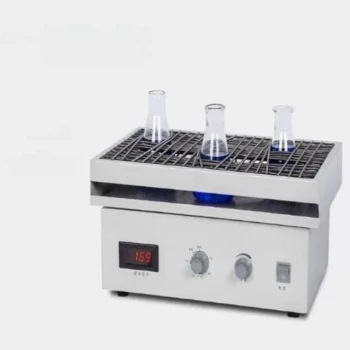
- Laboratory Multifunctional Small Speed-Adjustable Horizontal Mechanical Shaker for Lab
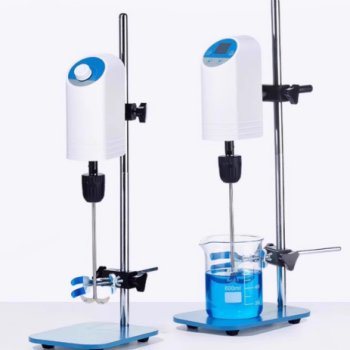
- High Performance Laboratory Stirrers for Diverse Applications
- Laboratory Small Constant Temperature Heated Magnetic Stirrer Heater and Stirrer
People Also Ask
- How do static culture and shaking culture affect the morphology of BC? Optimize Lab Shaker Results
- What is the role of a laboratory shaker in silane sol preparation? Master Uniform Aramid Fabric Coating
- Why is a laboratory shaker required for continuous 24-hour catalyst treatment? Achieve Deep Uniform Impregnation
- What is the function of a laboratory shaker in evaluating Fe-C@C nanoparticles? Optimize Methylene Blue Adsorption
- How do laboratory shakers or stirrers influence the efficiency of hydrogen production during dark fermentation?