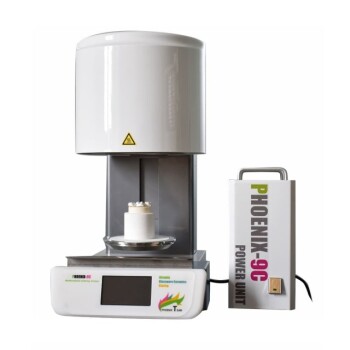
Atmosphere sintering furnaces facilitate AuPd solid solution formation by introducing a specific reducing gas mixture, typically 5% hydrogen (H2) and 95% argon (Ar), during the late stages of heat treatment. This environment actively prevents oxidation, ensuring that Gold (Au) and Palladium (Pd) remain in their pure metallic states. By maintaining these metals in a non-oxidized form, the furnace maximizes atomic diffusion, allowing the two distinct elements to merge into a single, stable solid solution phase.
By strictly controlling the atmosphere to keep metals in their metallic state, the sintering process transforms separate Au and Pd elements into a cohesive alloy. This precise environmental control is the deciding factor for achieving high electrochemical stability and resistance to catalytic poisoning.
The Mechanism of Solid Solution Formation
The Critical Role of Reducing Gases
The primary function of the atmosphere sintering furnace is to manage the chemical environment around the metals. By introducing a mixture of 5% H2 and 95% Ar, the furnace creates a reducing atmosphere.
This specific gas composition acts as a protective shield. It ensures that the metal components remain entirely in their metallic state throughout the heating process.
Enabling Atomic Diffusion
Solid solution formation relies heavily on the movement of atoms. For Au and Pd to alloy effectively, their atoms must be able to migrate and intermingle freely.
The reducing atmosphere facilitates this by preventing the formation of surface oxides. Oxides act as barriers that inhibit atomic movement; by eliminating them, the furnace promotes unobstructed atomic diffusion.
Impact on Catalyst Performance
Increasing the Degree of Alloying
The effectiveness of the final material depends on how thoroughly the metals mix. Precise atmosphere control is described as decisive for increasing the degree of alloying.
A higher degree of alloying ensures a uniform material structure. This uniformity is essential for consistent performance across the entire catalyst surface.
Enhancing Stability and Resistance
The ultimate goal of this sintering process is to improve the functional properties of the material. A well-formed AuPd solid solution exhibits improved anti-poisoning capabilities.
Furthermore, this process enhances electrochemical stability. The resulting catalyst is more robust and maintains its efficiency longer under operating conditions.
Understanding the Operational Trade-offs
The Necessity of Precision
While a reducing atmosphere is beneficial, the primary reference notes that control must be "precise." This implies that deviations in gas composition or flow can significantly alter results.
If the atmosphere is not strictly maintained, the metals may not fully reduce, or the alloying process may remain incomplete.
Complexity vs. Performance
Using a hydrogen-argon mix introduces operational complexity compared to standard air sintering. However, this complexity is a necessary trade-off to achieve the metallic purity required for high-performance alloying.
Making the Right Choice for Your Goal
To maximize the effectiveness of your AuPd catalysts, consider the following based on your specific objectives:
- If your primary focus is maximum alloying: Prioritize the precise regulation of the 5% H2 / 95% Ar ratio to ensure no oxides inhibit diffusion.
- If your primary focus is long-term durability: Ensure the "late-stage" heat treatment is sufficient to fully set the metallic state, directly enhancing electrochemical stability.
Effective atmosphere sintering is not just about heating; it is about creating the chemical freedom for metals to fuse into a superior, stable alloy.
Summary Table:
| Feature | Function in AuPd Sintering | Key Benefit |
|---|---|---|
| Reducing Gas (5% H2/95% Ar) | Prevents metal oxidation during late-stage heating | Maintains metals in pure metallic states |
| Oxide Prevention | Eliminates surface barriers on Au and Pd | Maximizes atomic diffusion for alloying |
| Atmosphere Control | Precise regulation of gas composition | Increases degree of alloying and uniformity |
| Solid Solution Phase | Formation of a cohesive, stable alloy | Enhances electrochemical stability and durability |
Elevate Your Material Research with KINTEK Precision Solutions
Achieving the perfect AuPd solid solution requires more than just heat—it demands absolute control over your chemical environment. KINTEK specializes in advanced atmosphere furnaces, vacuum systems, and high-temperature furnaces (CVD, PECVD, Rotary) designed to deliver the precise reducing conditions necessary for high-performance catalyst production.
From high-purity ceramic crucibles to integrated crushing and milling systems, our comprehensive laboratory equipment portfolio ensures your research maintains the highest standards of metallic purity and structural integrity.
Ready to optimize your alloying process and enhance catalyst stability? Contact a KINTEK Specialist Today to find the ideal equipment for your laboratory.
References
- Hsuan-Ming KUNG, Chung‐Kwei Lin. Anode Catalyst of Hybrid AuPd and Rare Earth Doped Cerium Oxide/Multi-Walled Carbon Nanotubes for Direct Formic Acid Fuel Cells. DOI: 10.2497/jjspm.63.706
This article is also based on technical information from Kintek Solution Knowledge Base .
Related Products
- Mesh belt controlled atmosphere furnace
- Controlled Nitrogen Inert Hydrogen Atmosphere Furnace
- Vacuum Heat Treat and Sintering Furnace with 9MPa Air Pressure
- 1200℃ Controlled Atmosphere Furnace Nitrogen Inert Atmosphere Furnace
- Spark Plasma Sintering Furnace SPS Furnace
People Also Ask
- What are some of the reasons why a controlled atmosphere furnace is desirable in sintering? Achieve Superior Sintering Results
- What role does a controlled atmosphere furnace with argon gas flow play in the production of reduced graphene oxide (rGO)?
- Why is a furnace equipped with a controlled atmosphere necessary for the preparation of active metal catalysts?
- How does a mesh belt furnace work? Achieve High-Volume, Repeatable Heat Treatment
- What is the process of a mesh belt furnace? Achieve Consistent, High-Volume Heat Treatment