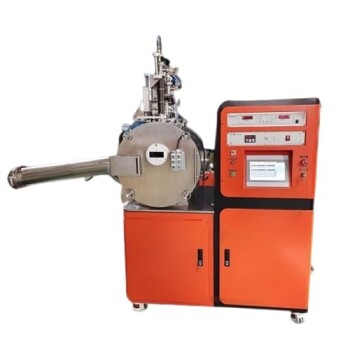
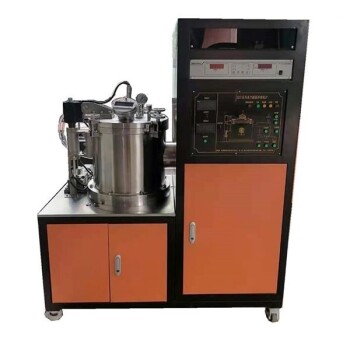
Knowledge How does arc melting equipment facilitate the preparation of refractory multi-principal element alloys (RMPEAs)?
Author avatar

Tech Team · Kintek Solution

Updated 2 days ago

How does arc melting equipment facilitate the preparation of refractory multi-principal element alloys (RMPEAs)?


Arc melting equipment operates as the critical enabler for preparing refractory multi-principal element alloys (RMPEAs) by delivering the requisite high-energy density to melt refractory metals. It specifically targets elements with extreme melting points, such as tungsten and tantalum, allowing them to be combined into a uniform alloy under strictly controlled conditions.

The core value of arc melting lies in its ability to generate extreme temperatures within a protected environment. This ensures the complete fusion of refractory elements into a chemically homogeneous, single-phase body-centered cubic (BCC) structure.

Overcoming the Thermal Threshold

Harnessing High Energy Density

The primary challenge in creating RMPEAs is the immense heat required to alter the state of the constituent materials. Arc melting equipment solves this by utilizing high energy density arcs.

These arcs focus intense thermal energy into a concentrated area. This allows the system to rapidly elevate temperatures beyond the capabilities of standard induction or resistance furnaces.

Liquefying Refractory Metals

This equipment is specifically engineered to handle metals with very high melting points.

It successfully processes refractory elements such as molybdenum (Mo), tungsten (W), and tantalum (Ta). Without the extreme temperatures generated by the arc, these elements would remain solid or partially melted, resulting in a failed alloy.

Ensuring Material Integrity

Achieving Complete Alloying

Merely melting the metals is insufficient; they must be thoroughly mixed to form a cohesive material.

Arc melting ensures complete alloying of the constituent elements. This process drives the materials to mix at the atomic level, preventing segregation where elements might otherwise separate based on density or melting point.

Forming a Single-Phase BCC Structure

The ultimate goal of this process is structural stability.

The equipment facilitates the formation of a single-phase body-centered cubic (BCC) structure. This specific crystal structure is characteristic of high-quality RMPEAs and is essential for achieving the desired mechanical properties of the final ingot.

The Role of Inert Gas

To maintain purity, arc melting operates under an inert gas atmosphere.

This controlled environment prevents the molten metals from reacting with oxygen or other atmospheric contaminants. The result is an ingot with minimal impurity levels and superior compositional uniformity.

Understanding Process Dependencies

While arc melting is the definitive solution for RMPEAs, it relies heavily on specific operational parameters to succeed.

The Risk of Oxidation

The process is entirely dependent on the integrity of the inert gas atmosphere. If the atmosphere is compromised, the high reactivity of refractory metals at melting temperatures will lead to immediate oxidation and embrittlement of the alloy.

Energy vs. Homogeneity

Achieving a uniform composition requires sustained high energy density. If the arc energy fluctuates or is insufficient for the specific mixture of tungsten or tantalum, the alloy may suffer from incomplete melting, leading to localized weak points within the ingot.

Making the Right Choice for Your Goal

To maximize the effectiveness of arc melting for your specific alloy preparation:

  • If your primary focus is Material Purity: Prioritize the integrity of the inert gas atmosphere to ensure minimal impurity levels and prevent oxidation of sensitive refractory elements.
  • If your primary focus is Structural Stability: Focus on the energy density parameters to guarantee the formation of a complete single-phase body-centered cubic (BCC) structure.

By leveraging the extreme thermal capabilities and environmental controls of arc melting, you can successfully transform distinct refractory elements into robust, high-performance alloys.

Summary Table:

Feature Benefit for RMPEA Preparation
High Energy Density Rapidly melts metals with extreme melting points like Tungsten (W) and Tantalum (Ta).
Inert Gas Atmosphere Prevents oxidation and atmospheric contamination to ensure maximum material purity.
Complete Alloying Drives atomic-level mixing to prevent elemental segregation and ensure homogeneity.
Structural Control Facilitates the formation of stable, single-phase body-centered cubic (BCC) structures.

Elevate Your Materials Research with KINTEK

Unlock the full potential of high-performance alloy synthesis with KINTEK’s precision engineering. Whether you are developing refractory multi-principal element alloys (RMPEAs) or advanced ceramic composites, our comprehensive range of induction melting furnaces, vacuum arc melters, and high-temperature furnaces provide the thermal control and purity your lab demands.

From crushing and milling systems for feedstock preparation to high-pressure reactors and PTFE consumables for specialized processing, KINTEK supports every stage of your workflow.

Ready to achieve superior structural stability and chemical homogeneity? Contact our laboratory equipment experts today to find the perfect solution for your research goals.

References

  1. Ranran Su, John H. Perepezko. Phase Stability During High-Temperature Oxidation. DOI: 10.1007/s11837-023-06080-2

This article is also based on technical information from Kintek Solution Knowledge Base .

Related Products

People Also Ask

Related Products

1700℃ Laboratory High Temperature Tube Furnace with Alumina Tube

1700℃ Laboratory High Temperature Tube Furnace with Alumina Tube

Looking for a high-temperature tube furnace? Check out our 1700℃ Tube Furnace with Alumina Tube. Perfect for research and industrial applications up to 1700C.

1400℃ Laboratory High Temperature Tube Furnace with Alumina Tube

1400℃ Laboratory High Temperature Tube Furnace with Alumina Tube

Looking for a tube furnace for high-temperature applications? Our 1400℃ Tube Furnace with Alumina Tube is perfect for research and industrial use.

1200℃ Split Tube Furnace with Quartz Tube Laboratory Tubular Furnace

1200℃ Split Tube Furnace with Quartz Tube Laboratory Tubular Furnace

KT-TF12 split tube furnace: high-purity insulation, embedded heating wire coils, and max. 1200C. Widely used for new materials and chemical vapour deposition.

1700℃ Muffle Oven Furnace for Laboratory

1700℃ Muffle Oven Furnace for Laboratory

Get superior heat control with our 1700℃ Muffle Furnace. Equipped with intelligent temperature microprocessor, TFT touch screen controller & advanced insulation materials for precise heating up to 1700C. Order now!

High Pressure Laboratory Vacuum Tube Furnace Quartz Tubular Furnace

High Pressure Laboratory Vacuum Tube Furnace Quartz Tubular Furnace

KT-PTF High Pressure Tube Furnace: Compact split tube furnace with strong positive pressure resistance. Working temp up to 1100°C and pressure up to 15Mpa. Also works under controller atmosphere or high vacuum.

Graphite Vacuum Furnace Bottom Discharge Graphitization Furnace for Carbon Materials

Graphite Vacuum Furnace Bottom Discharge Graphitization Furnace for Carbon Materials

Bottom-out graphitization furnace for carbon materials, ultra-high temperature furnace up to 3100°C, suitable for graphitization and sintering of carbon rods and carbon blocks. Vertical design, bottom discharging, convenient feeding and discharging, high temperature uniformity, low energy consumption, good stability, hydraulic lifting system, convenient loading and unloading.

Horizontal High Temperature Graphite Vacuum Graphitization Furnace

Horizontal High Temperature Graphite Vacuum Graphitization Furnace

Horizontal Graphitization Furnace: This type of furnace is designed with the heating elements placed horizontally, allowing for uniform heating of the sample. It's well-suited for graphitizing large or bulky samples that require precise temperature control and uniformity.

Vertical High Temperature Graphite Vacuum Graphitization Furnace

Vertical High Temperature Graphite Vacuum Graphitization Furnace

Vertical high temperature graphitization furnace for carbonization and graphitization of carbon materials up to 3100℃.Suitable for shaped graphitization of carbon fiber filaments and other materials sintered in a carbon environment.Applications in metallurgy, electronics, and aerospace for producing high-quality graphite products like electrodes and crucibles.

Molybdenum Vacuum Heat Treat Furnace

Molybdenum Vacuum Heat Treat Furnace

Discover the benefits of a high-configuration molybdenum vacuum furnace with heat shield insulation. Ideal for high-purity, vacuum environments like sapphire crystal growth and heat treatment.

Laboratory Rapid Thermal Processing (RTP) Quartz Tube Furnace

Laboratory Rapid Thermal Processing (RTP) Quartz Tube Furnace

Get lightning-fast heating with our RTP Rapid Heating Tube Furnace. Designed for precise, high-speed heating and cooling with convenient sliding rail and TFT touch screen controller. Order now for ideal thermal processing!

Dental Porcelain Zirconia Sintering Ceramic Vacuum Press Furnace

Dental Porcelain Zirconia Sintering Ceramic Vacuum Press Furnace

Get precise dental results with Dental Vacuum Press Furnace. Automatic temperature calibration, low noise tray, and touch screen operation. Order now!

Graphite Vacuum Furnace IGBT Experimental Graphitization Furnace

Graphite Vacuum Furnace IGBT Experimental Graphitization Furnace

IGBT experimental graphitization furnace, a tailored solution for universities and research institutions, with high heating efficiency, user-friendliness, and precise temperature control.

Laboratory Vacuum Tilt Rotary Tube Furnace Rotating Tube Furnace

Laboratory Vacuum Tilt Rotary Tube Furnace Rotating Tube Furnace

Discover the versatility of Laboratory Rotary Furnace: Ideal for calcination, drying, sintering, and high-temperature reactions. Adjustable rotating and tilting functions for optimal heating. Suitable for vacuum and controlled atmosphere environments. Learn more now!

Vacuum Heat Treat Sintering Brazing Furnace

Vacuum Heat Treat Sintering Brazing Furnace

A vacuum brazing furnace is a type of industrial furnace used for brazing, a metalworking process that joins two pieces of metal using a filler metal that melts at a lower temperature than the base metals. Vacuum brazing furnaces are typically used for high-quality applications where a strong, clean joint is required.

Graphite Vacuum Furnace High Thermal Conductivity Film Graphitization Furnace

Graphite Vacuum Furnace High Thermal Conductivity Film Graphitization Furnace

The high thermal conductivity film graphitization furnace has uniform temperature, low energy consumption and can operate continuously.

Small Vacuum Heat Treat and Tungsten Wire Sintering Furnace

Small Vacuum Heat Treat and Tungsten Wire Sintering Furnace

The small vacuum tungsten wire sintering furnace is a compact experimental vacuum furnace specially designed for universities and scientific research institutes. The furnace features a CNC welded shell and vacuum piping to ensure leak-free operation. Quick-connect electrical connections facilitate relocation and debugging, and the standard electrical control cabinet is safe and convenient to operate.

Vacuum Heat Treat Furnace with Ceramic Fiber Liner

Vacuum Heat Treat Furnace with Ceramic Fiber Liner

Vacuum furnace with polycrystalline ceramic fiber insulation liner for excellent heat insulation and uniform temperature field. Choose from 1200℃ or 1700℃ max. working temperature with high vacuum performance and precise temperature control.

Electric Rotary Kiln Continuous Working Small Rotary Furnace Heating Pyrolysis Plant

Electric Rotary Kiln Continuous Working Small Rotary Furnace Heating Pyrolysis Plant

Efficiently calcine and dry bulk powder and lump fluid materials with an electric heating rotary furnace. Ideal for processing lithium ion battery materials and more.

Vacuum Hot Press Furnace Machine for Lamination and Heating

Vacuum Hot Press Furnace Machine for Lamination and Heating

Experience clean and precise lamination with Vacuum Lamination Press. Perfect for wafer bonding, thin-film transformations, and LCP lamination. Order now!

Benchtop Laboratory Freeze Dryer for Lab Use

Benchtop Laboratory Freeze Dryer for Lab Use

Premium benchtop laboratory freeze dryer for lyophilization, preserving samples with ≤ -60°C cooling. Ideal for pharmaceuticals & research.


Leave Your Message