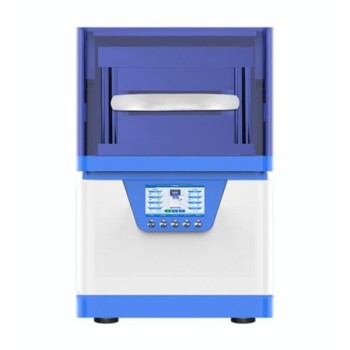
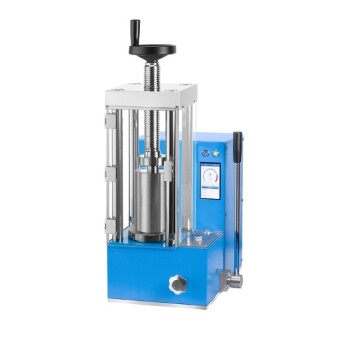
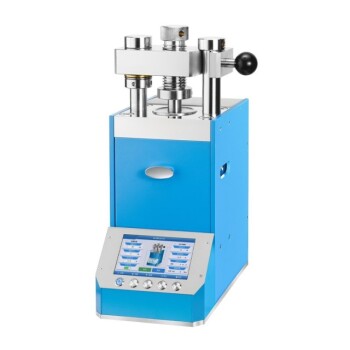
Hot Isostatic Pressing (HIP) optimizes additive manufactured Inconel 718 by subjecting the material to a simultaneous combination of extreme heat and uniform gas pressure. This process mechanically collapses internal voids and heals residual defects that naturally occur during 3D printing, resulting in a fully dense component.
By maintaining a synergistic environment of approximately 1160°C and 100 MPa, HIP equipment forces the closure of residual pores. Beyond simple densification, this process actively refines the material's microstructure by adjusting carbide distribution, ensuring superior mechanical integrity.
The Mechanism of Densification
Applying Synergistic Forces
HIP equipment creates an environment where temperature and pressure work in unison. The process typically utilizes a high temperature of 1160°C combined with a uniform static pressure of 100 MPa.
Closing Residual Pores
The pressure is applied isostatically, meaning it comes from all directions via high-pressure gas. This omnidirectional force compresses the material, effectively squeezing shut the residual pores generated during the additive manufacturing process.
Eliminating Internal Voids
The primary outcome of this physical compression is the closure of internal voids. This significantly increases the overall density of the Inconel 718 part, transforming a porous printed structure into a solid, high-integrity component.
Microstructural Refinement
Adjusting Carbide Distribution
Optimization is not limited to closing holes; it also involves chemical and structural stabilization. The HIP process adjusts the distribution of carbides within the Inconel 718 matrix.
Leveraging Ostwald Ripening
This redistribution occurs through a phenomenon known as Ostwald ripening. During the high-temperature dwell time, smaller carbide precipitates dissolve and redeposit onto larger ones, creating a more thermodynamically stable and uniform microstructure.
Achieving Uniformity
The result is a "clean" microstructure free of the irregularities often found in as-printed parts. This uniformity is critical for consistent performance and predictable material behavior under stress.
Critical Process Requirements
The Necessity of Specific Parameters
It is important to understand that standard heat treatment alone cannot achieve these results. The specific combination of 1160°C and 100 MPa is required to activate the synergistic effect that bonds the material internally.
Reliance on Non-Destructive Testing
While HIP is highly effective, verification remains essential. Non-destructive testing of HIPped parts is the standard method to confirm that the internal defects have been successfully repaired and that the part meets density requirements.
Making the Right Choice for Your Goal
To maximize the utility of HIP for your Inconel 718 components, consider your specific engineering objectives:
- If your primary focus is Structural Integrity: Utilize HIP to eliminate porosity and maximize density, ensuring the part is solid throughout.
- If your primary focus is Mechanical Performance: Rely on the process to homogenize the microstructure and improve properties like fatigue strength and workability.
- If your primary focus is Material Stability: Leverage the Ostwald ripening effect to optimize carbide distribution for a uniform internal structure.
HIP transforms an additive manufactured part from a near-net shape into a high-performance, industrial-grade component.
Summary Table:
| Feature | Optimization Parameter | Impact on Inconel 718 |
|---|---|---|
| Processing Temperature | 1160°C | Facilitates diffusion and microstructural refinement |
| Isostatic Pressure | 100 MPa | Closes internal voids and eliminates residual pores |
| Microstructure | Ostwald Ripening | Stabilizes carbide distribution for uniformity |
| Final Property | Full Densification | Maximizes structural integrity and fatigue resistance |
Elevate Your Additive Manufacturing Performance with KINTEK
Don't let internal defects compromise your mission-critical components. KINTEK specializes in advanced laboratory and industrial solutions, providing high-performance Hot Isostatic Pressing (HIP) equipment and isostatic presses designed to transform as-printed Inconel 718 into fully dense, high-integrity parts.
Whether you are refining microstructures for aerospace applications or optimizing mechanical strength for energy sectors, our comprehensive range of high-temperature furnaces, hydraulic presses, and cooling solutions ensures your materials meet the most rigorous standards.
Ready to achieve superior material density? Contact our engineering experts today to find the perfect HIP solution for your lab or production line.
References
- Raiyan Seede, Mamoun Medraj. Microstructural and Microhardness Evolution from Homogenization and Hot Isostatic Pressing on Selective Laser Melted Inconel 718: Structure, Texture, and Phases. DOI: 10.3390/jmmp2020030
This article is also based on technical information from Kintek Solution Knowledge Base .
Related Products
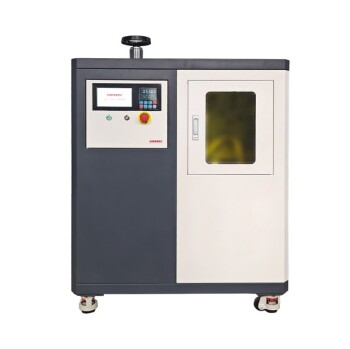
- Warm Isostatic Press for Solid State Battery Research
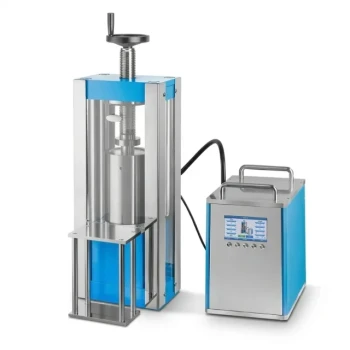
- Electric Split Lab Cold Isostatic Press CIP Machine for Cold Isostatic Pressing
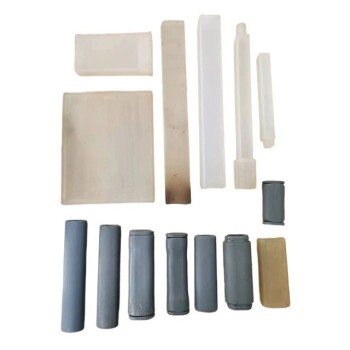
- Isostatic Molding Pressing Molds for Lab
- Automatic High Temperature Heated Hydraulic Press Machine with Heated Plates for Lab
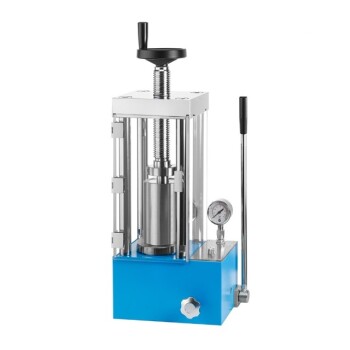
- Manual High Temperature Heated Hydraulic Press Machine with Heated Plates for Lab
People Also Ask
- What is the temperature of a warm isostatic press? Achieve Optimal Densification for Your Materials
- What is the function of a Warm Isostatic Press (WIP) in all-solid-state pouch cells? Optimize Battery Density
- Why are Warm Isostatic Presses (WIP) necessary for solid-state batteries? Achieve Atomic-Level Contact
- What advantages does a warm isostatic press offer over a traditional uniaxial press for Li6PS5Cl electrolyte sheets?
- How do warm isostatic presses improve dry electrode performance? Enhance ASSB Conductivity with Heat & Pressure