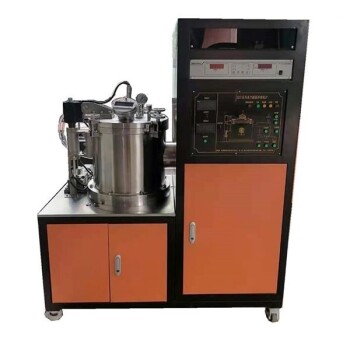
High-purity argon gas serves as a critical protective barrier during the induction melting of Cantor alloys. By physically displacing atmospheric air within the furnace chamber, it prevents the oxidation of highly reactive metallic elements, specifically manganese and chromium. This preservation of elemental integrity is the primary factor in ensuring the final alloy meets strict quality standards.
Core Takeaway The introduction of high-purity argon is not an optional enhancement but a fundamental requirement for stabilizing Cantor alloys. It secures the nominal composition against elemental loss and eliminates oxide inclusions that would otherwise compromise the material's corrosion resistance.
The Mechanism of Composition Control
Displacing Reactive Gasses
The primary function of introducing high-purity argon is to create an inert environment.
Argon is heavier than air and effectively purges oxygen and nitrogen from the melting zone.
This displacement removes the reactants necessary for oxidation to occur during the high-temperature liquid phase.
Protecting Active Elements
Cantor alloys rely on a precise balance of multiple principal elements.
Among these, manganese and chromium are particularly "active," meaning they react aggressively with oxygen when heated.
Without an argon shield, these elements would rapidly oxidize and burn off, permanently altering the alloy's chemical makeup.
Maintaining Nominal Ratios
The quality of a Cantor alloy depends on adhering to its intended nominal composition ratios.
Argon ensures that the raw materials weighed prior to melting remain present in the final ingot.
This stability prevents the "compositional drift" that occurs when active elements are lost to the atmosphere or slag.
Impact on Physical and Chemical Properties
Reducing Microstructural Defects
Oxygen contamination leads to the formation of oxide inclusions within the metal matrix.
These inclusions act as impurities that disrupt the crystal lattice of the alloy.
By excluding oxygen, argon dramatically reduces the density of these defects, resulting in a cleaner, more homogenous microstructure.
Enhancing Corrosion Resistance
The presence of oxide inclusions creates weak points on the alloy's surface where corrosion can initiate.
High-purity argon processing produces electrodes with superior surface integrity.
Consequently, the resulting material exhibits significantly enhanced resistance to corrosive environments.
The Operational Context and Trade-offs
The Necessity of Purity
It is critical to note that the gas used must be high-purity.
Using industrial-grade argon with trace impurities can inadvertently introduce the very contaminants you are trying to avoid.
The effectiveness of the process is directly tied to the purity level of the protective gas supply.
A Clean Process Synergy
Induction melting is inherently a low-impact process, producing minimal noise, dust, or harmful exhaust gases.
The addition of argon aligns with this "clean process" philosophy.
It ensures that the internal chemical environment is as safe and controlled as the external working environment for the operators.
Making the Right Choice for Your Goal
To maximize the quality of your Cantor alloys, tailor your gas control strategy to your specific metallurgical objectives:
- If your primary focus is Compositional Accuracy: Ensure a continuous flow of high-purity argon to prevent the vaporization and oxidation of manganese and chromium, preserving the alloy's stoichiometry.
- If your primary focus is Material Performance: Prioritize the elimination of atmospheric oxygen to minimize oxide inclusions, which is the direct path to maximizing corrosion resistance.
By rigorously controlling the melting atmosphere, you transform a standard induction process into a precision manufacturing environment.
Summary Table:
| Factor | Impact of High-Purity Argon | Benefit to Cantor Alloy |
|---|---|---|
| Atmospheric Control | Displaces Oxygen & Nitrogen | Prevents oxidation of active elements |
| Elemental Stability | Protects Manganese & Chromium | Maintains precise nominal composition |
| Microstructure | Eliminates oxide inclusions | Ensures clean, homogenous material |
| Surface Integrity | Reduces lattice defects | Significantly enhances corrosion resistance |
Elevate Your Metallurgical Precision with KINTEK
Achieving the perfect stoichiometry in Cantor alloys requires more than just high-purity gas—it requires a high-performance melting environment. KINTEK specializes in advanced laboratory equipment designed for the most demanding research and production standards.
Our comprehensive range of induction melting furnaces, high-temperature vacuum and atmosphere furnaces, and high-pressure reactors provides the precise control necessary to eliminate compositional drift and material defects. Whether you are developing next-generation high-entropy alloys or refining specialized battery materials, our solutions—including precision crushing systems, hydraulic presses, and high-quality crucibles—ensure your results are consistent and reproducible.
Ready to optimize your material performance? Contact our technical experts today to discover how KINTEK's laboratory solutions can transform your research outcomes.
References
- Gülizar Kurtoğlu Akkaya, Gökhan Polat. Treatment by Electrocoagulation of Congo red from Aqueous Solution Using Cantor Alloy. DOI: 10.31590/ejosat.1041536
This article is also based on technical information from Kintek Solution Knowledge Base .
Related Products
- Lab-Scale Vacuum Induction Melting Furnace
- Non Consumable Vacuum Arc Induction Melting Furnace
- Vacuum Heat Treat Furnace and Levitation Induction Melting Furnace
- Vacuum Arc Induction Melting Furnace
- 600T Vacuum Induction Hot Press Furnace for Heat Treat and Sintering
People Also Ask
- How do vacuum induction or arc melting furnaces facilitate the synthesis of U-Al-C MAX phases? Precision Heat & Purity
- What types of metals are typically processed in a vacuum induction melting furnace? High-Purity Alloys for Critical Applications
- Why use VIM for rare earth steel? Essential Precision for Melting Reactive Lanthanum and Cerium
- What is the primary function of a vacuum induction melting furnace in Ni-Mo-Cr-Fe master alloy prep? Ensure High Purity
- What are the key components inside the vacuum chamber of a vacuum induction melting furnace? A Guide to the Core Melting Assembly