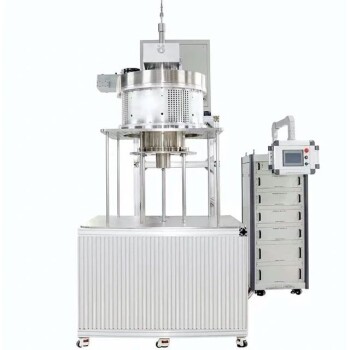
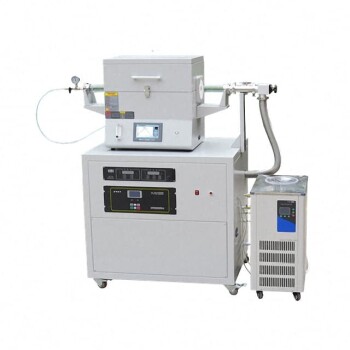
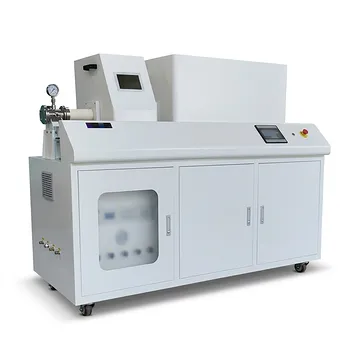
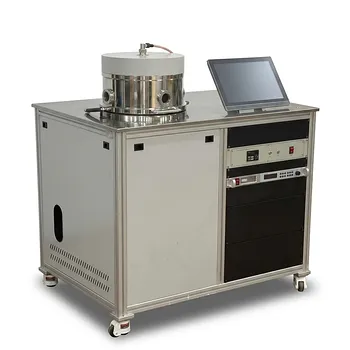
Chemical Vapor Deposition (CVD) is a process used to deposit thin layers of solid material onto a substrate by manipulating chemical reactions in the vapor phase. Instead of simply spraying a coating, CVD introduces a mixture of reacting gases and carrier gases into a chamber, where thermal energy triggers the breakdown or reaction of these vapors to nucleate and form solid particles on the surface.
The Core Mechanism CVD is distinct because it relies on chemical transformation rather than physical deposition. Gaseous precursors are chemically decomposed or reacted to generate solid-state particles, which nucleate and condense to form a uniform, high-quality film on the target material.
The Principles of Deposition
The fundamental goal of CVD is to transform volatile precursors into a solid layer. This requires precise control over gas composition and thermal energy.
The Role of Gas Mixtures
The process begins by supplying a specific gas mixture to the reaction chamber. This mixture consists of a reacting gas composed of volatile compounds (such as SiH4, SiCl4, or WF6) and a carrier gas (typically H2 or Ar).
The carrier gas acts as a transport medium. It ensures the reacting gas is delivered smoothly and evenly to the deposition zone.
Thermal Breakdown and Reaction
Once inside the apparatus, the vapor from the precursor undergoes a critical transformation. The precursor is either thermally broken down (decomposition) or reacts with another precursor vapor.
This reaction is chemically driven. It typically occurs when the gas comes into contact with the heated substrate or a specific reaction zone.
Particle Formation
The chemical reaction leads to a sequence of physical changes: nucleation, condensation, and coagulation.
During nucleation, the initial clusters of atoms form. These clusters condense and coagulate, generating solid-state particles that accumulate to form the final coating layer.
The Operational Sequence
While the chemistry is complex, the physical operation of a CVD system generally follows a defined timeline.
Vaporization and Transport
The material intended for coating is first placed inside a vacuum chamber. If the coating material is not already gaseous, it is vaporized by heating or pressure reduction.
The gas mixture, containing the reactants and diluents, is then transported toward the substrate surface.
Adsorption and Film Growth
As the gas species reach the substrate, they are adsorbed onto the surface. Here, the reactants undergo the necessary chemical reactions (heterogeneous surface-catalyzed reactions) to form the solid film.
To ensure uniform growth, the species diffuse across the surface to find optimal growth sites before nucleating.
Desorption and Evacuation
The chemical reactions that form the solid film also produce gaseous byproducts. These byproducts must be desorbed (released) from the surface.
Finally, these waste gases are evacuated from the reaction chamber to prevent contamination of the new layer.
Understanding the Trade-offs
CVD is a powerful tool for creating high-quality materials, but it presents specific engineering challenges that must be managed.
Thermal Requirements
CVD often requires high temperatures to initiate the necessary chemical decomposition. Substrates must sometimes be heated to extreme levels (e.g., 1000–1100 ˚C) to prepare surface chemistry and ensure proper adhesion.
This limits the types of substrates you can use. Materials that cannot withstand high thermal stress may degrade during the process.
Process Complexity and Control
The process relies on a delicate balance of gas flow, pressure, and temperature. The thickness of the coating is strictly controlled by adjusting these variables and the duration of the exposure.
Failure to purge residual gases or control the cooling phase (which can take 20–30 minutes) can lead to impurities or structural defects in the film.
Making the Right Choice for Your Goal
When evaluating CVD for your application, consider your specific material requirements.
- If your primary focus is coating uniformity: Rely on CVD for its ability to diffuse reactants across complex geometries, ensuring even coverage through surface adsorption.
- If your primary focus is material purity: Ensure your substrate can withstand the high thermal dehydration and etch passivation steps required to remove oxygen impurities.
- If your primary focus is film composition: Select precursors like SiH4 or WF6 carefully, as the volatility of the compound dictates the efficiency of the thermal breakdown.
Success in Chemical Vapor Deposition depends on strictly controlling the thermal environment to turn volatile gases into precise solid structures.
Summary Table:
| CVD Stage | Key Mechanism | Process Detail |
|---|---|---|
| Transport | Gas Mixing | Reactant and carrier gases (H2/Ar) are delivered to the chamber. |
| Reaction | Thermal Breakdown | Precursors decompose or react via high thermal energy (up to 1100°C). |
| Deposition | Nucleation & Growth | Solid particles form, condense, and coagulate into a uniform film layer. |
| Evacuation | Desorption | Gaseous byproducts are released and removed via vacuum systems. |
Elevate Your Material Research with KINTEK
Precision is the heart of every successful Chemical Vapor Deposition process. At KINTEK, we specialize in providing high-performance laboratory equipment tailored for advanced material science. Whether you need specialized CVD and PECVD systems, high-temperature furnaces, or vacuum chambers, our solutions ensure the strict thermal and pressure control required for superior thin-film quality.
From high-purity ceramics and crucibles to integrated cooling solutions, our comprehensive portfolio supports research institutions and industrial labs in achieving flawless deposition and coating uniformity. Empower your innovation today—contact our experts to find the right equipment for your lab!
Related Products
- Chemical Vapor Deposition CVD Equipment System Chamber Slide PECVD Tube Furnace with Liquid Gasifier PECVD Machine
- Microwave Plasma Chemical Vapor Deposition MPCVD Machine System Reactor for Lab and Diamond Growth
- 915MHz MPCVD Diamond Machine Microwave Plasma Chemical Vapor Deposition System Reactor
- Customer Made Versatile CVD Tube Furnace Chemical Vapor Deposition Chamber System Equipment
- HFCVD Machine System Equipment for Drawing Die Nano-Diamond Coating
People Also Ask
- What are the advantages of chemical vapor deposition? Achieve Superior Thin Films for Your Lab
- What types of substrates are used in CVD to facilitate graphene films? Optimize Graphene Growth with the Right Catalyst
- What is the chemical vapor deposition growth process? Build Superior Thin Films from the Atom Up
- How expensive is chemical vapor deposition? Understanding the True Cost of High-Performance Coating
- Why is Chemical Vapor Deposition (CVD) equipment uniquely suited for constructing hierarchical superhydrophobic structures?