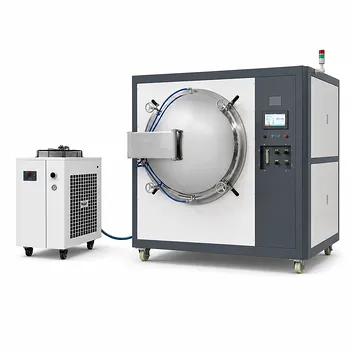
Integrated temperature and pressure forming creates a synergistic environment that is essential for processing reactive materials like titanium.
In a vacuum hot pressing furnace, this capability facilitates a dual-stage process: a warm pressing phase (typically around 400°C and 10 MPa) to expel internal gases and densify loose powder, followed by a high-temperature phase (1100°C–1300°C at 30 MPa). This second stage simultaneously synthesizes reinforcing agents (such as graphene) and sinters the titanium powder to full density, allowing chemical reaction and material shaping to occur in a single, streamlined operation.
Core Takeaway The coupling of heat and mechanical force drives plastic flow and atomic diffusion more effectively than heat alone, allowing titanium composites to reach near-full density at lower temperatures. This integrated approach controls the growth of brittle interface layers while a high-vacuum environment prevents the oxidation of the highly reactive titanium matrix.
The Mechanics of the Dual-Stage Process
The primary advantage of this technology is the ability to execute distinct processing steps without removing the material from the vacuum environment.
Stage 1: Degassing and Pre-Compaction
The initial phase involves "warm pressing," typically at moderate temperatures like 400°C with lower pressure (e.g., 10 MPa).
This stage is critical for mechanical stability. It densifies the loose powder enough to ensure structural integrity while actively expelling volatile internal gases before the material is sealed off by full densification.
Stage 2: In-Situ Synthesis and Sintering
The furnace then ramps up to high temperatures (between 1100°C and 1300°C) while increasing pressure to 30 MPa.
During this phase, the furnace facilitates in situ synthesis, creating reinforcing materials (like graphene) chemically within the matrix rather than just mixing them in. Simultaneously, the high pressure eliminates remaining voids, achieving full density.
Why Integrated Processing is Critical for Titanium
Titanium is notoriously difficult to process due to its high chemical reactivity and melting point. Integrated forming solves several fundamental challenges.
Oxidation Prevention
Titanium reacts aggressively with oxygen at high temperatures, which compromises its strength.
The vacuum hot pressing furnace maintains a high-vacuum environment (typically 10^-3 Pa or lower). This prevents the titanium matrix from oxidizing during the critical heating stages, ensuring the final composite retains its metallic properties.
Accelerated Densification via Plastic Flow
Applying pressure while the metal is softened by heat induces plastic flow.
The external force (e.g., 30 MPa) physically forces softened metal particles to fill voids between ceramic particles or fiber reinforcements. This mechanical assist allows the material to reach over 99% relative density without requiring the extreme temperatures of pressureless sintering.
Lower Thermal Requirements
Because mechanical pressure aids densification, the process can occur at lower overall temperatures.
This is vital for preserving the microstructure. Lower processing temperatures prevent the grain coarsening that often occurs in traditional sintering, leading to finer microstructures and superior mechanical performance.
Controlling the Interface
In composite materials, the "interface"—where the matrix meets the reinforcement—is the weak link. The precision of the vacuum hot press is the key to managing it.
Regulating Reaction Layer Thickness
High temperatures cause the titanium to react with carbon-based reinforcements, forming brittle Titanium Carbide (TiC).
Precise temperature control allows you to limit this reaction. By holding a stable temperature, the thickness of the brittle interface layer can be kept below critical thresholds (e.g., 2 micrometers), ensuring a strong bond without embrittling the composite.
Balancing Diffusion and Integrity
The process relies on the coupling effect of heat and force to promote solid-phase diffusion.
This diffusion creates a metallurgical bond between the titanium and its reinforcement. However, strict control is required; excessive heat can lead to localized liquefaction or excessive reactions that degrade the material properties.
Understanding the Trade-offs
While integrated vacuum hot pressing is powerful, it is not without limitations.
Geometric Constraints
The pressure in these furnaces is typically uniaxial (applied in one direction).
This limits the complexity of the shapes you can produce. The process is best suited for simple geometries like plates, discs, or cylinders. Complex parts often require secondary machining.
Throughput vs. Precision
This is a batch process that prioritizes quality over speed.
The need for precise heating rates, hold times for diffusion, and controlled cooling to manage microstructure development means cycle times can be long compared to continuous processing methods.
Making the Right Choice for Your Goal
The settings you choose for your vacuum hot press should be dictated by the specific failure modes you are trying to avoid.
- If your primary focus is maximum density: Prioritize the pressure application magnitude (e.g., 30 MPa) during the peak softening phase to forcibly eliminate residual pores and facilitate plastic flow.
- If your primary focus is ductility and impact resistance: Prioritize temperature precision to strictly limit the growth of brittle reaction layers (like TiC) to under 2 micrometers.
- If your primary focus is material purity: Ensure your vacuum levels remain better than 10^-3 Pa throughout the heating ramp to prevent oxidation of the active titanium powder.
By synchronizing thermal fields with mechanical force, you transform the sintering process from a passive heating cycle into an active, controlled manufacturing event.
Summary Table:
| Feature | Warm Pressing Phase | High-Temp Sintering Phase |
|---|---|---|
| Temperature | ~400°C | 1100°C – 1300°C |
| Pressure | ~10 MPa | ~30 MPa |
| Primary Goal | Degassing & Pre-compaction | In-situ Synthesis & Densification |
| Atmosphere | High Vacuum (10⁻³ Pa) | High Vacuum (10⁻³ Pa) |
| Outcome | Structural Integrity | >99% Relative Density |
Elevate Your Material Research with KINTEK
Precision is non-negotiable when processing reactive materials like titanium. KINTEK specializes in advanced laboratory equipment, offering high-performance vacuum hot pressing furnaces and high-temperature furnaces designed to deliver the exact coupling of heat and mechanical force your research requires.
Whether you are developing titanium matrix composites, exploring high-pressure reactors, or utilizing crushing and milling systems, our comprehensive portfolio—from hydraulic presses to PTFE consumables—is engineered for excellence.
Ready to achieve superior material density and purity? Contact our technical experts today to find the perfect solution for your lab.
Related Products
- 600T Vacuum Induction Hot Press Furnace for Heat Treat and Sintering
- Vacuum Hot Press Furnace Heated Vacuum Press Machine Tube Furnace
- Vacuum Hot Press Furnace Machine for Lamination and Heating
- Vacuum Hot Press Furnace Machine Heated Vacuum Press
- Vacuum Heat Treat and Pressure Sintering Furnace for High Temperature Applications
People Also Ask
- What role does an induction vacuum hot pressing furnace play in sintering? Achieve 98% Density in Carbide Blocks
- What advantages does a vacuum hot press furnace provide for LSLBO ceramic electrolytes? Achieve 94% Relative Density
- What role does a Vacuum Hot Press (VHP) furnace play in the densification of austenitic stainless steel 316 composites?
- What role does mechanical pressure play during the vacuum diffusion bonding of tungsten and copper? Keys to Solid Bonding
- What are the advantages of a vacuum hot press furnace for W-50%Cu? Achieve 99.6% Density at Lower Temperatures