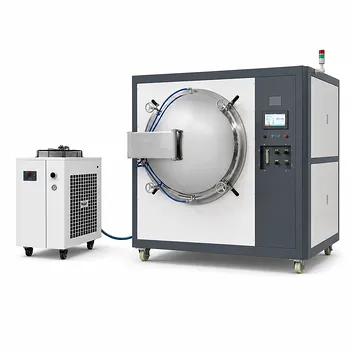
The pressure applied by a vacuum hot-pressing furnace is the critical catalyst for converting physical contact into a high-strength metallurgical bond. By exerting a continuous axial load, typically 20 MPa, the furnace physically forces the Cu-2Ni-7Sn alloy and the 45 steel substrate together. This mechanical force overcomes microscopic surface roughness, accelerating plastic deformation and eliminating voids to ensure the interface is strong and continuous.
The applied pressure functions as a bridge for atomic diffusion; by closing microscopic pores and creating atomic-level contact, it significantly shortens the distance atoms must travel to bond, directly enhancing the shear strength of the composite.
Overcoming Physical Barriers at the Interface
Eliminating Surface Irregularities
Even carefully prepared metal surfaces possess microscopic hills and valleys. Without sufficient pressure, these irregularities create gaps that prevent true bonding between the Cu-2Ni-7Sn alloy and the 45 steel. The axial pressure flattens these asperities, mechanically interlocking the two materials.
Forcing Atomic-Level Contact
For a metallurgical bond to form, atoms from the copper alloy and the steel must be in close proximity. The 20 MPa pressure overcomes the resistance of the solid materials, bringing the surfaces within the atomic distances required for chemical interaction.
Mechanisms of Bond Strengthening
Accelerating Plastic Deformation
Under the combination of high heat (800-850°C) and 20 MPa pressure, the materials—particularly the softer copper alloy—undergo plastic deformation. This flow of material fills the interstitial spaces at the interface, effectively sealing the joint.
Shortening Diffusion Distances
Atomic diffusion is the movement of atoms from one material into the other, which creates the bond. By eliminating physical gaps, the applied pressure drastically shortens the distance atoms must migrate. This facilitates faster and more complete diffusion across the interface.
Closure of Pores
Pores and voids at the interface act as stress concentrators and fracture points. The continuous pressure promotes the closure of these pores, densifying the composite and removing the defects that would otherwise compromise mechanical integrity.
Understanding the Trade-offs and Control
The Necessity of Uniformity
While high pressure is beneficial, it must be applied uniformly. A precise control system is essential to ensure the 20 MPa load is distributed evenly across the interface to prevent localized weak spots.
Synergistic Role of Vacuum
Pressure alone is not enough; it must work in tandem with the vacuum environment. The vacuum prevents oxidation at high temperatures, ensuring that the pressure is pressing clean metal against clean metal, rather than compressing oxide layers that inhibit diffusion.
Making the Right Choice for Your Goal
To maximize the performance of your Cu-2Ni-7Sn/45 steel composites, consider the following focus areas:
- If your primary focus is Maximum Shear Strength: Ensure the axial pressure is maintained strictly at 20 MPa to maximize plastic deformation and atomic contact without damaging the substrate.
- If your primary focus is Defect Elimination: Prioritize the synchronization of pressure application with the vacuum cycle to ensure pores are closed before oxidation can occur.
The precise application of pressure is the difference between a superficial mechanical adhesion and a durable, integrated metallurgical bond.
Summary Table:
| Mechanism | Impact on Interface | Benefit for Composite |
|---|---|---|
| Surface Flattening | Eliminates microscopic hills and valleys | Mechanical interlocking of surfaces |
| Plastic Deformation | Fills interstitial spaces at 800-850°C | Seamless, continuous joint formation |
| Pore Closure | Removes internal voids and defects | Higher densification and shear strength |
| Atomic Contact | Forces surfaces to atomic distances | Rapid diffusion and metallurgical bonding |
Elevate Your Material Bonding with KINTEK Precision
Unlock the full potential of your research with KINTEK’s industry-leading vacuum hot-pressing furnaces and isostatic presses. Our systems provide the precise, uniform pressure control and high-vacuum environments essential for transforming Cu-2Ni-7Sn/45 steel composites into high-performance materials.
Whether you are focusing on high-temperature metallurgical bonding, crushing and milling, or advanced battery research, KINTEK offers a comprehensive range of laboratory equipment including muffle, rotary, and CVD furnaces, high-pressure reactors, and precision hydraulic presses.
Ready to eliminate interface defects and maximize shear strength? Contact KINTEK today to consult with our experts on the perfect solution for your lab’s thermal processing needs.
Related Products
- Vacuum Hot Press Furnace Heated Vacuum Press Machine Tube Furnace
- 600T Vacuum Induction Hot Press Furnace for Heat Treat and Sintering
- Vacuum Hot Press Furnace Machine Heated Vacuum Press
- Vacuum Hot Press Furnace Machine for Lamination and Heating
- Vacuum Heat Treat and Pressure Sintering Furnace for High Temperature Applications
People Also Ask
- What advantages does a vacuum hot press furnace provide for LSLBO ceramic electrolytes? Achieve 94% Relative Density
- What role does a Vacuum Hot Press (VHP) furnace play in the densification of austenitic stainless steel 316 composites?
- What are the advantages of using a vacuum hot pressing furnace? Superior Densification for 2024Al/Gr/SiC Composites
- What are the advantages of a vacuum hot press furnace for LTPO solid electrolytes? Boost Density and Conductivity
- What core processing conditions does a vacuum hot press furnace provide? Achieve High-Density Cu-SiC/Diamond Composites