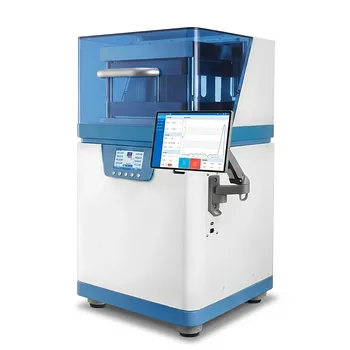
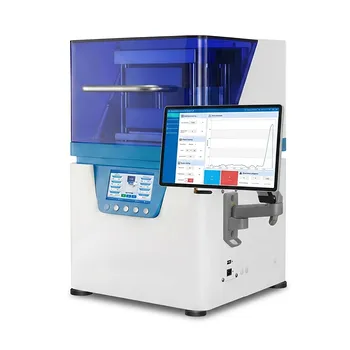
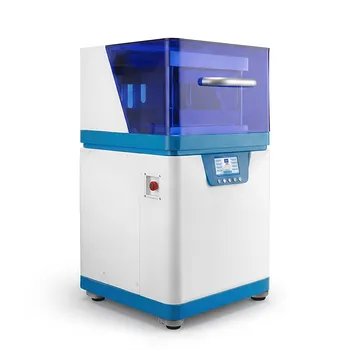
The precision of a laboratory hydraulic press is the foundation of high-quality thin-film electrode growth. By applying uniform, adjustable pressure—either uniaxial or isostatic—the press ensures that electrolyte powders like yttria-stabilized zirconia (YSZ) reach a consistent density distribution. This uniformity prevents surface defects during the sintering process, creating a flat, stable platform that allows pulsed laser deposition (PLD) or sputtering to form a continuous, well-adhered thin film.
High-precision pressing creates a dense, defect-free substrate that is essential for uniform thin-film adhesion and consistent electrochemical responses. Without this controlled densification, surface roughness and internal pores lead to film peeling and degraded ion transport.
Achieving Uniform Substrate Density
The primary role of a hydraulic press is to transform loose powder into a cohesive "green body" with optimal packing density. This stage is critical because any inconsistency in the initial mold will be magnified during high-temperature sintering.
Eliminating Internal Pore Defects
Controlled vertical or isostatic pressure forces powder particles into an optimal packing arrangement, significantly reducing internal pore defects. This is vital for preventing micro-crack propagation and, in solid-state batteries, stopping the deposition of metallic lithium filaments that can cause short circuits.
Ensuring Consistent Mechanical Integrity
A high-precision press provides the mechanical strength necessary for the substrate to withstand the stresses of subsequent processing. By ensuring the powder particles are firmly compressed, the resulting substrate maintains its structural integrity during the high-vacuum and high-temperature environments of thin-film growth.
Creating a High-Quality Interface for Thin Films
The quality of a thin-film electrode is directly proportional to the quality of the substrate surface it is grown upon. A hydraulic press ensures this surface meets the rigorous requirements of advanced deposition techniques.
Surface Flatness and Adhesion
High-precision pressing results in a flat and defect-free support interface once the substrate is sintered. This flatness is essential for techniques like PLD or sputtering, as it prevents film peeling and ensures the thin-film electrode adheres uniformly across the entire surface.
Preventing Non-Uniform Electrochemical Responses
If a substrate surface is rough or inconsistent, the resulting thin film will exhibit localized variations in thickness and morphology. By providing a uniform substrate, the hydraulic press ensures a consistent electrochemical response across the entire electrode, which is critical for accurate testing and device performance.
Optimizing Ion Transport Channels
Proper densification via a hydraulic press establishes effective ion transport channels by reducing grain boundary resistance. This ensures that once the thin-film electrode is grown, the interface between the electrode and the electrolyte allows for efficient charge carrier movement.
Understanding the Trade-offs and Pitfalls
While high pressure is necessary for densification, it must be applied with extreme precision to avoid compromising the substrate.
The Risk of Over-Pressurization
Applying excessive pressure can lead to internal stresses within the green body, which may cause the substrate to crack or warp during the sintering process. It can also lead to "lamination" defects, where the material begins to split into layers upon release from the mold.
Pressure Inhomogeneity in Manual Systems
Using a manual press without precise gauge control can lead to inconsistent density between different samples. This variability makes it difficult to replicate experimental results, as the thin-film growth will react differently to each unique substrate morphology.
How to Apply This to Your Project
To ensure your substrate preparation supports high-quality thin-film growth, consider your specific material requirements and research goals.
- If your primary focus is maximizing ion conductivity: Use high-precision pressure (e.g., 380 MPa) to eliminate pores and reduce grain boundary resistance within the electrolyte.
- If your primary focus is thin-film adhesion and longevity: Prioritize a press that offers ultra-smooth mold surfaces and uniform pressure distribution to create a defect-free growth interface.
- If your primary focus is research reproducibility: Utilize an automated hydraulic press with digital pressure control to ensure every substrate has an identical density profile.
By mastering the densification of the substrate, you ensure the integrity and performance of the subsequent thin-film electrode.
Summary Table:
| Feature | Impact on Substrate | Benefit for Thin-Film Growth |
|---|---|---|
| Uniform Pressure | Consistent density distribution | Prevents film peeling and cracking |
| Pore Elimination | Reduced internal defects | Optimized ion transport channels |
| Surface Flatness | High-quality interface | Ensures uniform adhesion and morphology |
| Mechanical Strength | Structural integrity | Withstands vacuum and high-temp growth |
| Digital Control | Sample reproducibility | Consistent electrochemical responses |
Elevate Your Material Research with KINTEK Precision
Achieving a defect-free substrate is the first step toward high-performance thin-film electrodes. KINTEK specializes in advanced laboratory equipment, offering high-precision hydraulic presses (pellet, hot, isostatic), crushing and milling systems, and high-temperature furnaces designed for the rigorous demands of solid-state battery and material science research.
Whether you need to optimize ion conductivity or ensure consistent experimental reproducibility, our team provides the tools and technical expertise to enhance your lab's productivity. Contact KINTEK today to find the perfect pressing solution for your project and secure the foundation of your thin-film growth.
References
- Martin Krammer, Jürgen Fleig. Closed-Pore Formation in Oxygen Electrodes for Solid Oxide Electrolysis Cells Investigated by Impedance Spectroscopy. DOI: 10.1021/acsami.2c20731
This article is also based on technical information from Kintek Solution Knowledge Base .
Related Products
- Automatic Laboratory Hot Press 400x400 mm with Programmable High Temperature and Hydraulic Force Control
- Automatic High Temperature Heated Hydraulic Press Machine with Heated Plates for Lab
- Manual High Temperature Heated Hydraulic Press Machine with Heated Plates for Lab
- Fully Automatic Heated Hydraulic Lab Press for Materials Sintering and Sample Preparation
- Automatic Laboratory Hydraulic Press for XRF & KBR Pellet Press
People Also Ask
- What is the primary function of a laboratory hot press in MEA assembly? Optimize Fuel Cell Bonding & Performance
- What specific conditions does a laboratory hot press provide for the assembly of fuel cell MEA? Expert Bond Tips.
- How do a laboratory hydraulic hot press and standardized steel molds ensure the quality of WPC test specimens?
- What are the core advantages of using a laboratory hot press to produce Bi2Se3? Achieve 93% Density & High Conductivity
- How does a laboratory heating hydraulic press contribute to the preparation of recycled graphite green bodies? - Optimize Density.