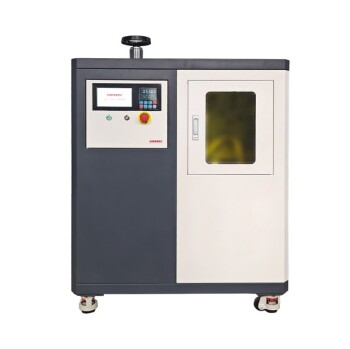
The laboratory hot press acts as the critical mechanism for densifying Thallium Bromide (TlBr) and aligning its internal structure. By applying a continuous mechanical pressure of approximately 30 kN within a precise temperature window of 455-465°C, the equipment creates a synergistic environment that fully compacts purified raw material. This thermo-mechanical treatment is essential for eliminating physical defects and ensuring the material performs effectively as a semiconductor radiation detector.
Core Takeaway The hot press functions not merely as a molding tool, but as a method of structural perfection. By coupling high heat with high pressure, it eliminates internal microscopic pores and enforces uniform crystal orientation, transforming raw TlBr into a high-density, detector-grade material capable of precise gamma-ray photon counting.
The Mechanism of Thermo-Mechanical Coupling
Achieving High-Density Consolidation
The primary function of the hot press is to achieve full compaction of the purified TlBr material. By maintaining a constant pressure of 30 kN, the machine forces the material to consolidate within a mold.
This pressure, applied continuously over a specific duration (typically around 2 hours), eliminates internal microscopic pore defects. The result is a dense, solid blank that possesses the necessary geometric accuracy for detector fabrication.
Guiding Crystal Orientation
Beyond simple compression, the hot press actively influences the crystallographic structure. The combination of thermal energy and mechanical stress helps guide crystal orientation.
This controlled stress field improves the consistency of the crystal lattice. Uniform orientation is a prerequisite for reliable electronic transport properties within the semiconductor.
Impact on Detector Performance
Enhancing Detection Efficiency
The quality of the physical structure directly dictates the device's ability to sense radiation. A fully densified crystal with uniform orientation exhibits superior detection efficiency.
This is particularly vital for photon-counting detectors. The elimination of voids and structural inconsistencies ensures that the material has high gamma-ray attenuation coefficients, allowing it to capture and register photons effectively.
Improving Energy Resolution
The hot pressing process significantly reduces residual stresses and suppresses defect formation compared to some traditional growth methods.
Fewer internal defects lead to better charge collection properties. Consequently, the final detector achieves higher energy resolution, meaning it can more accurately distinguish between different energy levels of incoming radiation.
Understanding the Trade-offs
The Necessity of Precision Control
The benefits of hot pressing are entirely dependent on staying within the narrow processing window. The temperature must be strictly maintained between 455°C and 465°C.
If the temperature deviates or the pressure of 30 kN fluctuates, the synergy breaks down. Inaccurate control can lead to incomplete densification or the introduction of new thermal stresses, rendering the crystal unsuitable for high-performance spectrometry.
Throughput vs. Quality
Hot pressing is a time-intensive batch process, often requiring hours for a single pressing cycle to ensure the material creates a "stress-free" solid.
While this ensures distinct geometric dimensional accuracy (such as 2 mm x 2 mm x 2.5 mm samples), it limits production speed compared to rapid, lower-quality molding techniques. You are trading volume for the high fidelity required by scientific instrumentation.
Making the Right Choice for Your Goal
To maximize the potential of your TlBr detectors, you must align your processing parameters with your specific performance targets.
- If your primary focus is Detection Efficiency: Prioritize maintaining the full 30 kN pressure to ensure maximum densification and high gamma-ray attenuation.
- If your primary focus is Energy Resolution: Focus on the precise stability of the thermal environment (455-465°C) to minimize residual stress and internal lattice defects.
Ultimately, the laboratory hot press is the bridge between raw chemical purity and functional electronic utility, ensuring your material is physically robust enough to deliver precise spectroscopic data.
Summary Table:
| Parameter | Processing Value | Impact on TlBr Crystal Quality |
|---|---|---|
| Applied Pressure | 30 kN | Eliminates microscopic pores; ensures full compaction |
| Temperature Range | 455 - 465°C | Facilitates thermo-mechanical coupling; guides orientation |
| Cycle Duration | ~2 Hours | Ensures stress-free solidification and geometric accuracy |
| Key Outcome | High Density | Maximizes detection efficiency and energy resolution |
Elevate Your Semiconductor Research with KINTEK Precision
Precision is non-negotiable when producing high-performance materials like TlBr. KINTEK specializes in advanced laboratory equipment designed to meet the rigorous demands of material science. Our high-performance hydraulic presses (pellet, hot, isostatic) provide the stable pressure and thermal control necessary to eliminate defects and ensure superior crystal orientation.
From high-temperature furnaces and crushing systems to high-pressure reactors and specialized consumables (PTFE, ceramics, crucibles), KINTEK offers a comprehensive ecosystem for laboratory excellence.
Ready to achieve high-density, detector-grade results? Contact KINTEK today to discuss how our solutions can optimize your production workflow.
References
- Miloš Janeček, Tomáš Chráska. Microstructure and mechanical properties of biomedical alloys spark plasma sintered from elemental powders. DOI: 10.21175/rad.abstr.book.2023.19.8
This article is also based on technical information from Kintek Solution Knowledge Base .
Related Products
- Double Plate Heating Press Mold for Lab
- Manual Lab Heat Press
- Automatic Laboratory Heat Press Machine
- 24T 30T 60T Heated Hydraulic Press Machine with Heated Plates for Laboratory Hot Press
- Automatic High Temperature Heated Hydraulic Press Machine with Heated Plates for Lab
People Also Ask
- How to use a press mold? Master the Art of Creating Consistent Ceramic Forms
- What is the process of mold press? A Step-by-Step Guide to Compression Molding
- What is the primary function of mold pressing for LAGP powders? Achieve High-Performance Solid Electrolytes
- Why are pressure molds with non-conductive resin inner walls required for battery testing? Ensure Data Accuracy
- What is the press mould method? A Guide to Consistent, Detailed Ceramic Forms