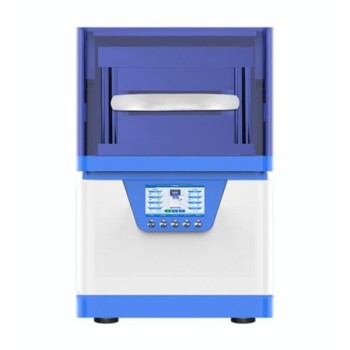
Vacuum hot pressing equipment dramatically improves densification by applying external mechanical force directly to the material during the heating cycle, rather than relying solely on thermal energy. While pressureless sintering depends on passive diffusion mechanisms to close pores, vacuum hot pressing actively forces metal and ceramic particles together, promoting plastic slip and physical rearrangement. This mechanical intervention allows complex composites to achieve relative densities exceeding 90%—levels often impossible to reach through standard sintering methods.
Core Takeaway The addition of mechanical pressure converts sintering from a passive thermal process into an active, force-assisted operation. By physically compressing particles while they are in a thermally softened state, vacuum hot pressing closes internal voids and fills pores that heat alone cannot eliminate.
The Mechanics of Force-Assisted Densification
Driving Particle Rearrangement
In pressureless sintering, particles bond slowly as temperature increases. Vacuum hot pressing accelerates this by applying axial mechanical pressure.
This pressure forces immediate particle rearrangement. It mechanically pushes powder particles into closer proximity before diffusion bonding even begins.
Inducing Plastic Flow
The combination of high temperature and pressure creates a unique environment for the material. As the heat puts the powder particles into a "plastic state," the external force exerts a squeezing effect.
This causes the material to flow like a viscous fluid. The softened metal and ceramic particles are forced into internal pores, effectively eliminating voids that would otherwise remain as defects.
Promoting Surface Diffusion
The primary reference highlights that pressure facilitates specific micro-mechanisms: particle surface diffusion and plastic slip.
By forcing surfaces into intimate contact, the equipment reduces the distance atoms must diffuse. This triggers "activated sintering," significantly reducing the time required for phase changes and alloy formation.
Advantages Over Pressureless Methods
Breaking Surface Oxides
A critical barrier in sintering metal composites is the oxide film found on powder surfaces.
Vacuum hot pressing creates a "highly unbalanced process" where the continuous pressure helps rupture these oxide films. Once broken, the oxides can be reduced (often by carbon present in the matrix), clearing the way for cleaner metal-to-metal bonding.
Lower Temperatures and Shorter Times
Because mechanical force does much of the work in closing pores, the thermal requirements change.
You can often achieve higher densities at significantly lower temperatures compared to pressureless sintering. Furthermore, the holding times—the duration the material sits at peak heat—are notably shortened.
Inhibiting Grain Growth
Prolonged exposure to high heat typically causes grains to grow excessively, which weakens the material.
By reducing the required sintering temperature and shortening the cycle time, vacuum hot pressing inhibits this excessive grain growth. This results in a fine-grained microstructure that offers superior mechanical properties.
Understanding the Process Dynamics
Unbalanced Sintering
It is important to recognize that hot pressing is not a static thermal soak. It is a dynamic, unbalanced process driven by continuous force.
The shrinkage behavior of hot-pressed products differs fundamentally from normal sintering. The pressure dictates the direction of densification, often leading to anisotropic (direction-dependent) shrinkage profiles.
The Role of Material Defects
Interestingly, the process leverages imperfections. Powders with crystal defects often achieve greater alloy density.
The presence of these defects activates the hot pressing mechanism, allowing the mechanical force to more effectively compact the structure.
Making the Right Choice for Your Goal
Vacuum hot pressing is not merely a "faster" version of sintering; it is a fundamentally different approach to consolidation.
- If your primary focus is Maximum Density: Choose vacuum hot pressing to achieve relative densities exceeding 90% (and up to 98.5% for specific ceramics) by physically forcing void elimination.
- If your primary focus is Microstructural Control: Utilize this method to lower sintering temperatures and times, thereby preventing excessive grain growth and preserving mechanical strength.
By substituting thermal time for mechanical force, vacuum hot pressing delivers a denser, stronger composite that pressureless methods cannot replicate.
Summary Table:
| Feature | Pressureless Sintering | Vacuum Hot Pressing |
|---|---|---|
| Driving Force | Passive thermal diffusion | Active mechanical pressure + heat |
| Densification Level | Often lower (residual porosity) | High (>90% relative density) |
| Grain Growth | High (due to long heat exposure) | Low (shorter cycles/lower temps) |
| Oxide Film Removal | Limited | High (pressure ruptures oxide layers) |
| Microstructure | Coarser grains | Fine-grained, high-strength |
| Process Type | Balanced thermal soak | Dynamic, unbalanced force-assisted |
Elevate Your Material Performance with KINTEK
Maximize the density and mechanical integrity of your composites with KINTEK’s precision vacuum hot pressing systems. Whether you are working on advanced metal-matrix composites or high-performance ceramics, our equipment provides the controlled force and thermal stability needed to eliminate voids and inhibit grain growth.
Our laboratory solutions include:
- High-Temperature Furnaces: Vacuum, muffle, tube, and atmosphere-controlled options.
- Advanced Pressing: Hydraulic, hot, and isostatic presses for superior compaction.
- Specialized Reactors: High-temperature high-pressure reactors and autoclaves.
- Comprehensive Lab Tools: Crushing systems, cooling solutions (ULT freezers), and essential PTFE/ceramic consumables.
Ready to transform your material research? Contact KINTEK today to discuss how our vacuum hot pressing and sintering solutions can optimize your lab's production efficiency.
Related Products
- Vacuum Hot Press Furnace Machine for Lamination and Heating
- Electric Heated Hydraulic Vacuum Heat Press for Lab
- Vacuum Hot Press Furnace Machine Heated Vacuum Press
- Vacuum Hot Press Furnace Heated Vacuum Press Machine Tube Furnace
- Heated Hydraulic Press Machine with Heated Plates for Vacuum Box Laboratory Hot Press
People Also Ask
- What advantages does a vacuum hot press furnace provide for LSLBO ceramic electrolytes? Achieve 94% Relative Density
- Why is it necessary to maintain a high-vacuum environment within a vacuum hot press furnace? Optimize Cu-SiC Sintering
- What are the advantages of using a vacuum hot press furnace for sintering CNT/Cu composites? Superior Density & Bonding
- What are the advantages of a vacuum hot press furnace for W-50%Cu? Achieve 99.6% Density at Lower Temperatures
- What role does mechanical pressure play during the vacuum diffusion bonding of tungsten and copper? Keys to Solid Bonding