Knowledge Vacuum Furnace How hot does a furnace heat exchanger get? Understand Safe Operating Temperatures to Prevent Hazards
Author avatar

Tech Team · Kintek Solution

Updated 2 months ago

How hot does a furnace heat exchanger get? Understand Safe Operating Temperatures to Prevent Hazards


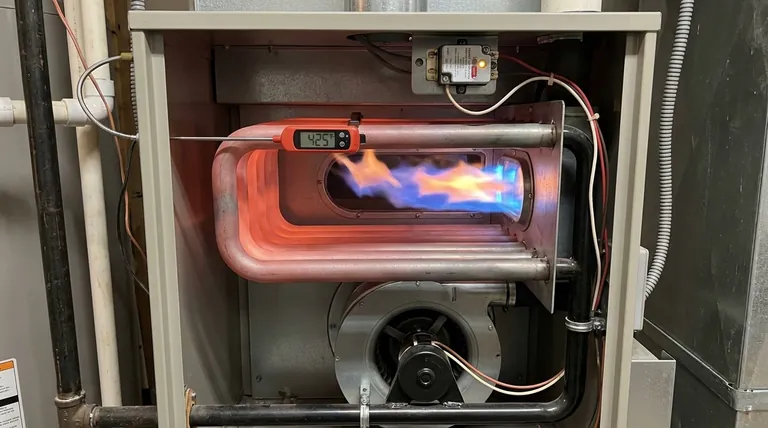
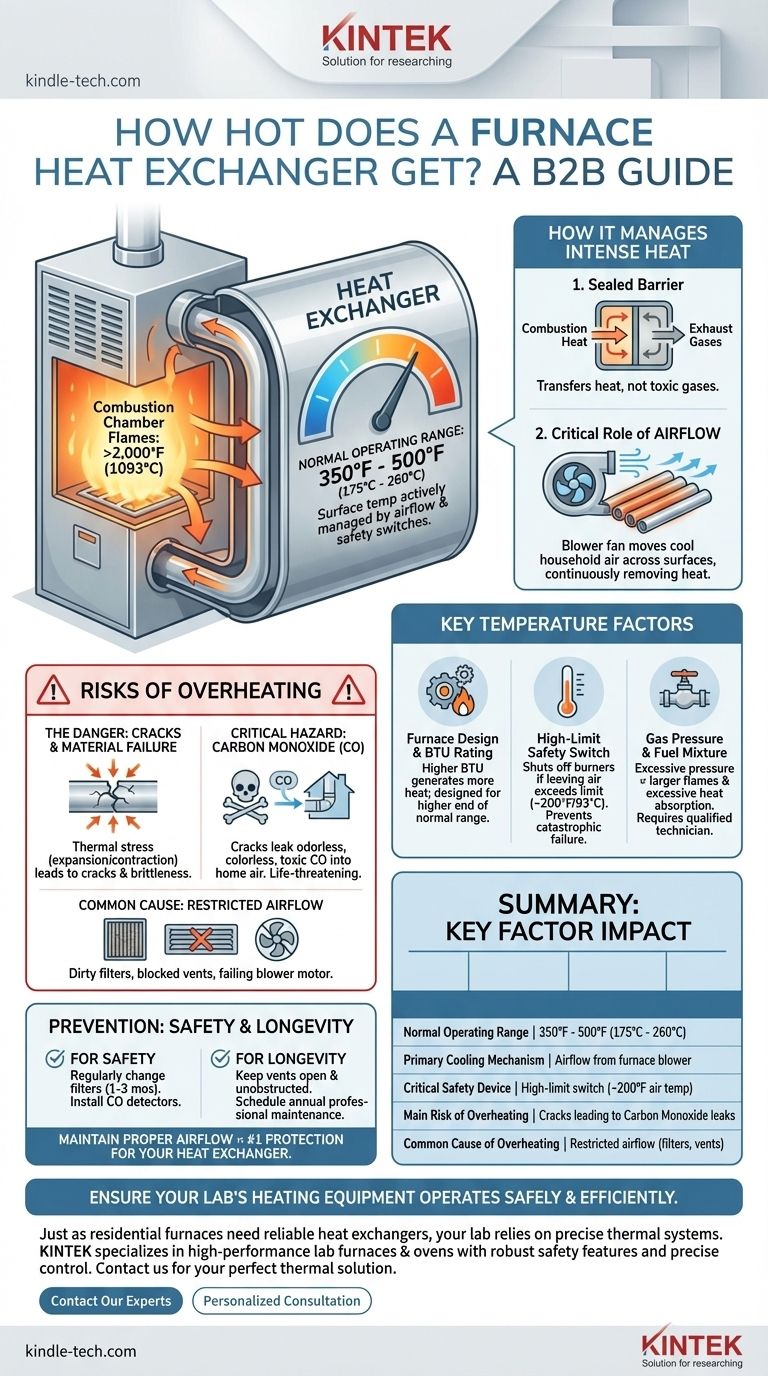
In a standard residential gas furnace, the surface of the heat exchanger typically operates between 350°F and 500°F (175°C to 260°C) during a normal heating cycle. While the burner flames inside can reach over 2,000°F (1093°C), the heat exchanger is specifically designed and cooled by circulating air to remain at these much lower, safer temperatures.

A furnace heat exchanger is engineered to operate well below its material failure point. Its temperature is actively managed by airflow and protected by a high-limit safety switch, as overheating is the primary cause of cracks that can lead to dangerous carbon monoxide leaks.
How hot does a furnace heat exchanger get? Understand Safe Operating Temperatures to Prevent Hazards

How a Heat Exchanger Manages Intense Heat

To understand its operating temperature, you first need to understand the heat exchanger's core function. It acts as a sealed barrier, allowing heat from combustion to be transferred to your home's air without allowing the toxic exhaust gases to mix.

The Combustion Chamber vs. The Exchanger Surface

The flames produced by your furnace's burners are extremely hot, easily exceeding 2,000°F (1093°C). However, this intense heat is contained within the initial section of the heat exchanger.

The heat exchanger itself is a series of metal tubes or chambers designed to have a large surface area. Its job is not to get as hot as the flame, but to efficiently transfer that heat to the air being pushed past it by the furnace blower.

The Critical Role of Airflow

Airflow is the single most important factor in regulating the heat exchanger's temperature. The furnace's blower fan constantly moves cooler household air across the exchanger's outer surfaces.

This process continuously removes heat from the metal, keeping it within its safe operating range. Think of it like running cool water over a hot pan—the water carries the heat away, preventing the pan from getting hotter.

Key Factors That Determine Temperature

The exact temperature of your heat exchanger is not a static number. It's a dynamic variable influenced by the furnace's design, its current operating state, and critical safety mechanisms.

Furnace Design and BTU Rating

A furnace with a higher BTU (British Thermal Unit) rating generates more heat. Its heat exchanger is built to handle this increased thermal load, but it will naturally operate at the higher end of the typical temperature range compared to a lower-BTU unit.

The High-Limit Switch: Your Furnace's Safety Net

Every furnace is equipped with a high-limit switch. This is a safety sensor that measures the temperature of the air leaving the furnace.

If this air temperature exceeds a preset limit, typically around 200°F (93°C), the switch will automatically shut off the burners. This is a direct response to the heat exchanger getting too hot, and it serves to prevent catastrophic failure.

Gas Pressure and Fuel Mixture

The gas valve regulates the flow and pressure of fuel to the burners. If this pressure is set too high, the flames will be larger and hotter than intended, forcing the heat exchanger to absorb an excessive amount of heat. This is why gas pressure should only be adjusted by a qualified technician.

Understanding the Risks of Overheating

A heat exchanger that operates above its designed temperature is a significant safety risk. The primary danger is not fire but the failure of the component itself.

The Danger: Cracks and Material Failure

When metal is repeatedly overheated and cooled, it expands and contracts. This thermal stress can cause the metal to become brittle and eventually develop cracks.

Even a microscopic crack compromises the integrity of the heat exchanger, creating a pathway for dangerous combustion byproducts to enter your home's air supply.

Why a Cracked Heat Exchanger is a Critical Hazard

The most dangerous byproduct of combustion is carbon monoxide (CO), an odorless, colorless, and highly toxic gas.

A cracked heat exchanger can leak CO directly into your ductwork, where it is then distributed throughout your entire home. This is a life-threatening situation that requires immediate attention.

Common Causes of Overheating

The most common cause of an overheating heat exchanger is restricted airflow. This is almost always due to one of three issues:

  1. A severely clogged air filter.
  2. Blocked or closed supply and return air vents.
  3. A failing or malfunctioning blower motor.

Making the Right Choice for Safety and Longevity

Your furnace's heat exchanger is designed to last for many years, but its lifespan is directly tied to proper operation and maintenance. Protecting it from overheating is the best way to ensure both safety and efficiency.

  • If your primary focus is safety: Change your furnace filter regularly (every 1-3 months) and ensure you have working carbon monoxide detectors on every level of your home.
  • If your primary focus is longevity and efficiency: Keep all air vents open and unobstructed, and schedule annual professional maintenance to have a technician clean the system and verify safe operation.

Ultimately, maintaining proper airflow is the single most effective action you can take to protect your heat exchanger and ensure your furnace operates safely.

Summary Table:

Key Factor Impact on Heat Exchanger Temperature
Normal Operating Range 350°F to 500°F (175°C to 260°C)
Primary Cooling Mechanism Airflow from the furnace blower
Critical Safety Device High-limit switch (shuts off burners at ~200°F air temp)
Main Risk of Overheating Cracks leading to carbon monoxide leaks
Common Cause of Overheating Restricted airflow (dirty filter, blocked vents)

Ensure your lab's heating equipment operates safely and efficiently. Just as a residential furnace relies on a properly functioning heat exchanger, your laboratory processes depend on precise and reliable thermal systems. KINTEK specializes in high-performance lab furnaces, ovens, and related equipment designed with robust safety features and precise temperature control. Our products are engineered for longevity and safety, helping you prevent equipment failure and maintain a secure lab environment. Contact our experts today to find the perfect thermal solution for your application. Reach out via our contact form for a personalized consultation.

Visual Guide
How hot does a furnace heat exchanger get? Understand Safe Operating Temperatures to Prevent Hazards Visual Guide

Related Products

People Also Ask

Related Products

Silicon Carbide SiC Thermal Heating Elements for Electric Furnace

Silicon Carbide SiC Thermal Heating Elements for Electric Furnace

Experience the advantages of Silicon Carbide (SiC) Heating Element: Long service life, high corrosion and oxidation resistance, fast heating speed, and easy maintenance. Learn more now!

Vacuum Heat Treat Furnace with Ceramic Fiber Liner

Vacuum Heat Treat Furnace with Ceramic Fiber Liner

Vacuum furnace with polycrystalline ceramic fiber insulation liner for excellent heat insulation and uniform temperature field. Choose from 1200℃ or 1700℃ max. working temperature with high vacuum performance and precise temperature control.

Vacuum Heat Treat and Pressure Sintering Furnace for High Temperature Applications

Vacuum Heat Treat and Pressure Sintering Furnace for High Temperature Applications

Vacuum pressure sintering furnaces are designed for high temperature hot pressing applications in metal and ceramic sintering. Its advanced features ensure precise temperature control, reliable pressure maintenance, and a robust design for seamless operation.

Electric Rotary Kiln Continuous Working Small Rotary Furnace Heating Pyrolysis Plant

Electric Rotary Kiln Continuous Working Small Rotary Furnace Heating Pyrolysis Plant

Efficiently calcine and dry bulk powder and lump fluid materials with an electric heating rotary furnace. Ideal for processing lithium ion battery materials and more.

600T Vacuum Induction Hot Press Furnace for Heat Treat and Sintering

600T Vacuum Induction Hot Press Furnace for Heat Treat and Sintering

Discover the 600T Vacuum Induction Hot Press Furnace, designed for high-temperature sintering experiments in vacuum or protected atmospheres. Its precise temperature and pressure control, adjustable working pressure, and advanced safety features make it ideal for nonmetal materials, carbon composites, ceramics, and metal powders.

Molybdenum Vacuum Heat Treat Furnace

Molybdenum Vacuum Heat Treat Furnace

Discover the benefits of a high-configuration molybdenum vacuum furnace with heat shield insulation. Ideal for high-purity, vacuum environments like sapphire crystal growth and heat treatment.

Multi Heating Zones CVD Tube Furnace Machine Chemical Vapor Deposition Chamber System Equipment

Multi Heating Zones CVD Tube Furnace Machine Chemical Vapor Deposition Chamber System Equipment

KT-CTF14 Multi Heating Zones CVD Furnace - Precise Temperature Control and Gas Flow for Advanced Applications. Max temp up to 1200℃, 4 channels MFC mass flow meter, and 7" TFT touch screen controller.

Rotary Tube Furnace Split Multi Heating Zone Rotating Tube Furnace

Rotary Tube Furnace Split Multi Heating Zone Rotating Tube Furnace

Multi zone rotary furnace for high-precision temperature control with 2-8 independent heating zones. Ideal for lithium ion battery electrode materials and high-temperature reactions. Can work under vacuum and controlled atmosphere.

Laboratory Rapid Thermal Processing (RTP) Quartz Tube Furnace

Laboratory Rapid Thermal Processing (RTP) Quartz Tube Furnace

Get lightning-fast heating with our RTP Rapid Heating Tube Furnace. Designed for precise, high-speed heating and cooling with convenient sliding rail and TFT touch screen controller. Order now for ideal thermal processing!

Electric Rotary Kiln Small Rotary Furnace Biomass Pyrolysis Plant

Electric Rotary Kiln Small Rotary Furnace Biomass Pyrolysis Plant

Learn about Rotary Biomass Pyrolysis Furnaces & how they decompose organic material at high temps without oxygen. Use for biofuels, waste processing, chemicals & more.

Controlled Nitrogen Inert Hydrogen Atmosphere Furnace

Controlled Nitrogen Inert Hydrogen Atmosphere Furnace

KT-AH Hydrogen atmosphere furnace - induction gas furnace for sintering/annealing with built-in safety features, dual housing design, and energy-saving efficiency. Ideal for lab and industrial use.

100L Heating Chilling Circulator Cooling Water Bath Circulator for High and Low Temperature Constant Temperature Reaction

100L Heating Chilling Circulator Cooling Water Bath Circulator for High and Low Temperature Constant Temperature Reaction

Get all-in-one heating, chilling, and circulating capabilities with our KinTek KCBH 80L Heating Chilling Circulator. High efficiency, reliable performance for labs and industrial applications.

5L Heating Chilling Circulator Cooling Water Bath Circulator for High and Low Temperature Constant Temperature Reaction

5L Heating Chilling Circulator Cooling Water Bath Circulator for High and Low Temperature Constant Temperature Reaction

KinTek KCBH 5L Heating Chilling Circulator - Ideal for labs and industrial conditions with multi-functional design and reliable performance.

High Temperature Constant Temperature Heating Circulator Water Bath Chiller Circulator for Reaction Bath

High Temperature Constant Temperature Heating Circulator Water Bath Chiller Circulator for Reaction Bath

Efficient and reliable, KinTek KHB Heating Circulator is perfect for your lab needs. With a max. heating temperature of up to 300℃, it features accurate temperature control and fast heating.

20L Heating Chilling Circulator Cooling Water Bath Circulator for High and Low Temperature Constant Temperature Reaction

20L Heating Chilling Circulator Cooling Water Bath Circulator for High and Low Temperature Constant Temperature Reaction

Maximize lab productivity with KinTek KCBH 20L Heating Chilling Circulator. Its all-in-one design offers reliable heating, chilling, and circulating functions for industrial and lab use.

30L Heating Chilling Circulator Cooling Water Bath Circulator for High and Low Temperature Constant Temperature Reaction

30L Heating Chilling Circulator Cooling Water Bath Circulator for High and Low Temperature Constant Temperature Reaction

Get versatile lab performance with KinTek KCBH 30L Heating Chilling Circulator. With max. heating temp of 200℃ and max. chilling temp of -80℃, it's perfect for industrial needs.

50L Heating Chilling Circulator Cooling Water Bath Circulator for High and Low Temperature Constant Temperature Reaction

50L Heating Chilling Circulator Cooling Water Bath Circulator for High and Low Temperature Constant Temperature Reaction

Experience versatile heating, chilling, and circulating capabilities with our KinTek KCBH 50L Heating Chilling Circulator. Ideal for labs and industrial settings, with efficient and reliable performance.

Graphite Vacuum Furnace Bottom Discharge Graphitization Furnace for Carbon Materials

Graphite Vacuum Furnace Bottom Discharge Graphitization Furnace for Carbon Materials

Bottom-out graphitization furnace for carbon materials, ultra-high temperature furnace up to 3100°C, suitable for graphitization and sintering of carbon rods and carbon blocks. Vertical design, bottom discharging, convenient feeding and discharging, high temperature uniformity, low energy consumption, good stability, hydraulic lifting system, convenient loading and unloading.

1200℃ Split Tube Furnace with Quartz Tube Laboratory Tubular Furnace

1200℃ Split Tube Furnace with Quartz Tube Laboratory Tubular Furnace

KT-TF12 split tube furnace: high-purity insulation, embedded heating wire coils, and max. 1200C. Widely used for new materials and chemical vapour deposition.

Electric Rotary Kiln Pyrolysis Furnace Plant Machine Calciner Small Rotary Kiln Rotating Furnace

Electric Rotary Kiln Pyrolysis Furnace Plant Machine Calciner Small Rotary Kiln Rotating Furnace

Electric rotary kiln - precisely controlled, it's ideal for calcination and drying of materials like lithium cobalate, rare earths, and non-ferrous metals.


Leave Your Message