Knowledge muffle furnace How hot does a muffle furnace get? Unlock the Right Temperature for Your Lab
Author avatar

Tech Team · Kintek Solution

Updated 3 months ago

How hot does a muffle furnace get? Unlock the Right Temperature for Your Lab


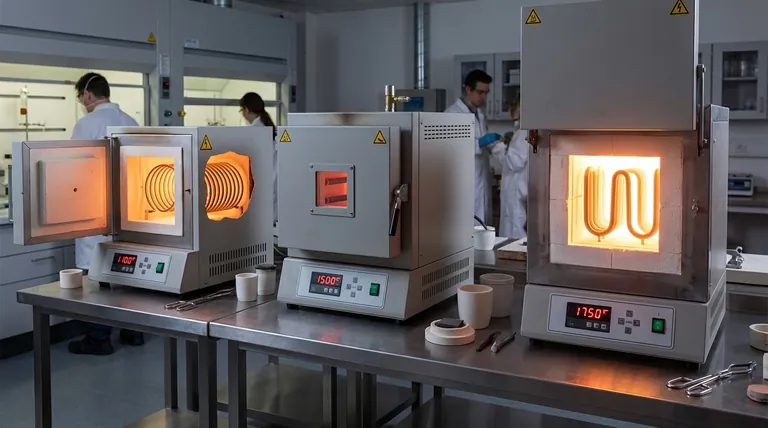
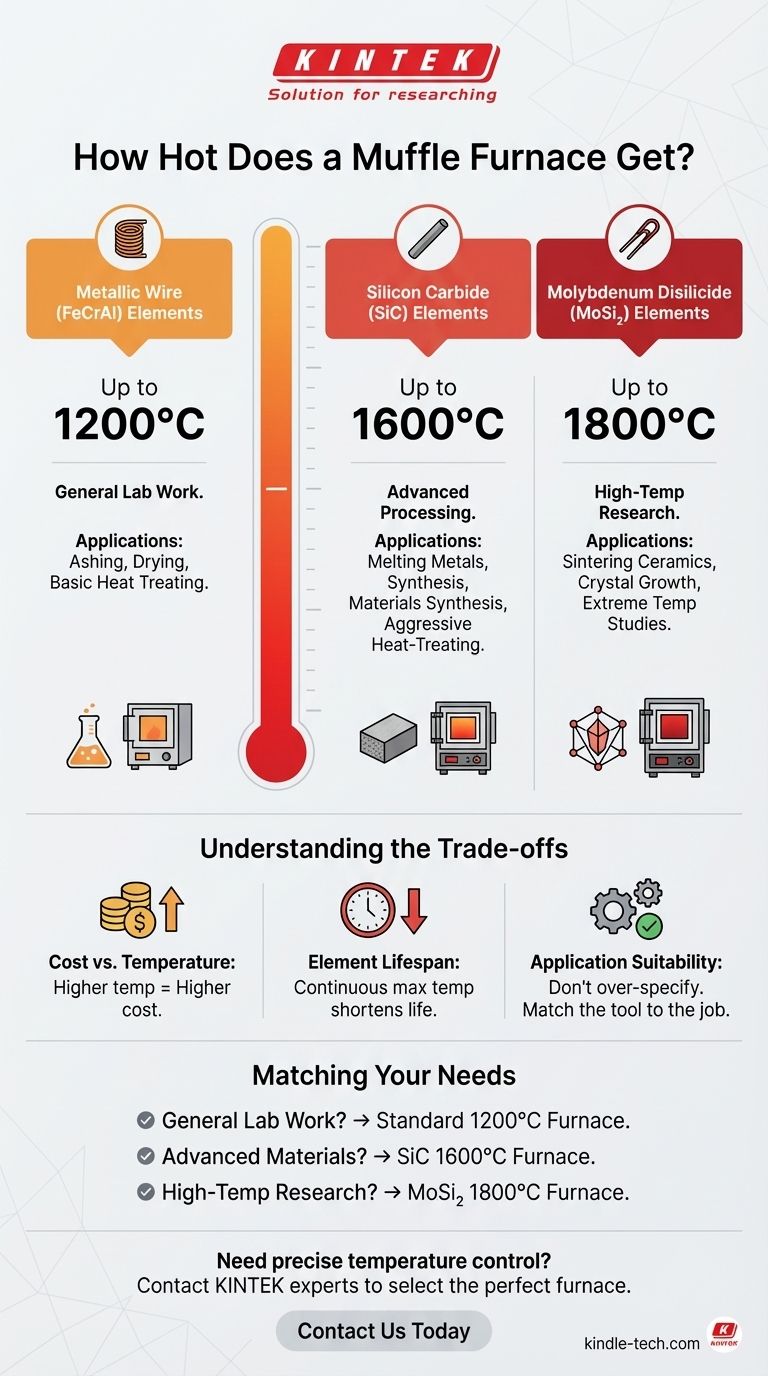
The maximum temperature of a muffle furnace is not a single value. While many common laboratory models operate in the 1000°C to 1200°C (2192°F) range, specialized industrial and research furnaces can reliably reach temperatures as high as 1800°C (3272°F). The specific maximum temperature is fundamentally determined by the materials used in its construction, particularly the heating elements.

The core takeaway is that a muffle furnace's temperature capability is directly tied to its heating element technology. Standard metallic elements handle general-purpose work up to 1200°C, while advanced ceramic elements are required for higher temperatures up to 1800°C.
How hot does a muffle furnace get? Unlock the Right Temperature for Your Lab

Why Muffle Furnace Temperatures Vary So Widely

The term "muffle furnace" describes a wide category of equipment. The key differentiator that dictates performance and cost is the type of internal heating element used.

The Role of the Heating Element

The heating element is the component that converts electrical energy into heat. The material it's made from has an inherent temperature limit beyond which it will degrade or fail, defining the furnace's maximum operating temperature.

Common Metallic Wire Elements (Up to 1200°C)

The most common and cost-effective muffle furnaces use heating elements made from metallic alloys, such as iron-chromium-aluminum (FeCrAl).

These furnaces are the workhorses of many labs. They are perfectly suited for general-purpose applications like ashing, tempering, annealing, and drying.

Silicon Carbide (SiC) Elements (Up to 1600°C)

For applications requiring temperatures beyond the limits of metallic wires, furnaces employ silicon carbide heating elements.

These more robust elements open the door to processes like melting certain metals, advanced materials synthesis, and more aggressive heat-treating cycles.

Molybdenum Disilicide (MoSi₂) Elements (Up to 1800°C)

At the highest end of the spectrum are furnaces equipped with molybdenum disilicide heating elements.

These are designed for the most demanding scientific and industrial tasks. This includes sintering high-performance ceramics, growing crystals, and conducting research on materials at extreme temperatures.

Understanding the Trade-offs

Selecting a furnace isn't just about picking the highest number. The underlying technology involves critical trade-offs in cost, longevity, and application.

Cost vs. Temperature

There is a direct and steep correlation between maximum temperature and price. The advanced materials required for high-temperature elements and the necessary high-grade insulation significantly increase the furnace's cost.

Element Lifespan and Stability

Operating any furnace continuously at its absolute maximum temperature will shorten the lifespan of its heating elements. High-temperature elements like MoSi₂ can also be more brittle and require careful handling.

Application Suitability

Over-specifying a furnace is an unnecessary expense. A standard 1200°C unit is often more reliable and efficient for lower-temperature work than using a specialized 1800°C furnace for the same task.

Matching the Furnace to Your Application

Choosing the right furnace requires aligning its capabilities with your specific process needs.

  • If your primary focus is general laboratory work (e.g., ashing, drying, basic heat treating): A standard furnace with metallic wire elements reaching 1100°C to 1200°C is sufficient and most cost-effective.
  • If your primary focus is advanced materials processing or specific metal treatments: You will likely require a furnace with silicon carbide (SiC) elements capable of reaching up to 1600°C.
  • If your primary focus is high-temperature research with specialized ceramics and alloys: A furnace with molybdenum disilicide (MoSi₂) elements, capable of 1800°C, is necessary for these demanding applications.

Ultimately, understanding the heating element technology is the key to selecting a muffle furnace that precisely meets your high-temperature requirements.

Summary Table:

Heating Element Type Typical Max Temperature Ideal Applications
Metallic Wire (FeCrAl) Up to 1200°C Ashing, drying, basic heat treating
Silicon Carbide (SiC) Up to 1600°C Advanced materials processing, metal treatments
Molybdenum Disilicide (MoSi₂) Up to 1800°C High-temperature research, specialized ceramics

Need precise temperature control for your laboratory processes? KINTEK specializes in lab equipment and consumables, offering muffle furnaces with the right heating element technology for your specific application—from general lab work to advanced materials research. Our experts will help you select the perfect furnace to enhance your lab's efficiency and accuracy. Contact us today to discuss your high-temperature requirements!

Visual Guide
How hot does a muffle furnace get? Unlock the Right Temperature for Your Lab Visual Guide

Related Products

People Also Ask

Related Products

1200℃ Muffle Furnace Oven for Laboratory

1200℃ Muffle Furnace Oven for Laboratory

Upgrade your lab with our 1200℃ Muffle Furnace. Achieve fast, precise heating with Japan alumina fibers and Molybdenum coils. Features TFT touch screen controller for easy programming and data analysis. Order now!

1800℃ Muffle Oven Furnace for Laboratory

1800℃ Muffle Oven Furnace for Laboratory

KT-18 muffle furnace with Japan Al2O3 polycrystalline fibe and Silicon Molybdenum heating element, up to 1900℃, PID temperature control and 7" smart touch screen. Compact design, low heat loss, and high energy efficiency. Safety interlock system and versatile functions.

1400℃ Muffle Oven Furnace for Laboratory

1400℃ Muffle Oven Furnace for Laboratory

Get precise high-temperature control up to 1500℃ with KT-14M Muffle furnace. Equipped with a smart touch screen controller and advanced insulation materials.

1700℃ Muffle Oven Furnace for Laboratory

1700℃ Muffle Oven Furnace for Laboratory

Get superior heat control with our 1700℃ Muffle Furnace. Equipped with intelligent temperature microprocessor, TFT touch screen controller & advanced insulation materials for precise heating up to 1700C. Order now!

High Temperature Muffle Oven Furnace for Laboratory Debinding and Pre Sintering

High Temperature Muffle Oven Furnace for Laboratory Debinding and Pre Sintering

KT-MD High temperature debinding and pre-sintering furnace for ceramic materials with various molding processes. Ideal for electronic components such as MLCC and NFC.

Laboratory Muffle Oven Furnace Bottom Lifting Muffle Furnace

Laboratory Muffle Oven Furnace Bottom Lifting Muffle Furnace

Efficiently produce batches with excellent temperature uniformity using our Bottom Lifting Furnace. Features two electric lifting stages and advanced temperature control up to 1600℃.

Molybdenum Vacuum Heat Treat Furnace

Molybdenum Vacuum Heat Treat Furnace

Discover the benefits of a high-configuration molybdenum vacuum furnace with heat shield insulation. Ideal for high-purity, vacuum environments like sapphire crystal growth and heat treatment.

Multi-zone Laboratory Tube Furnace

Multi-zone Laboratory Tube Furnace

Experience precise, efficient thermal testing with our Multi Zone Tube Furnace. Independent heating zones and temperature sensors allow for controlled high-temperature gradient heating fields. Order now for advanced thermal analysis!

Vacuum Heat Treat and Molybdenum Wire Sintering Furnace for Vacuum Sintering

Vacuum Heat Treat and Molybdenum Wire Sintering Furnace for Vacuum Sintering

A vacuum molybdenum wire sintering furnace is a vertical or bedroom structure, which is suitable for withdrawal, brazing, sintering and degassing of metal materials under high vacuum and high temperature conditions. It is also suitable for dehydroxylation treatment of quartz materials.

Horizontal High Temperature Graphite Vacuum Graphitization Furnace

Horizontal High Temperature Graphite Vacuum Graphitization Furnace

Horizontal Graphitization Furnace: This type of furnace is designed with the heating elements placed horizontally, allowing for uniform heating of the sample. It's well-suited for graphitizing large or bulky samples that require precise temperature control and uniformity.

Vacuum Hot Press Furnace Machine Heated Vacuum Press

Vacuum Hot Press Furnace Machine Heated Vacuum Press

Discover the advantages of Vacuum Hot Press Furnace! Manufacture dense refractory metals & compounds, ceramics, and composites under high temp and pressure.

Controlled Nitrogen Inert Hydrogen Atmosphere Furnace

Controlled Nitrogen Inert Hydrogen Atmosphere Furnace

KT-AH Hydrogen atmosphere furnace - induction gas furnace for sintering/annealing with built-in safety features, dual housing design, and energy-saving efficiency. Ideal for lab and industrial use.

1700℃ Controlled Atmosphere Furnace Nitrogen Inert Atmosphere Furnace

1700℃ Controlled Atmosphere Furnace Nitrogen Inert Atmosphere Furnace

KT-17A Controlled atmosphere furnace: 1700℃ heating, vacuum sealing technology, PID temperature control, and versatile TFT smart touch screen controller for laboratory and industrial use.

1200℃ Controlled Atmosphere Furnace Nitrogen Inert Atmosphere Furnace

1200℃ Controlled Atmosphere Furnace Nitrogen Inert Atmosphere Furnace

Discover our KT-12A Pro Controlled atmosphere furnace - high precision, heavy duty vacuum chamber, versatile smart touch screen controller, and excellent temperature uniformity up to 1200C. Ideal for both laboratory and industrial application.

Non Consumable Vacuum Arc Induction Melting Furnace

Non Consumable Vacuum Arc Induction Melting Furnace

Explore the benefits of Non-Consumable Vacuum Arc Furnace with high melting point electrodes. Small, easy to operate & eco-friendly. Ideal for laboratory research on refractory metals & carbides.

Rotary Tube Furnace Split Multi Heating Zone Rotating Tube Furnace

Rotary Tube Furnace Split Multi Heating Zone Rotating Tube Furnace

Multi zone rotary furnace for high-precision temperature control with 2-8 independent heating zones. Ideal for lithium ion battery electrode materials and high-temperature reactions. Can work under vacuum and controlled atmosphere.

600T Vacuum Induction Hot Press Furnace for Heat Treat and Sintering

600T Vacuum Induction Hot Press Furnace for Heat Treat and Sintering

Discover the 600T Vacuum Induction Hot Press Furnace, designed for high-temperature sintering experiments in vacuum or protected atmospheres. Its precise temperature and pressure control, adjustable working pressure, and advanced safety features make it ideal for nonmetal materials, carbon composites, ceramics, and metal powders.

Multi Heating Zones CVD Tube Furnace Machine Chemical Vapor Deposition Chamber System Equipment

Multi Heating Zones CVD Tube Furnace Machine Chemical Vapor Deposition Chamber System Equipment

KT-CTF14 Multi Heating Zones CVD Furnace - Precise Temperature Control and Gas Flow for Advanced Applications. Max temp up to 1200℃, 4 channels MFC mass flow meter, and 7" TFT touch screen controller.

Vacuum Heat Treat Furnace with Ceramic Fiber Liner

Vacuum Heat Treat Furnace with Ceramic Fiber Liner

Vacuum furnace with polycrystalline ceramic fiber insulation liner for excellent heat insulation and uniform temperature field. Choose from 1200℃ or 1700℃ max. working temperature with high vacuum performance and precise temperature control.

Vacuum Heat Treat and Pressure Sintering Furnace for High Temperature Applications

Vacuum Heat Treat and Pressure Sintering Furnace for High Temperature Applications

Vacuum pressure sintering furnaces are designed for high temperature hot pressing applications in metal and ceramic sintering. Its advanced features ensure precise temperature control, reliable pressure maintenance, and a robust design for seamless operation.


Leave Your Message



















