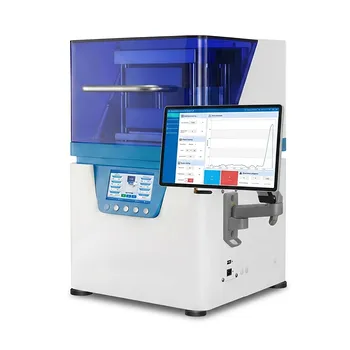
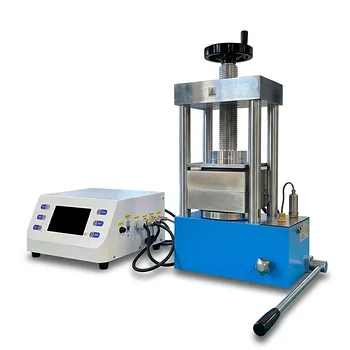
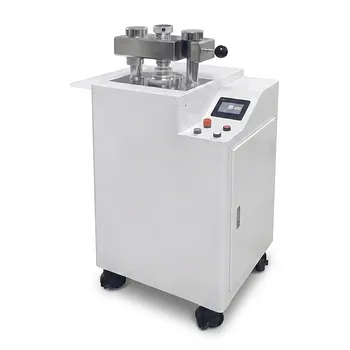
The laboratory hydraulic press is a critical tool for electrode densification and structural optimization. It is used to apply controlled, uniform pressure to electrode materials—typically a mixture of active material, binders, and conductive agents—after they have been coated onto a current collector such as copper or aluminum foil. This compaction process ensures a tight mechanical bond between the material and the collector, significantly reducing contact resistance and increasing the volumetric energy density of the final battery cell.
A laboratory hydraulic press converts loose, coated slurries or powders into highly conductive, dense electrode structures. By minimizing internal resistance and maximizing material density, it enables the creation of electrodes with superior charge transfer efficiency and cycling stability.
Enhancing Electrical and Ionic Conductivity
Reducing Interfacial Contact Resistance
The primary role of the hydraulic press is to force the active material into intimate contact with the current collector foil or mesh. This eliminates microscopic gaps that act as barriers to electron flow, effectively lowering the internal resistance of the battery.
Establishing Ion Transport Channels
In solid-state battery fabrication, the press applies high axial pressure (often exceeding 300 MPa) to eliminate pores between powder particles. This creates a dense bilayer structure that facilitates continuous ion transport across grain boundaries, which is essential for performance in the absence of liquid electrolytes.
Improving Charge Transfer Efficiency
By uniformly compressing the slurry onto current collectors like nickel foam or stainless steel mesh, the press enhances the mechanical bonding. This secure connection ensures that electrons can move efficiently from the active material to the external circuit during discharge.
Optimizing Physical Properties and Energy Density
Increasing Volumetric Energy Density
Compaction reduces the overall thickness of the electrode layer without removing active material. This process allows more energy-storing material to be packed into the limited volume of a coin cell or pouch cell, directly increasing the volumetric energy density.
Maintaining Structural Integrity
The application of stable, precise pressure prevents the electrode material from delaminating or "flaking" off the current collector during handling or cycling. This is particularly vital for materials that undergo significant volume expansion, such as Fe3O4@N-C, during lithiation and delithiation.
Minimizing Density Gradients
Precise hydraulic control ensures that pressure is distributed evenly across the entire surface of the electrode sheet. This uniformity prevents density gradients, which can cause uneven current distribution and premature battery failure during high-rate testing.
Understanding the Trade-offs
The Risk of Over-Compaction
Applying excessive pressure can crush the porosity required for liquid electrolyte wetting. If the electrode is too dense, the electrolyte cannot penetrate the structure, leading to poor ion accessibility and reduced rate performance.
Structural Damage to Current Collectors
High-pressure settings, particularly with thin foils, can cause the metal to stretch or tear. This compromises the mechanical stability of the electrode and can lead to short circuits during the cell assembly process.
Consistency and Repeatability Challenges
Manual hydraulic presses may suffer from slight variations in pressure application between batches. For high-precision research, consistent dwell time and pressure settings are necessary to ensure that experimental results are comparable across different electrode samples.
How to Apply This to Your Project
Making the Right Choice for Your Goal
To achieve the best results with a laboratory hydraulic press, you must tailor the pressure and duration to your specific material chemistry and cell architecture.
- If your primary focus is standard liquid-electrolyte cells: Use moderate pressure to optimize the bond between the slurry and the foil while maintaining enough porosity for electrolyte soaking.
- If your primary focus is solid-state battery research: Prioritize high-pressure settings (300+ MPa) to eliminate grain boundary resistance and create a dense, continuous ion-conducting interface.
- If your primary focus is using mesh or foam collectors: Ensure the press is calibrated to facilitate mechanical interlocking between the active material and the 3D structure without crushing the collector's framework.
By mastering the precise application of mechanical pressure, you transform raw materials into a high-performance electrochemical system.
Summary Table:
| Process Objective | Mechanism of Action | Impact on Battery Performance |
|---|---|---|
| Densification | Reduces porosity and layer thickness | Increases volumetric energy density |
| Interfacial Bonding | Forces contact between material and collector | Lowers internal resistance and enhances conductivity |
| Structural Stability | Prevents material flaking/delamination | Improves cycling stability and mechanical integrity |
| Uniformity | Eliminates density gradients | Ensures even current distribution and prevents failure |
Accelerate Your Battery Innovation with KINTEK
Precision is the backbone of high-performance electrochemical research. At KINTEK, we specialize in providing the advanced laboratory equipment needed to transform raw materials into superior energy storage solutions. Whether you are developing next-generation solid-state batteries or optimizing standard pouch cells, our range of laboratory hydraulic presses (pellet, hot, and isostatic) ensures the precise densification and structural integrity your electrodes require.
Beyond compaction, KINTEK offers a comprehensive ecosystem for battery scientists, including:
- High-Temperature Furnaces: Muffle, tube, and vacuum furnaces for material synthesis.
- Milling & Grinding: High-efficiency crushing systems for precursor preparation.
- Battery Research Tools: Specialized consumables, electrolytic cells, and electrodes.
- Thermal Management: ULT freezers and cooling solutions for stable testing environments.
Ready to elevate your lab's efficiency and electrode quality? Contact our technical experts today to find the perfect equipment tailored to your specific material chemistry and research goals.
References
- Chunxia Qi, Yuhua Shen. Multifunctional Hollow Porous Fe3O4@N-C Nanocomposites as Anodes of Lithium-Ion Battery, Adsorbents and Surface-Enhanced Raman Scattering Substrates. DOI: 10.3390/molecules28135183
This article is also based on technical information from Kintek Solution Knowledge Base .
Related Products
- Laboratory Hydraulic Press Lab Pellet Press for Button Battery
- Fully Automatic Heated Hydraulic Lab Press for Materials Sintering and Sample Preparation
- Laboratory Hydraulic Press Split Electric Lab Pellet Press
- Automatic Laboratory Hydraulic Press for XRF & KBR Pellet Press
- Automatic Laboratory Hydraulic Pellet Press Machine for Lab Use
People Also Ask
- Why is a high-precision laboratory hydraulic press necessary for radiation-shielding? Ensure Data Accuracy & Density
- Why is a laboratory hydraulic press required during the preparation of Ti3AlC2 precursor pellets?
- How does the laboratory hydraulic press contribute to the preparation of solid targets for laser ablation?
- What is the function of a laboratory hydraulic press in preparing La2FeCrO6? Ensure High-Density Ceramic Pellets
- Why use a lab hydraulic press for 380 MPa Ti-Al alloy compaction? Unlock superior density and structural integrity.