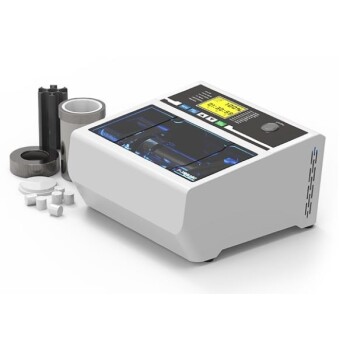
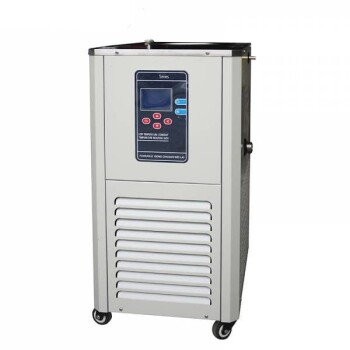
A laboratory micro reactor unit functions as a high-fidelity simulator for industrial light naphtha isomerization processes. By rigorously controlling reaction parameters—specifically temperature, pressure, and flow velocity—it allows researchers to quantitatively assess how effectively a catalyst improves fuel quality and conversion efficiency.
Core Takeaway: The unit’s primary value lies in its ability to isolate independent variables, enabling the precise measurement of Research Octane Number (RON) gains and catalyst selectivity in a controlled setting prior to industrial scale-up.
Replicating Industrial Environments
To accurately evaluate a catalyst, the laboratory environment must mirror the harsh conditions of a full-scale refinery. The micro reactor achieves this through precise parameter management.
Thermal Regulation
The unit operates within a strict thermal window, typically maintaining temperatures between 160°C and 220°C.
This specific range is critical for simulating the thermal stress and activation energy required for light naphtha isomerization.
Pressure Maintenance
To replicate the containment conditions of an industrial plant, the reactor maintains a constant pressure environment, generally set at 10 bar.
Stability in pressure is vital for ensuring consistent reaction kinetics and preventing phase changes that could alter data.
Liquid Hourly Space Velocity (LHSV)
The unit utilizes independent feed systems to control the Liquid Hourly Space Velocity.
By adjusting LHSV, researchers dictate exactly how long the reactants remain in contact with the catalyst, effectively simulating the throughput and "time on stream" of a commercial facility.
Quantifying Catalyst Efficacy
Once the environment is established, the micro reactor serves as a data generation tool. It focuses on specific output metrics to determine the viability of a catalyst.
Analyzing Conversion Rates
The system measures the total percentage of the raw feed that is successfully transformed during the process.
High conversion rates indicate a highly active catalyst, a prerequisite for efficient industrial operation.
Measuring Selectivity and Octane Gains
Activity alone is not enough; the reactor also evaluates the quality of the conversion.
The unit quantifies the improvement in the Research Octane Number (RON), ensuring the catalyst is producing high-value isomers rather than unwanted byproducts.
Understanding the Trade-offs
While micro reactor units are essential for evaluation, they require careful handling to ensure data integrity.
Sensitivity to Calibration
Because the unit uses small volumes to simulate large processes, minor errors in the control board settings can lead to outsized data skew.
Precision in the independent feed systems is non-negotiable; a slight fluctuation in flow can drastically alter the calculated LHSV.
The Scale-up Gap
A micro reactor provides excellent kinetic data, but it operates under "ideal" mixing conditions.
It may not perfectly predict heat transfer issues or fluid dynamic challenges that occur in massive industrial reactors.
Making the Right Choice for Your Goal
When utilizing a micro reactor unit for catalyst evaluation, tailor your analysis to your specific objective.
- If your primary focus is Fuel Quality: Prioritize the RON improvement metrics to ensure the catalyst produces high-octane isomers.
- If your primary focus is Process Efficiency: Focus on conversion rates and LHSV, determining how much throughput the catalyst can handle while maintaining activity.
Success in catalyst evaluation depends on using this precise control to rigorously test the boundaries of performance before moving to production.
Summary Table:
| Parameter | Typical Operating Range | Evaluation Metric |
|---|---|---|
| Temperature | 160°C - 220°C | Thermal stress & activation energy |
| Pressure | ~10 bar | Reaction kinetics & phase stability |
| LHSV | Variable | Feed contact time & throughput efficiency |
| Output Analysis | N/A | Conversion rates & Research Octane Number (RON) |
Maximize Your Research Precision with KINTEK
Ready to elevate your catalyst evaluation process? KINTEK specializes in advanced laboratory solutions, including high-temperature high-pressure reactors and autoclaves, designed to deliver the rigorous control your research demands. From precision crushing and milling systems for catalyst preparation to state-of-the-art cooling solutions and electrolytic cells, we provide the tools needed for comprehensive chemical engineering and battery research.
Don't settle for approximate results. Partner with KINTEK for reliable, industrial-grade laboratory equipment that bridges the gap between the lab and large-scale production.
Contact KINTEK Today to Discuss Your Project Requirements
References
- Ban A. Ahmed Al-Tabbakh, Maan Mudhfar Dawood. Synthesis and Characterization of Sulfated Zirconia Catalyst for Light Naphtha Isomerization Process. DOI: 10.52716/jprs.v12i1(suppl.).630
This article is also based on technical information from Kintek Solution Knowledge Base .
Related Products
- Laboratory Micro Horizontal Jar Mill for Precision Sample Preparation in Research and Analysis
- Mini SS High Pressure Autoclave Reactor for Laboratory Use
- High Pressure Laboratory Autoclave Reactor for Hydrothermal Synthesis
- Customizable Laboratory High Temperature High Pressure Reactors for Diverse Scientific Applications
- Stainless High Pressure Autoclave Reactor Laboratory Pressure Reactor
People Also Ask
- What are the different types of laboratory mills? Choose the Right Grinder for Your Sample Material
- What is use for grinding in the laboratory? Select the Right Mill for Accurate Sample Prep
- What is the function of laboratory mills? Achieve Precise Particle Size Control for Accurate Analysis
- What is the use of a laboratory mill? Achieve Accurate Sample Homogenization for Reliable Results
- What is the purpose of sample preparation? Ensure Accurate & Reliable Analytical Results