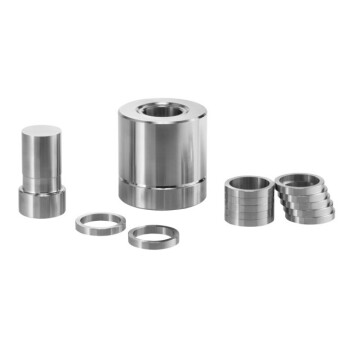
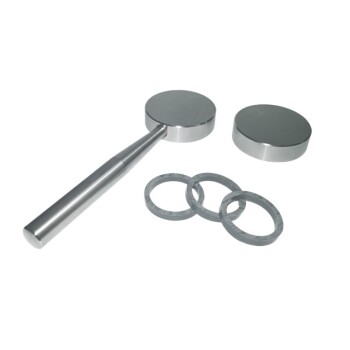
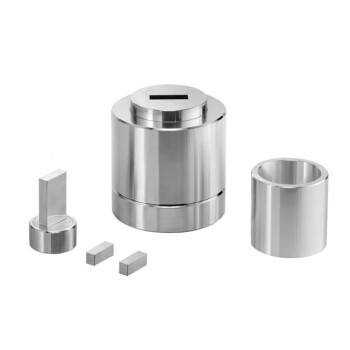
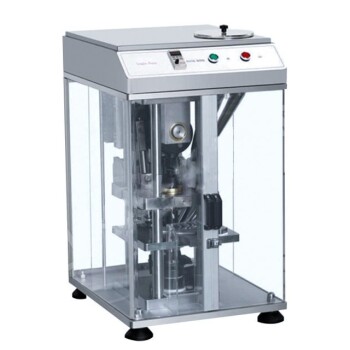
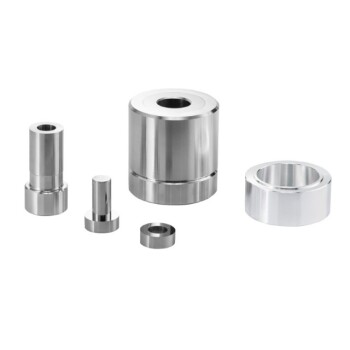
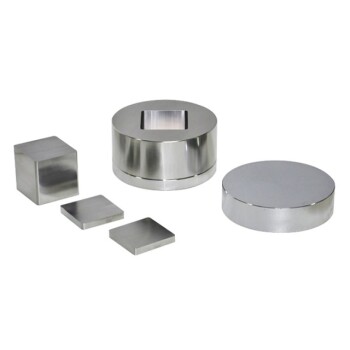
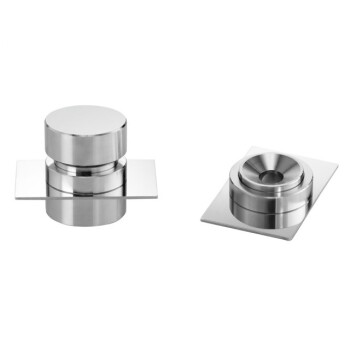
The laboratory powder pellet press is a critical sample preparation tool used to compress a mixture of iron oxide nanoparticles and Potassium Bromide (KBr) into a solid, transparent disc. This process ensures that the infrared beam can effectively pass through the sample in transmission mode, allowing for the precise identification of Fe-O vibration bonds and surface functional groups.
To achieve accurate FTIR results for iron oxide nanoparticles, a pellet press must transform opaque powders into a uniform, transparent optical path. This standardization minimizes light scattering and maximizes the signal-to-noise ratio during spectroscopic analysis.
The Role of Optical Transparency in FTIR
Achieving Infrared Transparency
Iron oxide nanoparticles are naturally opaque and would block an infrared beam if analyzed in their raw powder form. To solve this, they are mixed with Potassium Bromide (KBr), a salt that is entirely transparent to infrared radiation.
Minimizing Light Scattering
The pellet press applies extreme pressure to eliminate air gaps and ensure a uniform optical path. This high-pressure molding prevents the infrared beam from bouncing off individual particles, which would otherwise result in "noisy" or unreadable spectra.
The Mechanical Preparation Process
Mixing and Concentration
Before pressing, a small quantity of dried iron oxide nanoparticles is thoroughly ground with spectroscopic-grade KBr. The ratio must be precise to ensure the resulting pellet is thin and translucent enough for light penetration while containing enough sample for detection.
Applying Controlled High Pressure
The pellet press, often hydraulic or manual, typically applies pressures around 300 kg/cm². This force is necessary to fuse the KBr and nanoparticles into a single, cohesive, and crack-free disc that maintains its structural integrity during the test.
Identifying Chemical and Surface Structures
Detecting Fe-O Vibration Bonds
The primary goal of this preparation is to clearly observe the characteristic vibration peaks of iron oxide. The resulting high-quality spectra allow researchers to confirm the presence of Fe-O bonds, which are the "fingerprints" of the material’s core structure.
Verifying Surface Modifications
Pellet pressing is essential for detecting functional groups such as O-H, C=O, or C-N bonds on the nanoparticle surface. This is vital when the nanoparticles have been coated with stabilizers like Polyvinylpyrrolidone (PVP) or used for metal binding in environmental applications.
Understanding the Trade-offs and Pitfalls
Moisture Sensitivity of KBr
KBr is highly hygroscopic, meaning it absorbs moisture from the air rapidly. If the powder is not kept perfectly dry before pressing, water peaks will appear in the FTIR spectra, potentially masking the chemical signatures of the iron oxide.
The Risk of Opaque Pellets
If the pressure applied by the press is insufficient or the sample concentration is too high, the pellet will remain cloudy or opaque. An opaque pellet causes excessive light scattering, leading to a low signal-to-noise ratio and unreliable data.
How to Apply This to Your Analysis
Making the Right Choice for Your Goal
To ensure the best results from your laboratory pellet press, consider your specific analytical objectives:
- If your primary focus is spectral clarity: Ensure the KBr is pre-dried in an oven and use a hydraulic press to reach the recommended 300 kg/cm² for maximum transparency.
- If your primary focus is surface modification verification: Use a precise micro-scale mixing ratio to ensure that delicate vibration shifts in stabilizer molecules (like PVP) are not overwhelmed by the iron oxide core.
- If your primary focus is high-throughput testing: Utilize a standardized manual pellet press with a dedicated die set to maintain consistency across multiple samples.
Proper pellet preparation transforms raw iron oxide powder into a definitive window for molecular discovery.
Summary Table:
| Process Step | Primary Action | Purpose in FTIR Analysis |
|---|---|---|
| Mixing | Grinding nanoparticles with spectroscopic-grade KBr | Creates an IR-transparent medium for the sample |
| Compression | Applying ~300 kg/cm² of controlled pressure | Eliminates air gaps to minimize light scattering |
| Pellet Formation | Creating a uniform, thin, and translucent disc | Ensures a clear optical path for infrared beam transmission |
| Spectroscopy | Measuring characteristic vibration peaks | Identifies Fe-O bonds and surface functional groups |
Elevate Your Material Analysis with KINTEK Precision
Achieving the perfect transparent disc for FTIR analysis requires more than just pressure—it requires precision. KINTEK specializes in high-performance laboratory equipment, offering a robust range of manual and hydraulic pellet presses and precision die sets designed specifically for challenging materials like iron oxide nanoparticles.
Whether you are a researcher focused on surface modifications or a distributor seeking reliable laboratory solutions, KINTEK provides the tools to ensure uniform sample thickness and maximum signal-to-noise ratios. From crushing and milling systems to high-pressure reactors, our portfolio is engineered for accuracy and durability.
Ready to optimize your sample preparation workflow? Contact our expert team today to find the ideal pressing solution for your laboratory's needs!
References
- Rusul Al-Obaidy, Norhana Arsad. Study of the Effects of Solution Types on Concentration of Iron Oxide by Pulsed Laser Ablation in Liquid. DOI: 10.53293/jasn.2022.5025.1172
This article is also based on technical information from Kintek Solution Knowledge Base .
Related Products
- XRF & KBR steel ring lab Powder Pellet Pressing Mold for FTIR
- XRF Boric Acid Lab Powder Pellet Pressing Mold for Laboratory Use
- XRF & KBR plastic ring lab Powder Pellet Pressing Mold for FTIR
- Automatic Laboratory Hydraulic Pellet Press Machine for Lab Use
- Laboratory Manual Hydraulic Pellet Press for Lab Use
People Also Ask
- What is the purpose of using a mold for pellet pressing when preparing catalyst test samples? Ensure Data Consistency
- What are the advantages of using the pressed pellet method for XRF sample preparation? Optimize Your XRF Analysis
- What is the pressed powder pellet method? A Guide to Accurate FTIR Sample Preparation
- How does the selection of a pressure mold affect the performance of all-solid-state batteries? Expert Pelletizing Guide
- What are the different types of XRF samples? A Guide to Solid, Powder, and Liquid Prep