Knowledge How long does it take to make a diamond in a machine? From Weeks to Billions of Years
Author avatar

Tech Team · Kintek Solution

Updated 1 week ago

How long does it take to make a diamond in a machine? From Weeks to Billions of Years


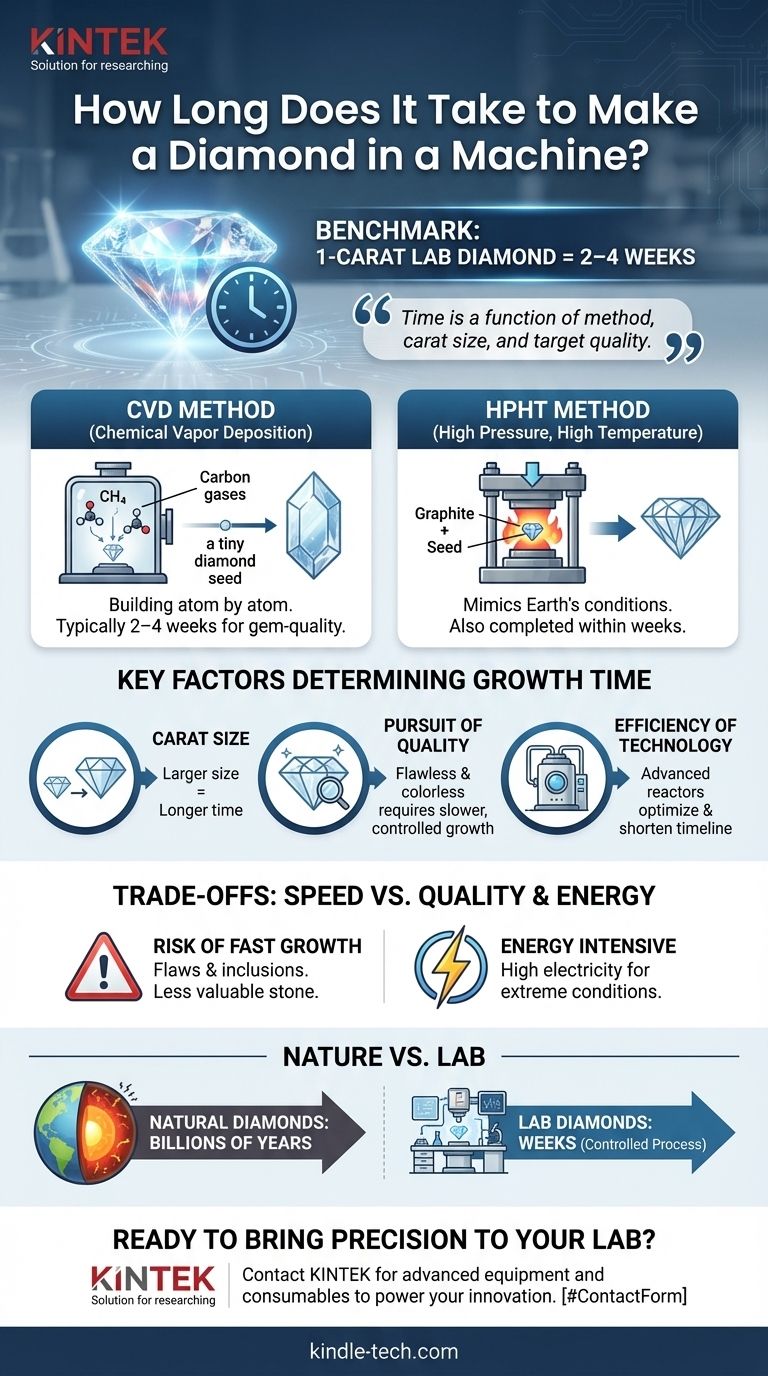
In a laboratory, a high-quality, 1-carat diamond can be grown in as little as two to four weeks. This process, a marvel of material science, relies on sophisticated technology that replicates the diamond-forming conditions of the Earth's mantle, but on a vastly accelerated timeline.

The time required to grow a diamond is not fixed; it is a direct function of the chosen growth method, the desired carat size, and the targeted level of quality. Understanding this relationship is key to appreciating the technology behind lab-created diamonds.
How long does it take to make a diamond in a machine? From Weeks to Billions of Years

The Two Primary Methods of Diamond Creation

At the heart of lab-grown diamonds are two distinct technological approaches. Each method grows a chemically and physically identical diamond, but the process and timeline differ.

The CVD Method (Chemical Vapor Deposition)

Chemical Vapor Deposition, or CVD, is akin to building a crystal atom by atom. The process begins with a tiny diamond "seed" placed inside a sealed vacuum chamber.

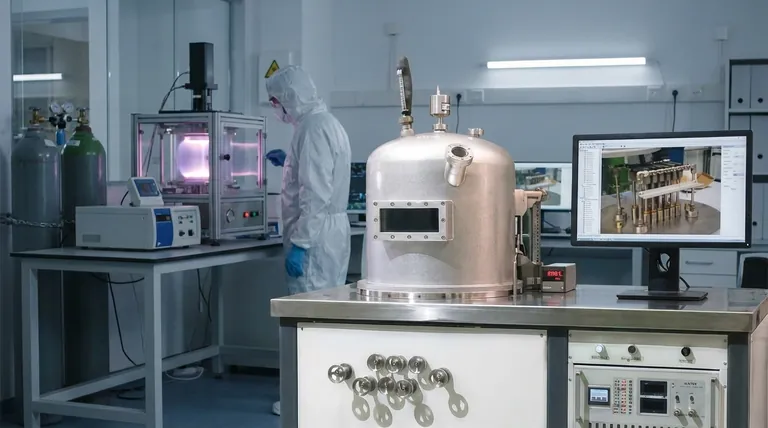
This chamber is filled with carbon-rich gases (like methane) and heated to extreme temperatures. The gases break down, and carbon atoms "rain" down, depositing onto the seed and growing the diamond in successive layers. This method typically takes two to four weeks for a gem-quality stone.

The HPHT Method (High Pressure, High Temperature)

High Pressure, High Temperature (HPHT) is the original method and more closely mimics the natural geologic process. It starts with a diamond seed and pure, solid carbon (like graphite).

This material is placed in a large mechanical press that applies immense pressure and intense heat—simulating the conditions deep within the Earth. The solid carbon melts and re-forms as a diamond crystal around the seed. While timelines vary, this process is also completed within a matter of weeks.

Key Factors That Determine Growth Time

The "two to four weeks" figure is a benchmark, not a universal constant. Several critical factors can shorten or lengthen the duration of the growth cycle.

The Role of Carat Size

The most significant factor is carat size. A larger diamond simply requires more material and more time for the crystalline structure to form, whether it's through the layering of CVD or the crystallization of HPHT. Growing a 3-carat diamond will take considerably longer than a 1-carat stone.

The Pursuit of Quality and Clarity

Growing a diamond is not just about speed; it's about precision. Creating a flawless, colorless diamond requires slower, more stable, and more controlled conditions to prevent inclusions or structural defects from forming. Rushing the process can compromise the final quality.

The Efficiency of the Technology

The specific equipment used plays a crucial role. Top producers with the latest, most efficient reactors can optimize temperature, pressure, and gas composition to grow high-quality diamonds more quickly than those using older technology. Continuous innovation in this field is constantly refining the process.

Understanding the Trade-offs: Speed vs. Quality

The ability to create a diamond in weeks is remarkable, but it involves a delicate balance of competing variables. The process is governed by physics and chemistry, where every choice has a consequence.

The Risk of Growing Too Fast

Attempting to accelerate growth beyond what the process can stably handle is the primary cause of flaws and inclusions. Rapid, unstable growth can trap non-diamond carbon or create fractures in the crystal lattice, resulting in a lower-clarity and less valuable stone.

The Energy Cost of Creation

Both CVD and HPHT methods are extremely energy-intensive. Maintaining the incredible pressures and temperatures required to form a diamond consumes a significant amount of electricity. This is a fundamental trade-off of the technology—speed and control are achieved at a high energy cost.

The Contrast with Natural Formation

The most profound context for lab growth time is its comparison to nature. Natural diamonds form over billions of years under chaotic conditions deep within the Earth's mantle. Laboratory methods are about controlling this process to produce a specific result in a tiny fraction of the time.

How to Interpret This Information

Understanding the growth timeline helps you appreciate the science behind the stone. Your interpretation of this fact depends on your ultimate goal.

  • If your primary focus is the technology: Recognize that lab diamond creation is a precise manufacturing process where time is a key variable managed to optimize for both size and quality.
  • If your primary focus is purchasing a diamond: The specific growth time is less important than the final, certified result—the 4Cs (cut, color, clarity, and carat) are what determine a diamond's quality and value.
  • If your primary focus is the environmental impact: The critical factor is not the number of weeks, but the high energy consumption of the process and whether that energy comes from a renewable or fossil-fuel source.

Ultimately, knowing how long it takes to grow a diamond empowers you to see it not as an imitation, but as a product of human ingenuity and scientific mastery.

Summary Table:

Factor Impact on Growth Time
Method CVD: 2-4 weeks. HPHT: Varies, but typically weeks.
Carat Size Larger carat = longer growth time.
Target Quality Higher clarity/color grades require slower, more controlled growth.
Technology Advanced, efficient reactors can optimize and shorten the timeline.

Ready to bring precision and efficiency to your laboratory processes? At KINTEK, we specialize in the advanced equipment and consumables that power innovation. Whether your research involves material science, chemistry, or any lab-based application, our solutions are designed to enhance your results and streamline your workflow. Contact us today via our [#ContactForm] to discuss how KINTEK can support your specific laboratory needs and help you achieve your scientific goals.

Visual Guide
How long does it take to make a diamond in a machine? From Weeks to Billions of Years Visual Guide

Related Products

People Also Ask

Related Products

HFCVD Machine System Equipment for Drawing Die Nano-Diamond Coating

HFCVD Machine System Equipment for Drawing Die Nano-Diamond Coating

The nano-diamond composite coating drawing die uses cemented carbide (WC-Co) as the substrate, and uses the chemical vapor phase method ( CVD method for short ) to coat the conventional diamond and nano-diamond composite coating on the surface of the inner hole of the mold.

915MHz MPCVD Diamond Machine Microwave Plasma Chemical Vapor Deposition System Reactor

915MHz MPCVD Diamond Machine Microwave Plasma Chemical Vapor Deposition System Reactor

915MHz MPCVD Diamond Machine and its multi-crystal effective growth, the maximum area can reach 8 inches, the maximum effective growth area of single crystal can reach 5 inches. This equipment is mainly used for the production of large-size polycrystalline diamond films, the growth of long single crystal diamonds, the low-temperature growth of high-quality graphene, and other materials that require energy provided by microwave plasma for growth.

CVD Diamond Cutting Tool Blanks for Precision Machining

CVD Diamond Cutting Tool Blanks for Precision Machining

CVD Diamond Cutting Tools: Superior Wear Resistance, Low Friction, High Thermal Conductivity for Non-Ferrous Materials, Ceramics, Composites Machining

CVD Diamond Domes for Industrial and Scientific Applications

CVD Diamond Domes for Industrial and Scientific Applications

Discover CVD diamond domes, the ultimate solution for high-performance loudspeakers. Made with DC Arc Plasma Jet technology, these domes deliver exceptional sound quality, durability, and power handling.

Metallographic Specimen Mounting Machine for Laboratory Materials and Analysis

Metallographic Specimen Mounting Machine for Laboratory Materials and Analysis

Precision metallographic mounting machines for labs—automated, versatile, and efficient. Ideal for sample prep in research and quality control. Contact KINTEK today!

Mini Planetary Ball Mill Machine for Laboratory Milling

Mini Planetary Ball Mill Machine for Laboratory Milling

Discover the KT-P400 desktop planetary ball mill, ideal for grinding and mixing small samples in the lab. Enjoy stable performance, long service life, and practicality. Functions include timing and overload protection.

High Energy Vibratory Laboratory Ball Mill Grinding Mill Single Tank Type

High Energy Vibratory Laboratory Ball Mill Grinding Mill Single Tank Type

High-energy vibration ball mill is a small desktop laboratory grinding instrument.It can be ball-milled or mixed with different particle sizes and materials by dry and wet methods.

Laboratory Test Sieves and Sieving Machines

Laboratory Test Sieves and Sieving Machines

Precision lab test sieves & sieving machines for accurate particle analysis. Stainless steel, ISO-compliant, 20μm-125mm range. Request specs now!

High Energy Planetary Ball Mill Machine for Laboratory Horizontal Tank Type

High Energy Planetary Ball Mill Machine for Laboratory Horizontal Tank Type

The KT-P2000H uses a unique Y-axis planetary trajectory, and utilizes the collision, friction and gravity between the sample and the grinding ball.

High Energy Planetary Ball Mill Milling Machine for Laboratory

High Energy Planetary Ball Mill Milling Machine for Laboratory

The biggest feature is that the high energy planetary ball mill can not only perform fast and effective grinding, but also has good crushing ability

High-Energy Omnidirectional Planetary Ball Mill Milling Machine for Laboratory

High-Energy Omnidirectional Planetary Ball Mill Milling Machine for Laboratory

The KT-P4000E is a new product derived from the vertical high-energy planetary ball mill with a 360° swivel function. Experience faster, uniform, and smaller sample output results with 4 ≤1000ml ball mill jars.

High-Energy Omnidirectional Planetary Ball Mill Machine for Laboratory

High-Energy Omnidirectional Planetary Ball Mill Machine for Laboratory

The KT-P2000E is a new product derived from the vertical high-energy planetary ball mill with a 360°rotation function. The product not only has the characteristics of the vertical high-energy ball mill, but also has a unique 360°rotation function for the planetary body.

High Energy Planetary Ball Mill Milling Machine for Laboratory

High Energy Planetary Ball Mill Milling Machine for Laboratory

Experience fast and effective sample processing with the F-P2000 high-energy planetary ball mill. This versatile equipment offers precise control and excellent grinding capabilities. Perfect for laboratories, it features multiple grinding bowls for simultaneous testing and high output. Achieve optimal results with its ergonomic design, compact structure, and advanced features. Ideal for a wide range of materials, it ensures consistent particle size reduction and low maintenance.

Precision Wire Saw Laboratory Cutting Machine with 800mm x 800mm Workbench for Diamond Single Wire Circular Small Cutting

Precision Wire Saw Laboratory Cutting Machine with 800mm x 800mm Workbench for Diamond Single Wire Circular Small Cutting

Diamond wire cutting machines are mainly used for precision cutting of ceramics, crystals, glass, metals, rocks, thermoelectric materials, infrared optical materials, composite materials, biomedical materials and other material analysis samples. Especially suitable for precision cutting of ultra-thin plates with thickness up to 0.2mm.

Small Injection Molding Machine for Lab Use

Small Injection Molding Machine for Lab Use

The small injection molding machinehas fast and stable movements; good controllability and repeatability, super energy saving; the product can be automatically dropped and formed; the machine body is low, convenient for feeding, easy to maintain, and no height restrictions on the installation site.

Anti-Cracking Press Mold for Lab Use

Anti-Cracking Press Mold for Lab Use

The anti-cracking press mold is a specialized equipment designed for molding various shapes and sizes of film using high pressure and electric heating.

Single Punch Manual Tablet Press Machine TDP Tablet Punching Machine

Single Punch Manual Tablet Press Machine TDP Tablet Punching Machine

Single punch manual tablet punching machine can press various granular, crystal or powdery raw materials with good fluidity into disc-shaped, cylindrical, spherical, convex, concave and other various geometric shapes (such as square, triangle, ellipse, capsule shape, etc.), and can also press products with text and patterns.

Laboratory Sterilizer Lab Autoclave Vertical Pressure Steam Sterilizer for Liquid Crystal Display Automatic Type

Laboratory Sterilizer Lab Autoclave Vertical Pressure Steam Sterilizer for Liquid Crystal Display Automatic Type

Liquid crystal display automatic vertical sterilizer is a safe, reliable and automatic control sterilization equipment, which is composed of heating system, microcomputer control system and overheating and overvoltage protection system.

Single Punch Tablet Press Machine and Mass Production Rotary Tablet Punching Machine for TDP

Single Punch Tablet Press Machine and Mass Production Rotary Tablet Punching Machine for TDP

Rotary tablet punching machine is an automatic rotating and continuous tableting machine. It is mainly used for tablet manufacturing in the pharmaceutical industry, and is also suitable for industrial sectors such as food, chemicals, batteries, electronics, ceramics, etc. to compress granular raw materials into tablets.

Laboratory Sterilizer Lab Autoclave Pulse Vacuum Lifting Sterilizer

Laboratory Sterilizer Lab Autoclave Pulse Vacuum Lifting Sterilizer

The pulse vacuum lifting sterilizer is a state-of-the-art equipment for efficient and precise sterilization. It uses pulsating vacuum technology, customizable cycles, and a user-friendly design for easy operation and safety.


Leave Your Message