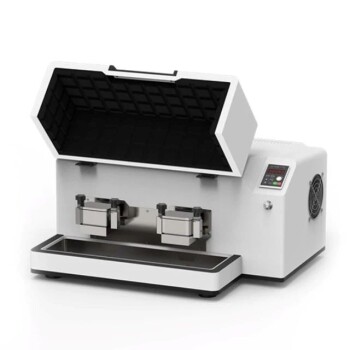
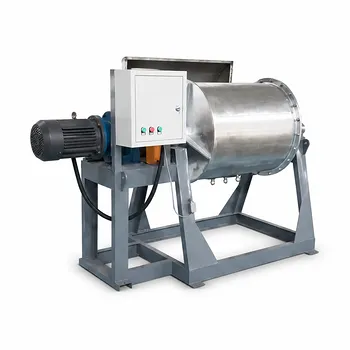
A high-energy ball mill serves as the kinetic driver of the synthesis, replacing thermal energy and solvents with mechanical force. It generates intense collisions and shear forces that provide the necessary activation energy to force solid-state reactions between metal salts and organic ligands.
By substituting mechanical impact for organic solvents, high-energy ball milling transforms MOF production into a "green," solvent-free process that is highly efficient and ready for industrial scale-up.
Driving Reactions Through Mechanical Force
To understand the role of the ball mill, you must look beyond simple mixing. It is an active reactor that converts kinetic energy into chemical potential.
Providing Activation Energy
In standard synthesis, heat often drives the reaction. In mechanochemistry, the intense collisions of the grinding balls provide the activation energy.
This mechanical input disrupts the stable solid structures of the reactants. It puts them in a highly reactive state, allowing the chemical transformation to occur without external heating.
Facilitating Solid-State Coordination
Solids generally do not react easily with one another because their particles only touch at specific points.
The ball mill overcomes this by exerting shear forces that constantly refresh the contact surfaces. This ensures "thorough contact" between the metal salts and organic ligands, driving the coordination reaction to completion.
Particle Refinement and Surface Area
While the primary goal is synthesis, the process inherently involves physical refinement.
The impact forces fragment the initial powders, significantly increasing the specific surface area. This maximizes the interface where the metal and ligand can meet, accelerating the reaction kinetics.
The Strategic Advantages for MOF Production
The shift from solvothermal (liquid-based) to mechanochemical (ball mill) synthesis addresses several critical bottlenecks in MOF manufacturing.
Green Chemistry Compliance
Traditional MOF synthesis often requires large volumes of toxic organic solvents.
High-energy ball milling enables synthesis with minimal or no solvent. This drastically reduces waste and environmental impact, aligning the process with green chemistry principles.
Industrial Scalability
Scaling up solution-based reactions is difficult due to solubility limits and heat transfer issues.
Because ball milling relies on mechanical force rather than complex fluid dynamics, it is inherently easier to scale for industrial production. The process remains consistent as you increase the batch size.
Understanding the Trade-offs
While powerful, high-energy ball milling introduces specific variables that must be managed carefully to ensure product quality.
Risk of Amorphization
The same energy that drives the reaction can destroy the product if uncontrolled.
Excessive milling time or intensity can introduce too much structural disorder or defects. While this is beneficial for some materials (like solid electrolytes), MOFs generally require a crystalline structure, so the energy input must be optimized to avoid amorphizing the framework.
Contamination Potential
The grinding media (balls and jar) are subjected to high-impact forces.
Over time, this can lead to abrasive wear, introducing trace impurities from the grinding tools into your MOF product. Selection of appropriate jar and ball materials (e.g., zirconia vs. steel) is critical.
Making the Right Choice for Your Goal
The utility of a high-energy ball mill depends on your specific production priorities.
- If your primary focus is Sustainability: Utilize this method to eliminate toxic solvents and lower the carbon footprint of your synthesis.
- If your primary focus is Scalability: Leverage the mill to produce larger batches of MOFs without the limitations of solubility or thermal gradients.
- If your primary focus is Crystallinity: Carefully calibrate the milling time to ensure reaction completion without degrading the ordered lattice structure of the MOF.
High-energy ball milling moves MOF synthesis from the delicate environment of the chemistry lab to the robust efficiency of solid-state manufacturing.
Summary Table:
| Feature | Role/Impact in MOF Synthesis | Benefit |
|---|---|---|
| Energy Source | Replaces thermal energy with kinetic impact | Solvent-free "Green" chemistry |
| Mechanism | High-shear forces & intense collisions | Overcomes solid-state reaction barriers |
| Surface Area | Continuous particle refinement | Increases reactivity & reaction kinetics |
| Scalability | Mechanical force independent of solubility | Easier industrial scale-up |
| Product Control | Adjustable milling time & intensity | Prevents amorphization & ensures crystallinity |
Elevate Your MOF Research with KINTEK
Ready to transition to green, solvent-free synthesis? KINTEK specializes in advanced laboratory solutions designed for high-performance material science. Our range of high-energy crushing and milling systems, including premium planetary ball mills and zirconia grinding media, provides the precision and durability needed for consistent mechanochemical synthesis.
Beyond milling, we offer a comprehensive portfolio for laboratory excellence:
- Material Processing: High-temperature furnaces (vacuum, tube, muffle) and hydraulic presses.
- Advanced Research: High-pressure reactors, autoclaves, and electrolytic cells.
- Sample Prep: Sieving equipment, homogenizers, and essential ceramics/crucibles.
Maximize your lab's efficiency and achieve industrial-grade scalability today. Contact our specialists to find the perfect equipment for your MOF production!
References
- Ricky Lalawmpuia, Diwakar Tiwari. Metal organic framework (MOF): Synthesis and fabrication for the application of electrochemical sensing. DOI: 10.4491/eer.2023.636
This article is also based on technical information from Kintek Solution Knowledge Base .
Related Products
- High Energy Planetary Ball Mill Milling Machine for Laboratory
- High Energy Planetary Ball Mill for Laboratory Horizontal Tank Type Milling Machine
- High-Energy Omnidirectional Planetary Ball Mill Milling Machine for Laboratory
- High Energy Planetary Ball Mill Milling Machine for Laboratory
- High Energy Planetary Ball Mill Machine for Laboratory Horizontal Tank Type
People Also Ask
- How does a planetary ball mill provide mechanical activation for scandium recovery? Maximize Your Leaching Efficiency
- What role do planetary ball mills and zirconia media play in LLZT preparation? Optimize Your Solid Electrolyte Research
- What is the function of a planetary ball mill in the preparation of high-entropy rare earth silicate multi-phase ceramics?
- What is the purpose of using a planetary ball mill for cathode material regeneration? Achieve Atomic-Level Mixing
- What is the primary function of a planetary ball mill? Mastering SiC/Al Composite Mixing for Homogeneity