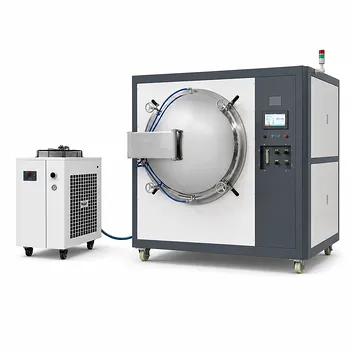
Resistance heating elements function as the foundational control mechanism for processing efficiency in hot press furnaces. By delivering a stable heat source and a strictly controlled heating rate—such as 10°C/min—they ensure the composite heats uniformly, effectively neutralizing the risks of thermal shock and excessive temperature gradients.
The core value of resistance heating lies in its ability to enforce a consistent thermal history across production batches. This precision allows manufacturers to dictate the final material properties by explicitly managing the transition between amorphous states and crystallization.
Achieving Thermal Uniformity
Preventing Thermal Shock
The primary role of resistance heating elements is to provide a stable heat source. This stability is critical for avoiding sudden temperature spikes that lead to thermal shock.
By maintaining a controlled heating rate (e.g., 10°C/min), the furnace ensures that the temperature rises evenly throughout the sample. This eliminates the formation of excessive temperature gradients that could warp or crack the composite.
Ensuring Consistent Thermal History
For amorphous alloys, the specific "path" of heating is as important as the final temperature. Resistance heating elements ensure a consistent thermal history for every batch processed.
This consistency is vital when the material approaches its glass transition or crystallization temperatures. Without this repeatability, material properties would fluctuate wildly between production runs, making quality control impossible.
Precision Control of Microstructure
Managing Phase Transitions
The efficiency of the process depends on the ability to target exact temperatures. Resistance heating allows for precise distinctions, such as holding a temperature at 485°C versus 530°C.
This precision determines the final state of the matrix. Lower temperatures may preserve the amorphous state, while slightly higher temperatures induce nanocrystallization, precipitating alpha-Fe phases.
Tuning Interfacial Layers
Beyond phase changes, resistance heating regulates the diffusion bonding process between the alloy and the aluminum. Accurate temperature management controls the thickness of the interfacial FeAl3 intermetallic compound layer.
By adjusting this layer's thickness, engineers can fine-tune the composite's mechanical performance. This creates a direct lever to adjust the balance between hardness and toughness.
Understanding the Trade-offs
Balancing Bonding and Structure
There is an inherent conflict in processing these composites: higher heat improves diffusion bonding but threatens the amorphous structure.
Resistance heating elements provide the control necessary to walk this line, but the window of error is small. A slight overshoot in temperature improves bonding but may trigger unwanted crystallization, altering the material's fundamental characteristics.
The Risk of Gradient Variations
While resistance elements reduce gradients, they do not eliminate the physics of heat transfer. If the heating rate is too aggressive for the specific sample size, the core may lag behind the surface.
This lag can result in a sample that is nanocrystalline on the surface but amorphous in the center. Operators must synchronize the heating rate capabilities of the elements with the thermal conductivity of the specific composite batch.
Making the Right Choice for Your Goal
To maximize the utility of your hot press furnace, align your heating strategy with your desired material outcome:
- If your primary focus is preserving the Amorphous State: Prioritize strict temperature ceilings (e.g., 485°C) and stable ramp rates to prevent unintended crystallization.
- If your primary focus is Hardness and Wear Resistance: Utilize precise higher-temperature setpoints (e.g., 530°C) to induce controlled nanocrystallization (alpha-Fe precipitation) and thicker FeAl3 layers.
- If your primary focus is Batch Consistency: Standardize the heating rate (e.g., 10°C/min) to ensure identical thermal histories for every unit produced.
True processing efficiency is achieved when thermal precision is used to intentionally design the microstructure of the composite.
Summary Table:
| Parameter | Impact of Resistance Heating | Material Outcome |
|---|---|---|
| Heating Rate | Controlled (e.g., 10°C/min) | Prevents thermal shock & gradients |
| Temp. Stability | High precision (±1°C) | Ensures consistent thermal history |
| Phase Control | Targeted (485°C vs 530°C) | Manages amorphous vs. nanocrystalline states |
| Interfacial Control | Regulated diffusion bonding | Tunes FeAl3 layer thickness for hardness |
| Batch Repeatability | Standardized ramp profiles | Uniform mechanical properties across runs |
Elevate Your Material Research with KINTEK Precision
Achieving the perfect balance between amorphous stability and mechanical hardness requires uncompromising thermal control. KINTEK specializes in advanced laboratory equipment, offering high-performance hot press systems, muffle furnaces, and vacuum furnaces designed to deliver the precise heating rates and uniform thermal environments your composites demand.
From high-temperature reactors to specialized crushing and milling systems, our comprehensive portfolio empowers researchers to master microstructure design with confidence.
Ready to optimize your alloy processing? Contact our technical experts today to discover how KINTEK’s precision heating solutions can enhance your production efficiency and batch consistency.
Related Products
- 600T Vacuum Induction Hot Press Furnace for Heat Treat and Sintering
- Vacuum Hot Press Furnace Heated Vacuum Press Machine Tube Furnace
- Vacuum Hot Press Furnace Machine Heated Vacuum Press
- Vacuum Heat Treat and Pressure Sintering Furnace for High Temperature Applications
- Laboratory High Pressure Vacuum Tube Furnace
People Also Ask
- What role does an induction vacuum hot pressing furnace play in sintering? Achieve 98% Density in Carbide Blocks
- What advantages does a vacuum hot press furnace provide for LSLBO ceramic electrolytes? Achieve 94% Relative Density
- What role does a Vacuum Hot Press (VHP) furnace play in the densification of austenitic stainless steel 316 composites?
- What are the advantages of a vacuum hot press furnace for W-50%Cu? Achieve 99.6% Density at Lower Temperatures
- What role does mechanical pressure play during the vacuum diffusion bonding of tungsten and copper? Keys to Solid Bonding