Knowledge Is sieve analysis applicable for particle size? Master Material Gradation for Superior Performance
Author avatar

Tech Team · Kintek Solution

Updated 1 week ago

Is sieve analysis applicable for particle size? Master Material Gradation for Superior Performance


Yes, absolutely. Sieve analysis is one of the most fundamental and widely used methods for determining the particle size distribution of granular materials. It is a trusted technique in many industries due to its simplicity, low cost, and the straightforward, universally understood nature of its results.

Sieve analysis is not merely about measuring particles; it is about understanding a material's "gradation"—the full spectrum of particle sizes within a sample—which directly dictates its physical properties and performance in real-world applications.

Is sieve analysis applicable for particle size? Master Material Gradation for Superior Performance

Why Particle Size Distribution Is a Critical Parameter

Sieve analysis provides the data needed to understand a material's physical makeup. This data is essential for predicting behavior, ensuring quality, and making correct design choices.

It Predicts Material Performance

The distribution of particle sizes is a critical factor that determines how a material will perform. A well-graded aggregate, for instance, has a mix of particle sizes that pack together densely, creating a strong, stable structure.

This is why sieve analysis is essential for designing durable concrete mixes, stable asphalt pavements, and effective water production well screens.

It Ensures Quality and Consistency

For engineers and manufacturers, consistency is key. Performing sieve analysis on incoming raw materials or finished products verifies that they meet the required specifications batch after batch.

This simple test prevents costly failures acessórios to out-of-spec materials.

It Provides a "Fingerprint" of the Material

The results of a sieve analysis, often plotted as a gradation curve, act as a unique fingerprint for a granular material. This allows for quick comparison between different sources or batches.

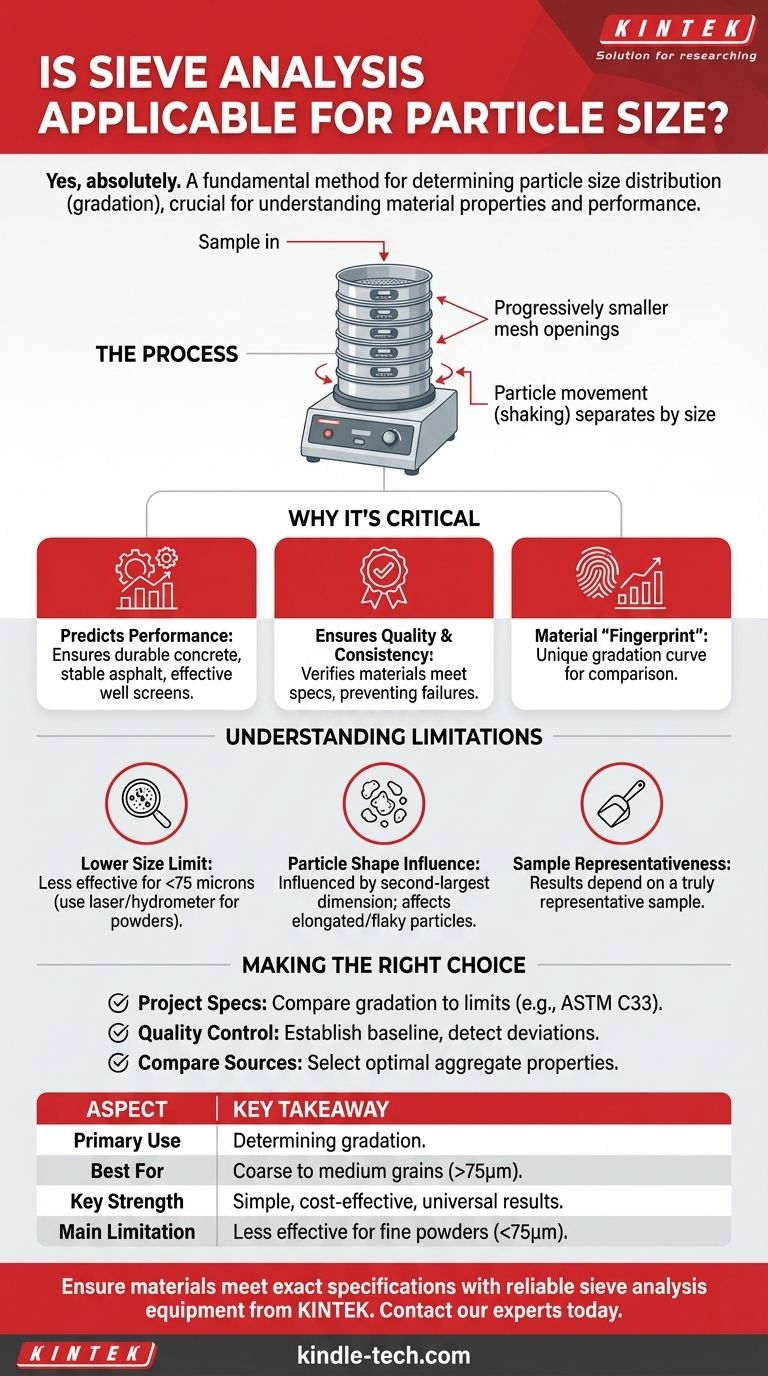
The process works by passing a sample through a stack of sieves with progressively smaller mesh openings. Particle movement, induced by shaking or tapping, is crucial for ensuring particles have the opportunity to pass through the apertures and be retained on the correct sieve, leading to an accurate separation by size.

Understanding the Trade-offs and Limitations

While highly effective, sieve analysis is not a universal solution. Understanding its limitations is crucial for interpreting results correctly.

The Lower Size Limit

Sieve analysis palavras with very fine particles, typically those smaller than 75 microns (or a No. 200 sieve). Forces like static electricity and cohesion can cause fine particles to clump together, preventing them from passing through the mesh.

For powders, silts, and clays, other methods like laser diffraction or hydrometer analysis are more appropriate.

The Influence of Particle Shape

Sieves measure a particle's size based on its ability to pass through a square opening. This means the result is most influenced by a particle's second-largest dimension.

Highly elongated or flat, flaky particles may be classified in a way that doesn't fully represent their true geometry, which can affect性能 in some applications.

Sample Representativeness is Paramount

The analysis is only as good as the sample provided. If the small sample used for the test is not truly representative of the entire stockpile or batch, the results will be misleading. Proper sampling técnica is non-negotiable.

Making the Right Choice for Your Goal

Use the results of sieve analysis to make data-driven decisions based on your specific objective.

  • If your primary focus is meeting a project specification: Compare your material's gradation curve directly against the upper and lower specification limits required for the application (e.g., ASTM C33 for concrete aggregate).
  • If your primary focus is quality control and consistency: Establish a baseline gradation for your ideal material and use sieve analysis to quickly detect any deviation in new batches.
  • If your primary focus is choosing between material sources: Use sieve analysis results to compare the gradation of different aggregates to select the one ženy has the optimal properties for your design.

Ultimately, sieve analysis empowers you to move from guessing about a material's quality to knowing its character with certainty.

Summary Table:

Aspect Key Takeaway
Primary Use Determining particle size distribution (gradation) of granular materials.
Best For Coarse to medium-grained materials (down to ~75 microns).
Key Strength Simple, cost-effective, and provides universally understood results.
Main Limitation Less effective for fine powders (<75 microns) where particle shape affects results.

Ensure your materials meet exact specifications with reliable sieve analysis equipment from KINTEK.

Whether you're working in construction, manufacturing, or research, accurate particle size data is critical for quality and performance. KINTEK specializes in high-quality lab sieves, shakers, and accessories designed for durability and precise results.

Contact our experts today to find the perfect sieving solution for your laboratory's needs and achieve consistent, data-driven quality control.

Visual Guide
Is sieve analysis applicable for particle size? Master Material Gradation for Superior Performance Visual Guide

Related Products

People Also Ask

Related Products

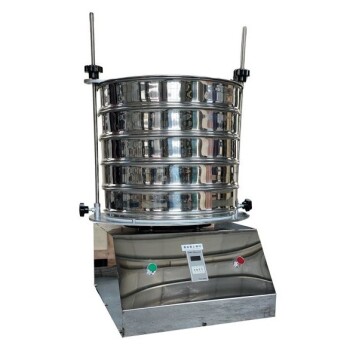
Laboratory Test Sieves and Sieving Machines

Laboratory Test Sieves and Sieving Machines

Precision lab test sieves & sieving machines for accurate particle analysis. Stainless steel, ISO-compliant, 20μm-125mm range. Request specs now!

Laboratory Vibratory Sieve Shaker Machine Slap Vibrating Sieve

Laboratory Vibratory Sieve Shaker Machine Slap Vibrating Sieve

KT-T200TAP is a slapping and oscillating sieving instrument for laboratory desktop use, with 300 rpm horizontal circular motion and 300 vertical slapping motions to simulate manual sieving to help sample particles pass through better.

HFCVD Machine System Equipment for Drawing Die Nano-Diamond Coating

HFCVD Machine System Equipment for Drawing Die Nano-Diamond Coating

The nano-diamond composite coating drawing die uses cemented carbide (WC-Co) as the substrate, and uses the chemical vapor phase method ( CVD method for short ) to coat the conventional diamond and nano-diamond composite coating on the surface of the inner hole of the mold.

Laboratory Single Horizontal Jar Mill

Laboratory Single Horizontal Jar Mill

KT-JM3000 is a mixing and grinding instrument for placing a ball milling tank with a volume of 3000ml or less. It adopts frequency conversion control to realize timing, constant speed, direction change, overload protection and other functions.

Laboratory Sterilizer Lab Autoclave Vertical Pressure Steam Sterilizer for Liquid Crystal Display Automatic Type

Laboratory Sterilizer Lab Autoclave Vertical Pressure Steam Sterilizer for Liquid Crystal Display Automatic Type

Liquid crystal display automatic vertical sterilizer is a safe, reliable and automatic control sterilization equipment, which is composed of heating system, microcomputer control system and overheating and overvoltage protection system.

Laboratory Sterilizer Lab Autoclave Pulse Vacuum Lifting Sterilizer

Laboratory Sterilizer Lab Autoclave Pulse Vacuum Lifting Sterilizer

The pulse vacuum lifting sterilizer is a state-of-the-art equipment for efficient and precise sterilization. It uses pulsating vacuum technology, customizable cycles, and a user-friendly design for easy operation and safety.

High Energy Planetary Ball Mill Milling Machine for Laboratory

High Energy Planetary Ball Mill Milling Machine for Laboratory

Experience fast and effective sample processing with the F-P2000 high-energy planetary ball mill. This versatile equipment offers precise control and excellent grinding capabilities. Perfect for laboratories, it features multiple grinding bowls for simultaneous testing and high output. Achieve optimal results with its ergonomic design, compact structure, and advanced features. Ideal for a wide range of materials, it ensures consistent particle size reduction and low maintenance.

Benchtop Laboratory Freeze Dryer for Lab Use

Benchtop Laboratory Freeze Dryer for Lab Use

Premium benchtop laboratory freeze dryer for lyophilization, preserving samples with ≤ -60°C cooling. Ideal for pharmaceuticals & research.

High Energy Vibratory Laboratory Ball Mill Grinding Mill Single Tank Type

High Energy Vibratory Laboratory Ball Mill Grinding Mill Single Tank Type

High-energy vibration ball mill is a small desktop laboratory grinding instrument.It can be ball-milled or mixed with different particle sizes and materials by dry and wet methods.

Benchtop Laboratory Vacuum Freeze Dryer

Benchtop Laboratory Vacuum Freeze Dryer

Benchtop laboratory freeze dryer for efficient lyophilization of biological, pharmaceutical, and food samples. Features intuitive touchscreen, high-performance refrigeration, and durable design. Preserve sample integrity—consult now!

High Energy Planetary Ball Mill Machine for Laboratory Horizontal Tank Type

High Energy Planetary Ball Mill Machine for Laboratory Horizontal Tank Type

The KT-P2000H uses a unique Y-axis planetary trajectory, and utilizes the collision, friction and gravity between the sample and the grinding ball.

Vacuum Hot Press Furnace Machine for Lamination and Heating

Vacuum Hot Press Furnace Machine for Lamination and Heating

Experience clean and precise lamination with Vacuum Lamination Press. Perfect for wafer bonding, thin-film transformations, and LCP lamination. Order now!

Precision Machined Zirconia Ceramic Ball for Engineering Advanced Fine Ceramics

Precision Machined Zirconia Ceramic Ball for Engineering Advanced Fine Ceramics

zirconia ceramic ball have the characteristics of high strength, high hardness, PPM wear level, high fracture toughness, good wear resistance, and high specific gravity.

Small Injection Molding Machine for Lab Use

Small Injection Molding Machine for Lab Use

The small injection molding machinehas fast and stable movements; good controllability and repeatability, super energy saving; the product can be automatically dropped and formed; the machine body is low, convenient for feeding, easy to maintain, and no height restrictions on the installation site.

Anti-Cracking Press Mold for Lab Use

Anti-Cracking Press Mold for Lab Use

The anti-cracking press mold is a specialized equipment designed for molding various shapes and sizes of film using high pressure and electric heating.

915MHz MPCVD Diamond Machine Microwave Plasma Chemical Vapor Deposition System Reactor

915MHz MPCVD Diamond Machine Microwave Plasma Chemical Vapor Deposition System Reactor

915MHz MPCVD Diamond Machine and its multi-crystal effective growth, the maximum area can reach 8 inches, the maximum effective growth area of single crystal can reach 5 inches. This equipment is mainly used for the production of large-size polycrystalline diamond films, the growth of long single crystal diamonds, the low-temperature growth of high-quality graphene, and other materials that require energy provided by microwave plasma for growth.

High Energy Planetary Ball Mill Milling Machine for Laboratory

High Energy Planetary Ball Mill Milling Machine for Laboratory

The biggest feature is that the high energy planetary ball mill can not only perform fast and effective grinding, but also has good crushing ability

High-Energy Omnidirectional Planetary Ball Mill Milling Machine for Laboratory

High-Energy Omnidirectional Planetary Ball Mill Milling Machine for Laboratory

The KT-P4000E is a new product derived from the vertical high-energy planetary ball mill with a 360° swivel function. Experience faster, uniform, and smaller sample output results with 4 ≤1000ml ball mill jars.

High-Energy Omnidirectional Planetary Ball Mill Machine for Laboratory

High-Energy Omnidirectional Planetary Ball Mill Machine for Laboratory

The KT-P2000E is a new product derived from the vertical high-energy planetary ball mill with a 360°rotation function. The product not only has the characteristics of the vertical high-energy ball mill, but also has a unique 360°rotation function for the planetary body.

CVD Diamond Cutting Tool Blanks for Precision Machining

CVD Diamond Cutting Tool Blanks for Precision Machining

CVD Diamond Cutting Tools: Superior Wear Resistance, Low Friction, High Thermal Conductivity for Non-Ferrous Materials, Ceramics, Composites Machining


Leave Your Message