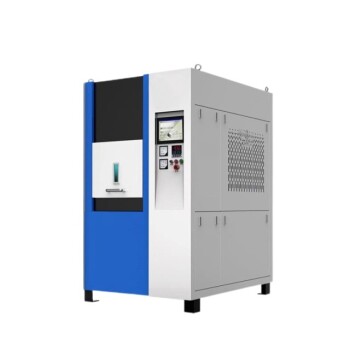
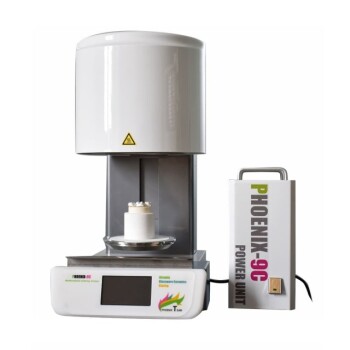
The primary advantage of an intermediate frequency induction sintering furnace is its ability to decouple densification from grain growth through rapid, direct heating. By generating heat directly within the graphite crucible or the specimen via induction currents, this method achieves heating rates and thermal uniformity that traditional resistance furnaces cannot match.
The core value of this technology lies in time management at critical temperatures: it allows for the full diffusion of the solid solution while drastically reducing the window of time available for matrix grains to coarsen.
The Mechanics of Direct Heating
Internal Heat Generation
Unlike traditional furnaces that rely on external heating elements and radiative transfer, induction sintering drives induction currents directly into the graphite crucible or the conductive specimen. This creates heat from within the material assembly itself.
Extreme Heating Rates
This direct energy transfer enables extremely fast heating rates. The system bypasses the thermal lag inherent in resistance heating, allowing the material to reach sintering temperatures almost immediately.
Uniform Thermal Distribution
The induction process ensures uniform overall heating of the sample. This eliminates the temperature gradients often found in slower heating methods, ensuring consistent densification throughout the alloy's volume.
Optimizing ODS-HEC Microstructure
Inhibiting Grain Coarsening
The most critical advantage for Oxide Dispersion Strengthened High Entropy Alloys (ODS-HECs) is the preservation of fine grain structure. By shortening the total time spent at high temperatures, the process effectively inhibits the coarsening of matrix grains, which is vital for maintaining mechanical strength.
Ensuring Full Solution Diffusion
Despite the rapid cycle, the process is highly efficient at promoting chemical homogeneity. It ensures the full diffusion of the CrFeCuMnNi solid solution, guaranteeing that the high entropy alloy elements are properly integrated.
Dispersed Particle Distribution
The rapid consolidation facilitates a dispersed distribution of oxide particles. Preventing these particles from agglomerating is essential for the ODS mechanism to effectively strengthen the alloy.
Understanding the Trade-offs
The Speed vs. Control Balance
While rapid heating is advantageous, it requires precise control. If the heating rate is uncontrolled, there is a theoretical risk of thermal shock, though the induction method generally provides superior uniformity compared to resistance heating.
Reliance on Graphite Susceptors
The effectiveness of this method often relies on the coupling efficiency between the induction field and the graphite crucible. This setup is strictly necessary to achieve the specific heating profiles required to balance diffusion with grain growth inhibition.
Making the Right Choice for Your Goal
To maximize the performance of your ODS-HEC materials, align your sintering method with your specific microstructural targets:
- If your primary focus is Strength and Hardness: Choose induction sintering to inhibit matrix grain coarsening while ensuring oxide particles remain finely dispersed.
- If your primary focus is Chemical Homogeneity: Rely on this method to ensure the full diffusion of complex solid solutions (like CrFeCuMnNi) without the penalty of grain growth associated with long dwell times.
Rapid induction sintering transforms the trade-off between density and grain size into a manageable process variable.
Summary Table:
| Feature | Intermediate Frequency Induction Sintering | Traditional Resistance Furnaces |
|---|---|---|
| Heating Mechanism | Direct induction/internal heat generation | Radiative/convective external heating |
| Heating Rate | Extremely fast (minimizes thermal lag) | Slower (prone to thermal gradients) |
| Grain Size Control | High (inhibits coarsening via short cycles) | Low (long dwell times promote coarsening) |
| Microstructure | Dispersed oxide particles & uniform diffusion | Higher risk of particle agglomeration |
| Efficiency | Rapid cycle times with high thermal uniformity | Longer cycles with higher energy loss |
Elevate Your Material Research with KINTEK Precision
Unlock the full potential of your Oxide Dispersion Strengthened High Entropy Alloys (ODS-HECs) with KINTEK’s advanced thermal solutions. Our intermediate frequency induction sintering furnaces and high-temperature vacuum systems are specifically engineered to decouple densification from grain growth, ensuring your alloys maintain peak mechanical strength and chemical homogeneity.
Beyond sintering, KINTEK offers a comprehensive suite of laboratory equipment, including crushing and milling systems, high-pressure reactors, and specialized battery research tools. Whether you are developing next-generation aerospace materials or advanced dental ceramics, our expertise in high-temperature technology ensures your lab achieves consistent, repeatable results.
Ready to optimize your sintering profile? Contact KINTEK today to consult with our technical experts and find the perfect equipment for your research goals.
References
- S. Sivasankaran, Abdel-baset H. Mekky. Influence of Oxide Dispersions (Al2O3, TiO2, and Y2O3) in CrFeCuMnNi High-Entropy Alloy on Microstructural Changes and Corrosion Resistance. DOI: 10.3390/cryst13040605
This article is also based on technical information from Kintek Solution Knowledge Base .
Related Products
- 600T Vacuum Induction Hot Press Furnace for Heat Treat and Sintering
- Spark Plasma Sintering Furnace SPS Furnace
- Controlled Nitrogen Inert Hydrogen Atmosphere Furnace
- Dental Porcelain Zirconia Sintering Ceramic Furnace Chairside with Transformer
- Lab-Scale Vacuum Induction Melting Furnace
People Also Ask
- What role does an induction vacuum hot pressing furnace play in sintering? Achieve 98% Density in Carbide Blocks
- What advantages does a vacuum hot press furnace provide for LSLBO ceramic electrolytes? Achieve 94% Relative Density
- What role does a Vacuum Hot Press (VHP) furnace play in the densification of austenitic stainless steel 316 composites?
- What are the advantages of a vacuum hot press furnace for W-50%Cu? Achieve 99.6% Density at Lower Temperatures
- What role does mechanical pressure play during the vacuum diffusion bonding of tungsten and copper? Keys to Solid Bonding