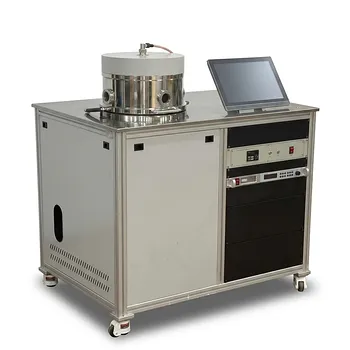
Fluidized Bed Chemical Vapor Deposition (FB-CVD) stands as the industry standard for the mass production of high-purity carbon nanotube (CNT) powders. By passing a carrier and carbon source gas through a bed of catalyst powder, this technology fluidizes the particles, overcoming the heat and mass transfer limitations that restrict other synthesis methods.
The Bottom Line: FB-CVD is designed for volume and uniformity. By transforming static catalyst aggregates into a fluid-like state, it maximizes gas-solid contact, enabling the production of kilogram-scale batches with purity levels exceeding 98.5%.
How FB-CVD Drives Efficiency
The Fluidization Principle
The core mechanism of FB-CVD involves passing gas upwards through a bed of catalyst powder. This gas flow causes the nanoparticle aggregates to behave like a fluid rather than a static solid.
Optimizing Gas-Solid Contact
This fluidized state dramatically increases the surface area available for reaction. Unlike static beds where gas might channel through cracks, fluidization ensures every catalyst particle is intimately exposed to the carbon source.
Solving the Scalability Challenge
Enhancing Transfer Rates
For large-scale production, managing heat and chemical transport is the biggest hurdle. FB-CVD significantly enhances the rates of heat and mass transfer within the reactor.
Achieving Uniform Growth
Because the catalyst particles are in constant motion and evenly exposed to the feedstock, the resulting carbon nanotubes grow uniformly on the catalyst surface. This prevents the heterogeneity often seen in static production methods.
Industrial Capabilities
Volume Production
FB-CVD equipment is specifically engineered for industrial-grade throughput. It allows manufacturers to achieve substantial daily volumes, such as 1 kg per day, making it viable for commercial supply chains.
Precision and Purity
The technology allows for the precise control of process parameters. This operational control yields a high-quality product with purity levels exceeding 98.5%, minimizing the need for costly post-processing purification.
Understanding the Trade-offs: Form Factor
Powder vs. Macroscopic Structures
While FB-CVD is superior for creating powders, it is not the tool for creating self-assembled macroscopic structures.
The Floating Catalyst Alternative
If your goal is to create ultra-light aerogels, fibers, or thin sheets, you would likely require Floating Catalyst CVD (FC-CVD). As noted in supplementary data, FC-CVD allows nanotubes to grow freely in space and self-assemble into 3D networks, whereas FB-CVD is strictly for growing nanotubes on a supported powder catalyst.
Making the Right Choice for Your Goal
To select the correct reactor technology, you must define the required final form of your carbon material:
- If your primary focus is large-scale powdered additives: Choose FB-CVD for its ability to produce kilograms of high-purity (>98.5%) CNT powder efficiently.
- If your primary focus is macroscopic assemblies: Choose FC-CVD to produce 3D networks like aerogels, films, or fibers that self-assemble during growth.
FB-CVD remains the definitive solution for converting raw carbon into uniform, high-grade nanotube powders at an industrial scale.
Summary Table:
| Feature | Fluidized Bed CVD (FB-CVD) | Floating Catalyst CVD (FC-CVD) |
|---|---|---|
| Primary Output | High-purity CNT powder | Aerogels, fibers, and films |
| Purity Level | > 98.5% | Variable |
| Scalability | High (kg/day capacity) | Specialized (macroscopic structures) |
| Gas-Solid Contact | Optimized via fluidization | Gas-phase reaction |
| Growth Mechanism | On supported catalyst powder | Free-space growth & self-assembly |
Elevate Your Nanomaterial Production with KINTEK
Are you looking to scale up your carbon nanotube synthesis or optimize high-temperature material research? KINTEK specializes in advanced laboratory equipment and industrial solutions designed for precision and reliability. Whether you require cutting-edge high-temperature CVD reactors (tube, rotary, vacuum, or PECVD), sophisticated crushing and milling systems for catalyst preparation, or high-temperature high-pressure reactors, we have the expertise to support your workflow.
From high-purity ceramics and crucibles to battery research tools and cooling solutions, KINTEK provides the comprehensive portfolio needed to achieve industrial-grade results. Contact us today to discover how our specialized equipment can enhance your lab's efficiency and drive your innovation forward!
References
- Kinshuk Dasgupta, Vivekanand Kain. A journey of materials development illustrated through shape memory alloy and carbon-based materials. DOI: 10.18520/cs/v123/i3/417-428
This article is also based on technical information from Kintek Solution Knowledge Base .
Related Products
- Customer Made Versatile CVD Tube Furnace Chemical Vapor Deposition Chamber System Equipment
- Microwave Plasma Chemical Vapor Deposition MPCVD Machine System Reactor for Lab and Diamond Growth
- Split Chamber CVD Tube Furnace with Vacuum Station Chemical Vapor Deposition System Equipment Machine
- Chemical Vapor Deposition CVD Equipment System Chamber Slide PECVD Tube Furnace with Liquid Gasifier PECVD Machine
- HFCVD Machine System Equipment for Drawing Die Nano-Diamond Coating
People Also Ask
- What is a CVD tube furnace? A Complete Guide to Thin-Film Deposition
- What is the function of a high-temperature CVD tube furnace in 3D graphene foam prep? Master 3D Nanomaterial Growth
- What are the technical advantages of using a CVD tube furnace? Optimize Silicon-Carbon Battery Anodes
- How does a CVD tube furnace inhibit the sintering of silver supports? Boost Membrane Durability and Performance
- What is the function of a tube furnace in CVD SiC synthesis? Achieving Ultra-Pure Silicon Carbide Powders