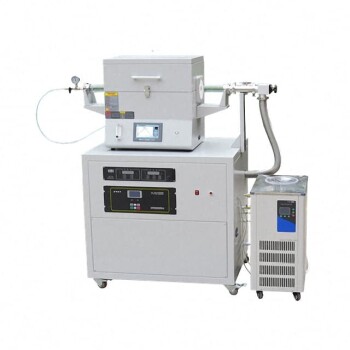
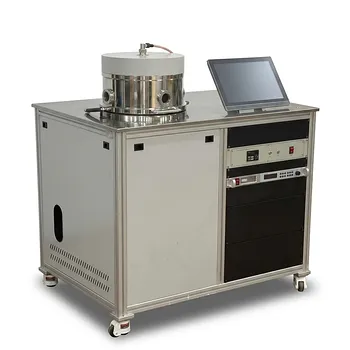
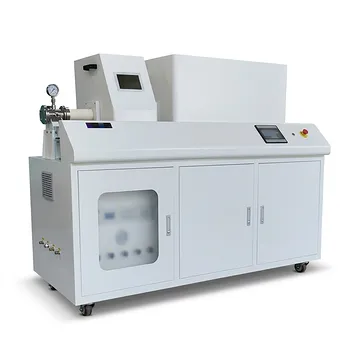
The high-vacuum tube furnace serves as the critical reaction chamber in the Chemical Vapor Deposition (CVD) process, providing a precisely controlled environment for graphene synthesis. It functions by heating carbon-containing precursors to decomposition temperatures while simultaneously maintaining a vacuum to exclude contaminants, allowing carbon atoms to rearrange into a high-quality crystal lattice on a substrate.
Core Takeaway The furnace is not merely a heater; it is a contamination control system. By combining high heat with a high vacuum, it forces organic molecules to break down into pure carbon and assemble into a pristine atomic structure without the interference of atmospheric oxygen or moisture.
The Role of the Thermal Environment
Facilitating Precursor Decomposition
The primary mechanical function of the furnace is to create a high-temperature reducing environment.
The heating system rapidly raises the temperature to a level where carbon-containing precursor gases become unstable. This thermal energy causes the precursors to decompose, liberating the carbon atoms required for growth.
Driving Lattice Formation
Heat is the energy source that allows carbon atoms to migrate across the substrate surface.
This mobility is essential for the atoms to organize themselves into the thermodynamic minimum: the perfect hexagonal honeycomb structure of graphene. Without precise thermal control, the carbon would form amorphous soot rather than ordered crystals.
Heteroatom Elimination
High temperatures facilitate the removal of unwanted non-carbon atoms.
As the organic precursors break down, the heat drives off heteroatoms such as oxygen. This thermal elimination significantly enhances the final material's purity and electrical conductivity.
The Critical Function of High Vacuum
Excluding Air Interference
The most vital role of the vacuum system is purity preservation.
It evacuates the tube to exclude atmospheric air, specifically oxygen and water vapor. Even trace amounts of oxygen during the heating phase can oxidize the carbon, destroying the graphene film or preventing its formation entirely.
Ensuring Crystal Integrity
The vacuum level directly correlates to the structural quality of the graphene.
By maintaining a low-pressure environment, the furnace minimizes collisions between gas molecules and impurities. This ensures the integrity of the crystal lattice structure, reducing defects in single-layer or multi-layer graphene.
Reaction Completeness
A low-pressure environment alters the reaction kinetics inside the tube.
The vacuum helps the physical and chemical reactions proceed more completely. It assists in the efficient transport of reactant gases to the substrate and the removal of gaseous byproducts away from the growth zone.
Understanding the Trade-offs
The Risk of Leakage
The reliance on high vacuum makes the system unforgiving of mechanical faults.
Any breach in the seal or micro-cracks in the ceramic/metal tube will introduce atmospheric contaminants immediately. This results in "doped" or defective graphene, rendering the batch unusable for high-performance electronics.
Thermal Inertia vs. Control
While the furnace must reach high temperatures, the stability of that temperature is harder to maintain than the heat itself.
Fluctuations in the heating zone can lead to uneven growth rates. This often results in patchy coverage, where some areas are single-layer graphene and others are uncontrolled multi-layers.
Making the Right Choice for Your Goal
To optimize your CVD process, align your equipment usage with your specific end-goal requirements:
- If your primary focus is Electrical Conductivity: Prioritize high vacuum levels to ensure maximum removal of heteroatoms and lattice defects.
- If your primary focus is Uniformity: Focus on the precision of the heating zone to ensure the temperature profile is consistent across the entire substrate.
- If your primary focus is Scalability: Ensure the tube material (ceramic or metal) has high thermal shock resistance to withstand rapid heating and cooling cycles.
The high-vacuum tube furnace is the gatekeeper of quality; its ability to isolate the reaction determines whether you produce high-performance graphene or simple amorphous carbon.
Summary Table:
| Feature | Function in Graphene CVD | Benefit to Final Material |
|---|---|---|
| High-Temperature Heating | Decomposes carbon precursors and drives lattice formation | Ensures high-purity, hexagonal honeycomb crystal structure |
| High-Vacuum System | Excludes atmospheric oxygen, moisture, and contaminants | Prevents oxidation and reduces structural defects |
| Controlled Environment | Facilitates gas transport and removal of byproducts | Enhances electrical conductivity and film uniformity |
| Precise Thermal Zones | Maintains consistent temperature across the substrate | Ensures uniform single-layer growth and coverage |
Elevate Your Graphene Research with KINTEK Precision
Achieve unparalleled purity and crystal integrity in your CVD processes with KINTEK’s advanced laboratory solutions. As specialists in high-performance thermal technology, we provide the critical tools necessary for cutting-edge material synthesis, including:
- High-Temperature Furnaces: Precision-engineered muffle, tube, vacuum, CVD, and PECVD systems designed for stable reaction environments.
- Comprehensive Lab Equipment: From high-pressure reactors and autoclaves to crushing, milling, and pellet presses for sample preparation.
- Advanced Research Tools: Specialized battery research equipment, electrolytic cells, and high-purity consumables like PTFE and ceramics.
Whether you are scaling production or perfecting single-layer graphene, KINTEK offers the technical expertise and equipment durability your lab demands. Contact our experts today to find the perfect furnace for your application!
References
- Xinyang Wang. Literature review on the application of graphene in the field of seawater desalination. DOI: 10.61173/bnd8vz96
This article is also based on technical information from Kintek Solution Knowledge Base .
Related Products
- Split Chamber CVD Tube Furnace with Vacuum Station Chemical Vapor Deposition System Equipment Machine
- Customer Made Versatile CVD Tube Furnace Chemical Vapor Deposition Chamber System Equipment
- Graphite Vacuum Furnace High Thermal Conductivity Film Graphitization Furnace
- Vertical High Temperature Graphite Vacuum Graphitization Furnace
- Ultra-High Temperature Graphite Vacuum Graphitization Furnace
People Also Ask
- What is the function of a tube furnace in CVD SiC synthesis? Achieving Ultra-Pure Silicon Carbide Powders
- What is a CVD tube furnace? A Complete Guide to Thin-Film Deposition
- What is the function of a high-temperature CVD tube furnace in 3D graphene foam prep? Master 3D Nanomaterial Growth
- How does a CVD tube furnace inhibit the sintering of silver supports? Boost Membrane Durability and Performance
- What functions does a tube CVD furnace perform during the stabilization and carbonization of composite fibers?