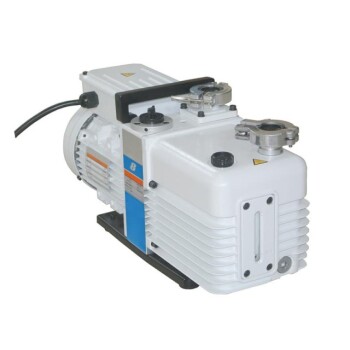
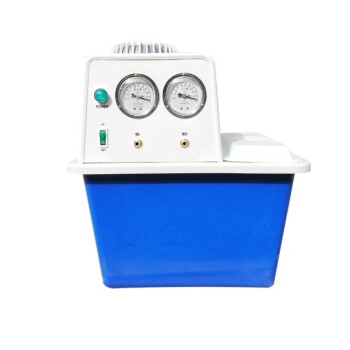
Maintaining a low reaction pressure significantly alters the gas phase dynamics during the deposition of Boron-Doped Diamond (BDD) films. By utilizing a vacuum pump system to hold the pressure at levels such as 2000 Pa, you optimize the transport of active species to the substrate, directly resulting in finer grain structures and superior mechanical properties.
The core advantage of this low-pressure environment is the reduction of particle collisions in the gas phase. This preserves the energy of active species, driving high-density nucleation and producing nanocrystalline films with low stress and high surface area.
The Physics of Gas Phase Dynamics
To understand why 2000 Pa is advantageous, you must look at how particles behave in the vacuum chamber.
Increasing the Mean Free Path
Lowering the pressure reduces the density of gas particles. This increases the "mean free path"—the average distance a particle travels before hitting another particle.
Reducing Collision Losses
With a longer mean free path, active species suffer fewer collisions in the gas phase. This minimizes energy loss and prevents premature reactions before the species reach the deposition surface.
Impact on Nucleation and Growth
The efficient delivery of active species changes how the diamond crystals form and grow.
Enhancing Nucleation Density
Because more active species reach the substrate with sufficient energy, the number of initial growth sites (nucleation density) increases significantly.
Promoting Secondary Nucleation
The environment fosters a high rate of secondary nucleation. Instead of existing grains simply growing larger, new grains continuously form.
Refining Diamond Grains
The combination of high nucleation density and secondary nucleation prevents the formation of large, blocky crystals. The result is a highly refined, nanocrystalline structure.
Resulting Material Properties
The structural changes at the microscopic level translate into specific physical advantages for the BDD film.
Lowering Residual Stress
Films grown at these pressures exhibit lower residual stress. The refined grain structure accommodates internal tension better than coarse-grained films, reducing the risk of delamination or cracking.
Increasing Specific Surface Area
Nanocrystalline films naturally possess a much higher specific surface area than microcrystalline equivalents. This maximizes the active area available for surface interactions.
Understanding the Operational Trade-offs
While low pressure offers significant benefits, it introduces specific challenges that must be managed.
Precision Vacuum Control
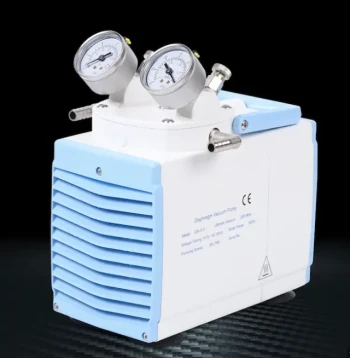
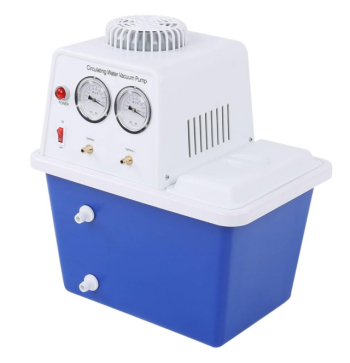
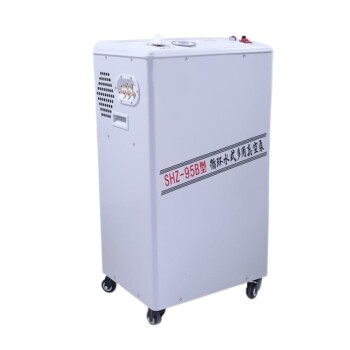
Maintaining a stable pressure like 2000 Pa requires a robust vacuum pump system capable of handling the gas load without fluctuation. Instability here can lead to inconsistent grain sizes.
System Complexity
Operating in this vacuum regime increases the complexity of the equipment compared to atmospheric pressure setups. The vacuum seals and pump maintenance become critical factors in production uptime.
Making the Right Choice for Your Goal
Deciding to target 2000 Pa depends on the specific requirements of your application.
- If your primary focus is mechanical durability: Leverage low pressure to minimize residual stress, ensuring the film remains intact under physical load.
- If your primary focus is surface reactivity: Target the high specific surface area of nanocrystalline films to maximize the interface for electrochemical or chemical reactions.
Optimizing pressure is not merely an operational setting; it is a tool for engineering the microscopic architecture of your diamond film.
Summary Table:
| Parameter | Advantage at 2000 Pa | Impact on BDD Quality |
|---|---|---|
| Mean Free Path | Increased | Fewer gas-phase collisions; preserves energy of active species. |
| Nucleation Rate | Enhanced | Higher density of growth sites; facilitates nanocrystalline formation. |
| Grain Structure | Refined | Prevents large, blocky crystals; produces smoother surfaces. |
| Internal Stress | Reduced | Decreased residual tension; lowers risk of film delamination. |
| Surface Area | Maximized | High specific surface area for superior electrochemical reactivity. |
Optimize Your Diamond Thin Film Research with KINTEK
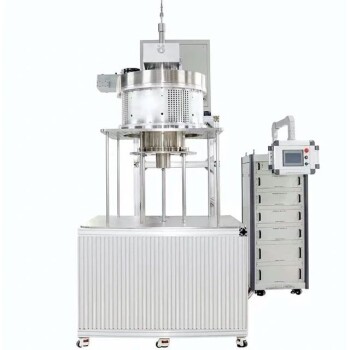
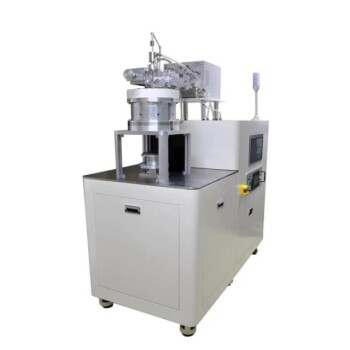
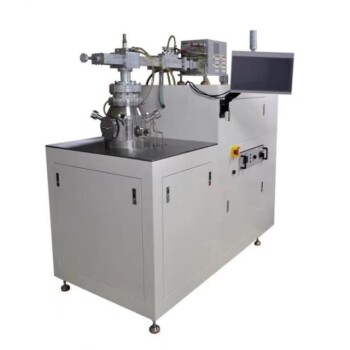
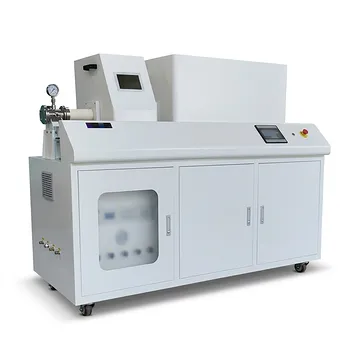
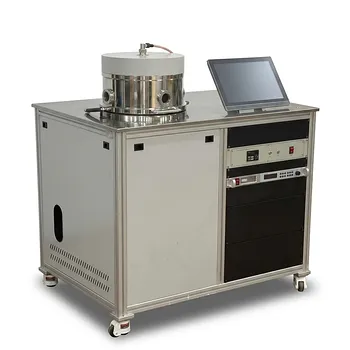
Precision at 2000 Pa requires uncompromising vacuum performance. KINTEK specializes in advanced laboratory solutions, providing the high-performance MPCVD and CVD systems, robust vacuum pump configurations, and precision control tools necessary for superior Boron-Doped Diamond deposition.
Whether you are scaling up electrochemical applications or engineering wear-resistant coatings, our portfolio—including high-temperature furnaces, crushing systems, and specialized ceramics—is designed to meet the rigorous demands of material science.
Ready to refine your BDD grain structure? Contact our technical experts today to find the perfect vacuum and deposition solution for your laboratory.
References
- Tao Zhang, Guangpan Peng. Fabrication of a boron-doped nanocrystalline diamond grown on an WC–Co electrode for degradation of phenol. DOI: 10.1039/d2ra04449h
This article is also based on technical information from Kintek Solution Knowledge Base .
Related Products
- Laboratory CVD Boron Doped Diamond Materials
- HFCVD Machine System Equipment for Drawing Die Nano-Diamond Coating
- 915MHz MPCVD Diamond Machine Microwave Plasma Chemical Vapor Deposition System Reactor
- Microwave Plasma Chemical Vapor Deposition MPCVD Machine System Reactor for Lab and Diamond Growth
- CVD Diamond Dressing Tools for Precision Applications
People Also Ask
- What is the purpose of adding a boron source in CVD diamond growth? Master P-Type Semiconductor Conductivity
- What materials are CVD deposition? From Semiconductors to Super-Hard Coatings
- What are the advantages of BDD electrodes? Maximize Wastewater Treatment Efficiency and Durability
- What are the applications of CVD diamonds? From Jewelry to High-Tech Tools
- Are CVD diamonds good? Real Diamonds with Ethical Origins & Better Value