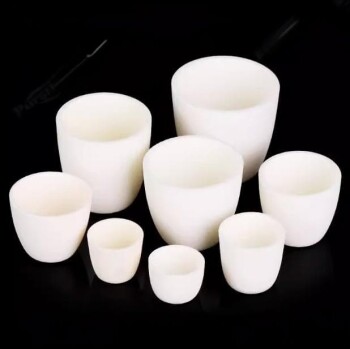
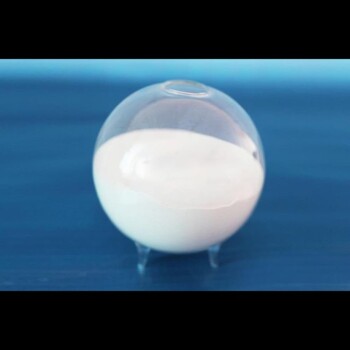
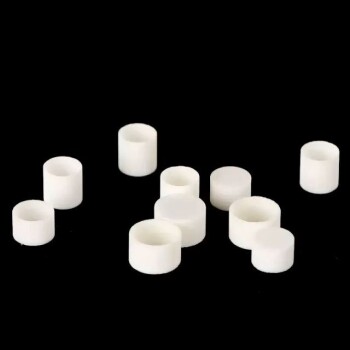
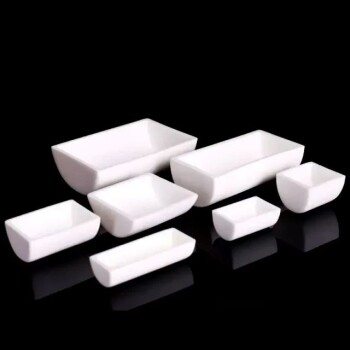
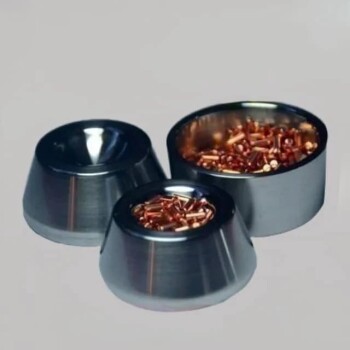
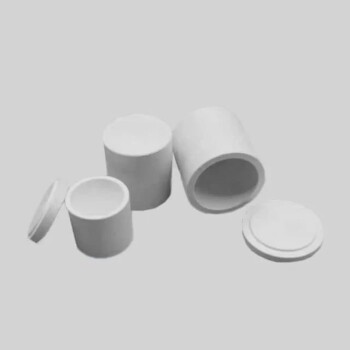
High-purity alumina crucibles are the preferred choice for vanadium-based catalyst analysis because they provide exceptional chemical inertness and thermal stability under oxidative conditions. These containers ensure that the endothermic and exothermic signals captured during Differential Scanning Calorimetry (DSC) originate exclusively from the catalyst's phase transitions or reactions, rather than interactions with the crucible itself.
By eliminating chemical interference from vanadium oxides and promoters like potassium salts, high-purity alumina crucibles guarantee the integrity of thermodynamic data. This chemical neutrality is critical for identifying precise transition temperatures and reaction enthalpies in complex catalytic systems.
Achieving Chemical Inertness in Reactive Environments
Resistance to Corrosive Vanadium Oxides
Vanadium-based catalysts often involve vanadium oxides and potassium salts that become highly reactive under high-temperature oxidative conditions. High-purity alumina is uniquely capable of resisting these components, ensuring no chemical reaction occurs between the sample and the container.
Prevention of Signal Interference
Because the crucible remains chemically neutral, the DSC equipment only records the internal phase transitions of the catalyst. This isolation is vital for accurately calculating the solidus and liquidus temperatures or identifying specific crystallization points without "noise" from container-sample reactions.
Maintaining Sample Purity
Using high-purity alumina prevents the introduction of impurities into the catalyst precursor during thermal cycling. This ensures that the physical properties observed after the experiment, such as magnetic performance or adsorption capacity, are representative of the material itself and not affected by crucible contamination.
Enhancing Thermal Precision and Data Accuracy
Superior Thermal Conductivity
High-purity alumina offers excellent thermal conductivity, which is essential for rapid and uniform heat transfer. This allows the DSC sensors to detect even subtle heat flow changes, ensuring that the baseline measurements remain stable and the resulting peaks are sharp and well-defined.
High-Temperature Refractoriness
These crucibles maintain their structural integrity at temperatures exceeding 1200°C, far beyond the typical operating range for most catalyst studies. Their high refractoriness prevents deformation or softening, which could otherwise damage sensitive equipment sensors during high-temperature runs.
Consistency Across Cycles
The ability of alumina to withstand high-temperature cycling without degrading makes it a reliable medium for repetitive testing. This stability ensures that results are reproducible across multiple samples, which is a cornerstone of rigorous technical analysis.
Understanding the Trade-offs
Thermal Shock Sensitivity
While alumina is chemically robust, it can be sensitive to rapid temperature changes. Heating or cooling the crucibles too quickly can lead to cracking, meaning experimental protocols must include controlled ramp rates to preserve the container.
Material Purity vs. Cost
Lower-grade ceramic crucibles may seem cost-effective but often contain silicon dioxide (SiO2) or other binders. These impurities can react with acidic or alkaline mineral components in the catalyst, leading to chemical erosion and inaccurate thermal data.
Making the Right Choice for Your Goal
Selecting the correct crucible is a balance between the specific chemistry of your catalyst and the precision required for your study.
- If your primary focus is absolute data precision: Utilize high-purity (99.9%+) alumina crucibles to eliminate any risk of side reactions with vanadium oxides.
- If your primary focus is protecting sensitive DSC sensors: Stick to high-quality alumina to prevent sample leakage or chemical "attack" on the sensor platform caused by crucible failure.
- If your primary focus is analyzing volatile components: Ensure you use alumina crucibles with compatible, high-purity lids to prevent mass loss from interfering with the baseline heat flow.
Choosing high-purity alumina ensures that your thermal analysis reflects the true behavior of the catalyst, providing the reliable foundation necessary for advanced material development.
Summary Table:
| Feature | Advantage for DSC Experiments | Impact on Research |
|---|---|---|
| Chemical Inertness | Resists corrosive vanadium oxides and salts | Eliminates signal interference and baseline noise |
| Thermal Stability | Maintains integrity above 1200°C | Protects sensitive sensors and prevents leakage |
| High Conductivity | Ensures rapid and uniform heat transfer | Produces sharp, well-defined peaks for enthalpy data |
| 99.9%+ Purity | Zero interaction with catalyst precursors | Guarantees integrity of thermodynamic measurements |
Elevate Your Thermal Analysis with KINTEK Precision
Don't let crucible contamination compromise your research data. KINTEK specializes in providing high-performance laboratory solutions tailored for advanced material science. Whether you are analyzing complex vanadium catalysts or developing next-generation precursors, our high-purity alumina crucibles, ceramics, and specialized crucibles ensure the chemical neutrality and thermal precision your DSC experiments demand.
Beyond consumables, KINTEK offers a comprehensive range of equipment to support your entire workflow, including:
- High-Temperature Furnaces: Muffle, tube, and vacuum furnaces for precise thermal treatment.
- Sample Preparation: Crushing, milling systems, and hydraulic pellet presses.
- Thermal Management: Cooling solutions like ULT freezers and freeze dryers.
Ready to achieve superior data integrity? Contact our technical experts today to find the perfect crucible and furnace configuration for your specific laboratory needs.
References
- Ezgi Erdem, Annette Trunschke. The Influence of Melting on Catalysis in Propane Oxidation. DOI: 10.1002/cctc.202301242
This article is also based on technical information from Kintek Solution Knowledge Base .
Related Products
- Arc-Shaped Alumina Ceramic Crucible High Temperature Resistant for Engineering Advanced Fine Ceramics
- Engineering Advanced Fine Alumina Al2O3 Ceramic Crucible for Laboratory Muffle Furnace
- High Purity Alumina Granulated Powder for Engineering Advanced Fine Ceramics
- Engineering Advanced Fine Ceramics Alumina Al2O3 Crucible With Lid Cylindrical Laboratory Crucible
- Engineering Advanced Fine Ceramics Alumina Crucibles (Al2O3) for Thermal Analysis TGA DTA
People Also Ask
- Why Use Alumina Crucibles & Powder Burial for NaSICON? Ensure Phase Purity and Prevent Elemental Volatilization
- What is the primary purpose of using alumina crucibles for LLTO ceramics? Optimize Your High-Temperature Sintering
- Why are alumina crucibles and mother powder essential for LATP sintering? Optimize Your Solid Electrolyte Performance
- Why are high-purity alumina crucibles used for liquid lead corrosion experiments? Ensure Data Accuracy at 550°C
- Primary considerations for choosing alumina crucibles and quartz tubes in indium intercalation: Ensure Material Purity