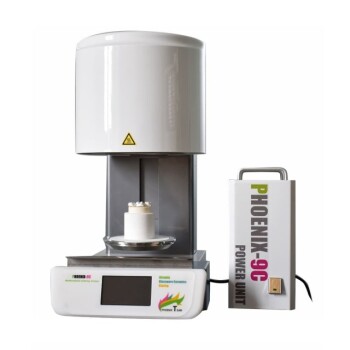
Spark Plasma Sintering (SPS) offers a decisive advantage over traditional hot pressing by utilizing pulsed electric currents to generate internal Joule heating. This mechanism allows for heating rates up to 1000°C/min, enabling the densification process to be completed in minutes rather than the hours or days required by conventional methods.
Core Insight: The primary value of SPS is not just speed, but the preservation of microstructural integrity. By minimizing high-temperature dwell time, SPS achieves high density without allowing excessive grain growth or damaging the critical interface between the fiber and the matrix, resulting in superior fracture toughness.
The Mechanics of Rapid Densification
Internal Joule Heating
Unlike traditional hot pressing, which relies on external heating elements to slowly transfer heat to the sample, SPS generates heat internally. The furnace applies a pulsed current directly through the graphite mold (and the sample, if conductive), creating Joule heat.
Extreme Heating Rates
This internal heating mechanism allows for temperature ramp rates as high as 1000°C/min. In comparison, conventional external heating typically manages only 5 to 10°C/min.
Drastically Reduced Processing Time
Because of the rapid ramp rates, the total sintering cycle is compressed significantly. A process that might require holding a temperature for hours in a hot press can often be completed with a holding time of just 5 to 10 minutes in an SPS furnace.
Preserving Microstructure and Performance
Inhibiting Grain Growth
The extended high-temperature exposure common in hot pressing allows grains within the ceramic matrix to grow excessively, which can weaken the material. The rapid cooling and short dwell times of SPS effectively inhibit this growth, preserving a fine-grained, robust microstructure.
Protecting the Fiber-Matrix Interface
For Ultra-High Temperature Ceramic Matrix Composites (UHTCMCs), the interface between the reinforcing fiber and the ceramic matrix is critical for mechanical performance. SPS minimizes the reaction time at high temperatures, preventing damage to this interface that often occurs during the long soak times of hot pressing.
Maximizing Fracture Toughness
The combination of high density and a preserved fiber-matrix interface directly correlates to mechanical performance. SPS ensures the composite achieves full density while retaining maximum fracture toughness, a balance that is often difficult to strike with slower sintering methods.
Understanding the Comparison: SPS vs. Hot Pressing
Elimination of Impurities
Traditional hot pressing can achieve dense ceramics, but it introduces the risk of forming unwanted glass phases within the material. SPS bypasses this issue through its rapid densification process, yielding a "cleaner" material with uniform pores and fewer defects.
The Role of Graphite Molds
In SPS, the mold is an active component of the process, acting as both the heating element and the pressure vessel. These high-strength graphite molds ensure uniform heating and shape retention even at sintering temperatures exceeding 2000°C.
Making the Right Choice for Your Project
If you are deciding between SPS and traditional hot pressing for UHTCMCs, consider your specific performance targets:
- If your primary focus is Fracture Toughness: Choose SPS to minimize interface reaction damage and preserve the reinforcing properties of the fibers.
- If your primary focus is Microstructural Control: Choose SPS to inhibit abnormal grain growth and avoid the formation of unwanted glass phases.
- If your primary focus is Efficiency: Choose SPS to reduce processing times from hours to minutes, significantly lowering energy consumption.
SPS is the superior choice for UHTCMCs when the goal is to achieve full density without compromising the delicate microstructural features that provide the material's strength.
Summary Table:
| Feature | Spark Plasma Sintering (SPS) | Traditional Hot Pressing |
|---|---|---|
| Heating Mechanism | Internal Joule Heating (Pulsed Current) | External Heating Elements |
| Heating Rate | Up to 1000°C/min | 5 - 10°C/min |
| Sintering Time | Minutes | Hours to Days |
| Grain Growth | Inhibited (Fine-grained) | High (Coarsened) |
| Interface Protection | Maximum (Short dwell time) | Low (Thermal degradation) |
| Fracture Toughness | Superior preservation | Often compromised |
Elevate Your Material Research with KINTEK
Unlock the full potential of Ultra-High Temperature Ceramic Matrix Composites with KINTEK’s advanced Spark Plasma Sintering (SPS) systems. Our high-performance sintering solutions—including specialized graphite molds and vacuum/atmosphere furnaces—ensure your materials achieve peak density while preserving critical microstructural integrity and fracture toughness.
From high-temperature reactors to precision hydraulic presses, KINTEK provides the comprehensive laboratory equipment needed for cutting-edge battery research and advanced ceramics development.
Ready to reduce your processing time from hours to minutes? Contact us today to find the perfect solution for your lab!
Related Products
- Spark Plasma Sintering Furnace SPS Furnace
- Vacuum Heat Treat and Pressure Sintering Furnace for High Temperature Applications
- 600T Vacuum Induction Hot Press Furnace for Heat Treat and Sintering
- Ultra-High Temperature Graphite Vacuum Graphitization Furnace
- Small Vacuum Heat Treat and Tungsten Wire Sintering Furnace
People Also Ask
- What is SPS sintering method? A Guide to High-Speed, High-Performance Material Fabrication
- Why are Spark Plasma Sintering (SPS) furnaces or hot presses utilized in the preparation of Li3PS4 solid electrolytes?
- What is the difference between spark plasma sintering and flash sintering? A Guide to Advanced Sintering Methods
- What technical advantages does a Spark Plasma Sintering (SPS) furnace offer for LZP ceramics? Enhance Ionic Conductivity
- What is the theory of spark plasma sintering? A Guide to Rapid, Low-Temperature Densification