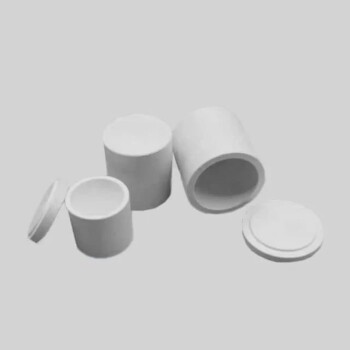
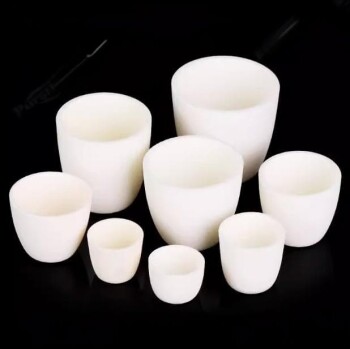
A dual-crucible configuration utilizing Yttria-Stabilized Zirconia (YSZ) and Magnesium Oxide (MgO) provides a critical defense against the aggressive nature of molten oxide electrolytes. This system combines the superior chemical inertness of YSZ for direct melt contact with the structural redundancy of an outer MgO vessel to safeguard your furnace's heating elements.
While the inner YSZ crucible resists erosion up to 1,600°C, the outer MgO layer acts as a fail-safe mechanism. This redundancy is essential for preventing catastrophic equipment damage caused by highly corrosive melt leakage.
The First Line of Defense: Yttria-Stabilized Zirconia (YSZ)
Superior Erosion Resistance
The inner crucible, made of YSZ, is selected specifically for its chemical stability. It serves as the primary vessel, maintaining direct contact with the corrosive molten oxide.
Handling Extreme Temperatures
YSZ is engineered to withstand extreme thermal environments. It exhibits excellent resistance to erosion at operating temperatures as high as 1,600 degrees Celsius, ensuring the integrity of the electrolysis process.
The Safety Net: Magnesium Oxide (MgO)
Secondary Containment
The outer crucible is constructed from Magnesium Oxide (MgO). Its primary function is not to interact with the melt, but to act as a secondary barrier in the event of an inner crucible failure.
Protecting Core Infrastructure
If the primary YSZ vessel cracks or leaks, the MgO crucible captures the escaping melt. This prevents the corrosive material from reaching and destroying the heating elements and the core structure of the high-temperature tube furnace.
Understanding the Operational Trade-offs
The Necessity of Redundancy
While YSZ is highly resistant, the existence of this dual system acknowledges a fundamental reality: ceramic failure is a possibility. The added complexity of a second crucible is a necessary trade-off to mitigate the high cost of furnace repair.
Thermal Considerations
Using two layers adds thermal mass to the system. While the reference focuses on containment, operators must be aware that heating and cooling cycles may require careful management to ensure both crucibles expand and contract without inducing mechanical stress.
Making the Right Choice for Your Goal
To maximize the lifespan of your high-temperature electrolysis setup, consider the following regarding your containment strategy:
- If your primary focus is process stability: Rely on the YSZ inner crucible to maintain chemical purity and resist erosion during high-temperature operations up to 1,600°C.
- If your primary focus is equipment safety: Prioritize the integrity of the outer MgO crucible to ensure a reliable fail-safe against melt leakage and furnace contamination.
By layering these materials, you transform a volatile high-temperature process into a manageable and secure operation.
Summary Table:
| Component | Material | Primary Function | Temperature Limit | Key Benefit |
|---|---|---|---|---|
| Inner Crucible | Yttria-Stabilized Zirconia (YSZ) | Direct Melt Contact | Up to 1,600°C | High chemical inertness & erosion resistance |
| Outer Crucible | Magnesium Oxide (MgO) | Secondary Containment | High-Temp Stable | Fail-safe protection for furnace heating elements |
| Full System | Dual-Layer Configuration | Process Security | Optimized for 1,600°C | Prevents equipment damage from corrosive leaks |
Secure Your High-Temperature Research with KINTEK
Don't let corrosive melts compromise your laboratory's productivity or damage expensive equipment. KINTEK specializes in providing high-performance laboratory solutions, from precision-engineered YSZ and MgO crucibles to advanced high-temperature tube furnaces and electrolytic cells.
Whether you are performing complex electrolysis, battery research, or material synthesis, our comprehensive range of high-temperature high-pressure reactors, ceramic consumables, and cooling solutions ensures your experiments are both safe and successful. Our team of experts is ready to help you select the ideal containment strategy tailored to your specific thermal and chemical requirements.
Enhance your lab's safety and efficiency today—Contact KINTEK for a customized solution!
References
- M. Esmaily, Antoine Allanore. Oxidation and electrical properties of chromium–iron alloys in a corrosive molten electrolyte environment. DOI: 10.1038/s41598-020-71903-0
This article is also based on technical information from Kintek Solution Knowledge Base .
Related Products
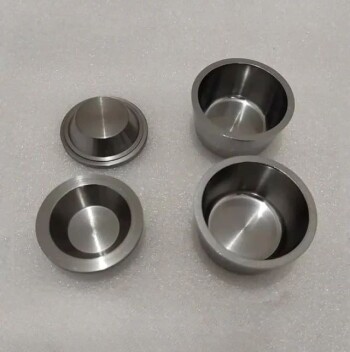
- Electron Beam Evaporation Coating Tungsten Crucible and Molybdenum Crucible for High Temperature Applications
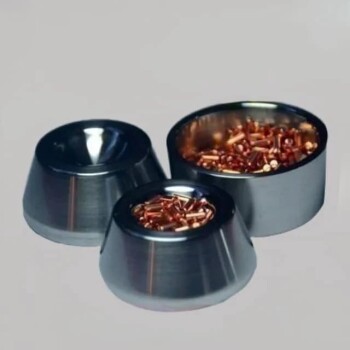
- Electron Beam Evaporation Coating Gold Plating Tungsten Molybdenum Crucible for Evaporation
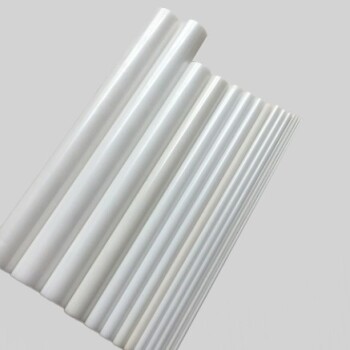
- Precision Machined Yttrium Stabilized Zirconia Ceramic Rod for Engineering Advanced Fine Ceramics
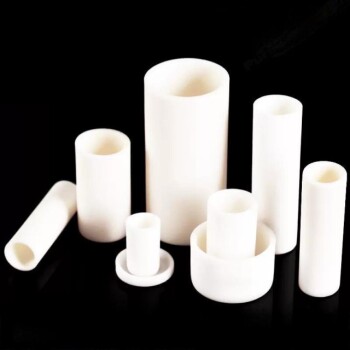
- Engineering Advanced Fine Ceramics Alumina Al2O3 Crucible With Lid Cylindrical Laboratory Crucible
- Evaporation Crucible for Organic Matter
People Also Ask
- What is the container that holds the metal source material called in e-beam evaporation? Ensure Purity and Quality in Your Thin-Film Deposition
- What materials are used in electron beam evaporation? Master High-Purity Thin Film Deposition
- What is the voltage of e-beam evaporation? Achieve Precise Thin-Film Deposition
- What are the applications of e-beam evaporation? Achieve High-Purity Coatings for Optics & Electronics
- What is e-beam evaporation? Achieve High-Purity Thin Film Deposition for Your Lab