Freeze-drying significantly outperforms traditional evaporation for perovskite-type cathode powders by fundamentally altering the solvent removal process to preserve particle integrity. While traditional methods often lead to clumping, freeze-drying utilizes vacuum sublimation to produce precursor powders that are physically fine, highly porous, and chemically reactive.
Core Takeaway: By removing solvents through sublimation rather than liquid evaporation, freeze-drying eliminates particle agglomeration. This results in a high-activity precursor that reliably yields high-purity, single-phase perovskite powders after calcination.
The Mechanism of Quality Improvement
Sublimation vs. Evaporation
The primary technical advantage lies in how the solvent is removed. Traditional evaporation forces the material through a liquid phase, which promotes density and clumping.
In contrast, a freeze dryer operates under high vacuum and low-temperature conditions.
This environment forces the solvent to sublime—transitioning directly from a solid state to a gas—completely bypassing the liquid phase.
Preventing Agglomeration
The most critical issue with liquid-phase evaporation is particle agglomeration.
As the liquid evaporates, surface tension and capillary forces often pull particles together, forming hard, dense aggregates.
Freeze-drying prevents this phenomenon entirely. Because the structure is frozen in place before solvent removal, the particles remain distinct and separated throughout the process.
Impact on Powder Characteristics
Physical Structure and Fineness
The resulting precursor powders exhibit superior physical properties.
Because the particles do not agglomerate, the powder retains high physical fineness.
Furthermore, the removal of ice crystals leaves behind voids, creating a desirable porous structure that increases surface area.
Reaction Activity and Phase Purity
The physical structure directly influences chemical behavior.
The porous, fine nature of the freeze-dried precursor ensures high reaction activity.
This enhanced reactivity is crucial during the subsequent high-temperature calcination step, ensuring the successful formation of high-purity single-phase perovskite powders.
Operational Considerations
The Limits of Evaporation
It is important to recognize why traditional evaporation is often insufficient for high-performance applications.
While evaporation is a standard process, it structurally degrades the precursor by collapsing the pore structure.
This leads to lower reactivity and potential impurities in the final crystal lattice due to uneven heating of agglomerated clumps.
The Requirement for Control
Freeze-drying is a precision process.
It relies strictly on maintaining specific low-temperature and high-vacuum parameters.
Failure to maintain these conditions can allow partial melting, which would reintroduce the agglomeration issues found in evaporation.
Making the Right Choice for Your Goal
To maximize the quality of your perovskite cathode materials, align your synthesis method with your specific structural requirements:
- If your primary focus is maximizing surface area: Utilize freeze-drying to create a porous, fine precursor structure that evaporation cannot achieve.
- If your primary focus is chemical purity: Rely on freeze-drying to prevent agglomeration, ensuring the high reactivity needed to obtain a single-phase product during calcination.
Ultimately, freeze-drying is the superior choice for applications where particle fineness and phase purity are non-negotiable.
Summary Table:
| Feature | Traditional Evaporation | Freeze-Drying (Sublimation) |
|---|---|---|
| Phase Transition | Liquid to Gas | Solid to Gas (Sublimation) |
| Particle Structure | Dense, agglomerated clumps | Fine, porous, and distinct |
| Surface Area | Low due to collapsed pores | High due to preserved voids |
| Reaction Activity | Moderate to Low | High (highly reactive precursor) |
| Final Product Quality | Risk of impurities/multi-phase | High-purity, single-phase perovskite |
Elevate Your Material Synthesis with KINTEK Precision
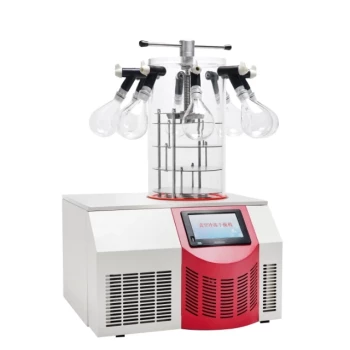
Don't let particle agglomeration compromise your research. KINTEK specializes in advanced laboratory solutions, offering high-performance freeze dryers and cold traps designed to maintain the low-temperature, high-vacuum environments essential for perovskite-type cathode preparation.
Whether you are developing next-generation batteries or advanced ceramics, our comprehensive portfolio—including high-temperature furnaces, planetary ball mills, and battery research tools—ensures you achieve the physical fineness and chemical purity your applications demand.
Ready to optimize your powder characteristics? Contact KINTEK today to discover how our freeze-drying technology can transform your material processing workflow.
References
- Selene Díaz-González, A.D. Lozano-Gorrı́n. RE0.01Sr0.99Co0.5Fe0.5O3 (RE = La, Pr, and Sm) Cathodes for SOFC. DOI: 10.3390/cryst14020143
This article is also based on technical information from Kintek Solution Knowledge Base .
Related Products
- Benchtop Laboratory Freeze Dryer for Lab Use
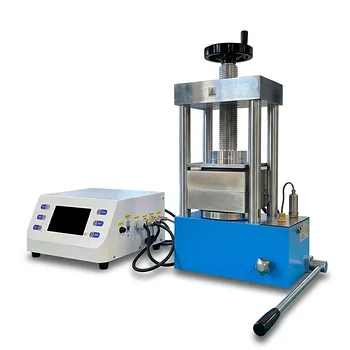
- Automatic Laboratory Hydraulic Pellet Press Machine for Lab Use
- Graphite Vacuum Furnace IGBT Experimental Graphitization Furnace
- Small Vacuum Heat Treat and Tungsten Wire Sintering Furnace
- Vacuum Hot Press Furnace Machine for Lamination and Heating
People Also Ask
- How does laboratory freeze drying work to preserve biological products? The Ultimate Guide to Lyophilization
- What factors should be considered when choosing a freeze dryer? Align Performance with Your Lab's Needs
- What should be considered when choosing a lab freeze dryer? Match Your Samples and Workflow for Success
- What types of Laboratory Freeze Dryers are available and what are their applications? Choose the Right Lyophilizer for Your Lab
- Why is a Laboratory Freeze Dryer essential? Preserve Sample Integrity for Long-Term Stability