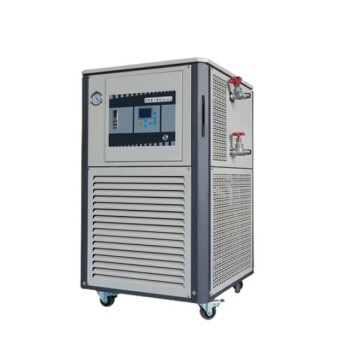
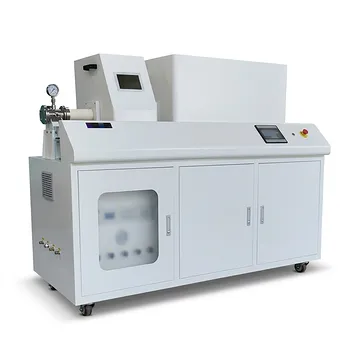
Using a gas-phase reaction device equipped with a reflux condensation system fundamentally optimizes the amination of g-C3N4 by utilizing vapor-solid interactions instead of liquid immersion. This method allows the nanosheets to react specifically with reactant vapors—such as nitric acid or ethylenediamine—yielding dry, modified samples directly without the need for solvent removal.
By shifting from liquid-phase to vapor-phase reactions, this system bypasses the labor-intensive post-processing steps of filtering and washing while preserving the delicate morphology of the nanosheets, resulting in a significantly more efficient and less destructive functionalization process.
Transforming Process Efficiency
Elimination of Complex Post-Processing
Traditional modification methods often require the g-C3N4 to be immersed in a liquid phase, which necessitates a chain of labor-intensive steps.
By using a gas-phase device, you completely eliminate the need for complex filtering and washing procedures.
Direct Acquisition of Dry Product
In liquid-phase reactions, long drying times are a standard bottleneck.
This reflux system allows for the direct collection of dry, modified nanosheets. This significantly shortens the overall production cycle and increases the throughput of the functionalization process.
Preserving Material Integrity
Undamaged Morphology
Subjecting nanomaterials to liquid solvents and subsequent mechanical processing (like stirring or filtration) can physically alter or damage their structure.
By reacting solely with vapors, the g-C3N4 nanosheets are treated gently. This ensures the final modified product retains its original morphology, leading to higher quality functionalization.
Understanding the Operational Requirements
Dependence on Reactant Volatility
While this system offers superior efficiency, it relies heavily on the ability of the modifying agent to vaporize.
The system is specifically designed to facilitate reactions with vapors of substances like nitric acid or ethylenediamine. Consequently, this method is best suited for reactants that can easily transition to the gas phase within the device's operating parameters.
Making the Right Choice for Your Goal
To determine if this modification method aligns with your project requirements, consider your specific priorities:
- If your primary focus is Process Efficiency: This system is ideal as it removes the time-consuming bottlenecks of filtering, washing, and drying associated with liquid-phase chemistry.
- If your primary focus is Material Quality: The gas-phase approach provides a distinct advantage by preserving the delicate morphology of the nanosheets, preventing structural damage common in immersion methods.
Ultimately, this device transforms amination from a multi-step wet chemical process into a streamlined vapor-phase operation that yields high-quality, dry nanosheets.
Summary Table:
| Feature | Traditional Liquid-Phase | Gas-Phase with Reflux System |
|---|---|---|
| Processing Steps | Requires filtering, washing, and drying | Direct collection of dry product |
| Material Integrity | Risk of morphological damage | Preserves delicate nanosheet structure |
| Efficiency | Low (bottlenecked by solvent removal) | High (streamlined vapor-solid interaction) |
| Key Reactants | Various liquid solvents | Volatile agents (e.g., Nitric acid, Ethylenediamine) |
Elevate Your Material Research with KINTEK
Unlock the full potential of your nanomaterial functionalization with KINTEK’s precision-engineered laboratory solutions. Whether you are performing advanced amination of g-C3N4 or complex vapor-phase synthesis, our high-performance equipment ensures superior material integrity and process efficiency.
Why choose KINTEK?
- Comprehensive High-Temp Solutions: From muffle and vacuum furnaces to advanced CVD and PECVD systems.
- Precision Reaction Tools: High-temperature high-pressure reactors, autoclaves, and specialized gas-phase devices.
- Material Preparation Excellence: Top-tier crushing, milling, and hydraulic press systems (pellet, hot, isostatic) for consistent results.
- End-to-End Lab Support: Cooling solutions, shakers, and high-quality consumables like PTFE and ceramics.
Don't let inefficient post-processing slow down your breakthroughs. Contact KINTEK today to discover how our specialized laboratory equipment can streamline your workflow and deliver high-quality, dry-modified samples every time.
References
- Sepideh Pourhashem, Davood Mohammady Maklavany. Developing a new method for synthesizing amine functionalized g-C3N4 nanosheets for application as anti-corrosion nanofiller in epoxy coatings. DOI: 10.1007/s42452-018-0123-7
This article is also based on technical information from Kintek Solution Knowledge Base .
Related Products
- Electrolytic Electrochemical Cell Gas Diffusion Liquid Flow Reaction Cell
- Chemical Vapor Deposition CVD Equipment System Chamber Slide PECVD Tube Furnace with Liquid Gasifier PECVD Machine
- Microwave Plasma Chemical Vapor Deposition MPCVD Machine System Reactor for Lab and Diamond Growth
- Inclined Rotary Plasma Enhanced Chemical Vapor Deposition PECVD Equipment Tube Furnace Machine
- Customer Made Versatile CVD Tube Furnace Chemical Vapor Deposition Chamber System Equipment
People Also Ask
- How does the design of an electrochemical electrolytic cell influence the coating uniformity? Optimize Your Catalysts
- What is the correct shutdown and disassembly procedure after an experiment? Ensure Safety and Protect Your Equipment
- Why are electrolytic cells essential in titanium production? Powering Circular Efficiency and Cost Savings
- What is galvanic cell or electrolytic cell? Unlock the Secrets of Electrochemical Power
- What are the three essential components that comprise an electrolytic cell? Key Elements of Chemical Synthesis