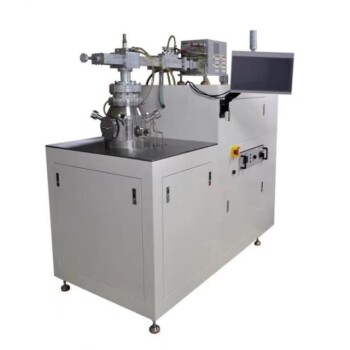
The primary advantage of a Rotary Chemical Vapor Deposition (CVD) reactor is its ability to produce multi-walled carbon nanotubes (MWCNTs) with exceptional structural consistency. By actively rotating the reaction tube, the system keeps catalyst particles in a state of continuous dynamic tumbling, which prevents the material from clumping together and ensures uniform growth.
Core Takeaway In static CVD systems, catalyst particles often agglomerate, leading to uneven nanotube growth. Rotary CVD solves this by keeping the catalyst bed in motion, ensuring every particle receives equal exposure to the carbon source gas for maximum uniformity.
The Mechanics of Uniform Synthesis
Dynamic Tumbling of Catalysts
The defining feature of a Rotary CVD reactor is the physical rotation of the reaction tube. This motion induces a state of continuous dynamic tumbling for the catalyst particles (such as Al2O3-MoO3-Fe2O3).
Unlike static horizontal reactors where catalysts remain stationary, the rotary action physically agitates the bed. This effectively prevents catalyst aggregation, a common issue that inhibits efficient nanotube growth.
Optimized Gas Distribution
In a stationary bed, the carbon source gas often interacts primarily with the top layer of the catalyst. Rotary CVD ensures that the carbon source gases are uniformly distributed throughout the entire catalyst volume.
As the reactor tumbles the catalysts, fresh surface areas are constantly exposed to the gas phase. This maximizes the efficiency of the chemical reaction, ensuring that nucleation occurs evenly across all particles.
High Structural Consistency
The combination of preventing aggregation and equalizing gas exposure leads to a superior end product.
The process yields MWCNTs with high structural consistency. Because the growth environment is uniform for every particle, the resulting nanotubes exhibit a uniform distribution in terms of size and structure, which is difficult to achieve in static bulk synthesis.
Understanding the Trade-offs
While Rotary CVD excels at bulk uniformity, it is essential to understand how it compares to other CVD methods referenced in the broader field.
Alignment vs. Bulk Homogeneity
Rotary CVD is ideal for producing loose, high-quality bulk powders. However, if your application requires vertically aligned arrays, a standard Horizontal or Plasma-Enhanced CVD (PECVD) system is preferable.
PECVD uses electric fields to guide growth directionality relative to the substrate, a feature that the tumbling action of a Rotary reactor inherently disrupts.
Temperature and Complexity
Rotary reactors must maintain mechanical rotation while operating at high temperatures (typically 700–900°C for effective carbon solubility).
While this adds mechanical complexity compared to a standard horizontal tube, it avoids the "shadowing" effects seen in static processes. However, if temperature sensitivity is a major constraint, methods like PECVD can operate at significantly lower temperatures (below 400°C), whereas Rotary CVD generally relies on thermal activation.
Making the Right Choice for Your Goal
To select the correct reactor type, you must prioritize your material requirements:
- If your primary focus is bulk uniformity: Choose Rotary CVD to prevent catalyst clumping and ensure every nanotube has consistent structural properties.
- If your primary focus is directional alignment: Choose PECVD or static Horizontal CVD to grow vertically aligned forests on a fixed substrate.
- If your primary focus is low-temperature processing: Choose PECVD to synthesize materials below 400°C, preserving sensitive substrates.
Summary: Use Rotary CVD when the consistency of the individual nanotube structure is more critical than the alignment of the array.
Summary Table:
| Feature | Rotary CVD Reactor | Static Horizontal CVD | PECVD |
|---|---|---|---|
| Catalyst State | Dynamic Tumbling (Prevents Aggregation) | Stationary (Risk of Agglomeration) | Stationary (Fixed Substrate) |
| Gas Exposure | Uniform distribution across all particles | Surface-level interaction | Highly controlled/Directional |
| Product Uniformity | Exceptional Bulk Consistency | Variable (Shadowing Effects) | High (within local arrays) |
| Best Use Case | Bulk MWCNT powders | Simple experimental synthesis | Vertically aligned arrays |
| Processing Temp | High (700–900°C) | High (Thermal) | Low (<400°C possible) |
Elevate Your Nanomaterial Synthesis with KINTEK
Maximize your research potential with KINTEK’s precision-engineered rotary CVD systems. Our advanced laboratory equipment—including high-temperature rotary furnaces, PECVD systems, and vacuum solutions—is designed specifically for researchers who demand high structural consistency and repeatable results in carbon nanotube and battery research applications.
From high-purity ceramics and crucibles to state-of-the-art crushing, milling, and hydraulic press systems, KINTEK provides the comprehensive tools you need to push the boundaries of material science.
Ready to optimize your MWCNT production? Contact KINTEK today to discuss your custom laboratory solution!
References
- С. Л. Рево, S. Hamamda. Structure, tribotechnical, and thermophysical characteristics of the fluoroplastic carbonnanotubes material. DOI: 10.1186/1556-276x-9-213
This article is also based on technical information from Kintek Solution Knowledge Base .
Related Products
- Inclined Rotary Plasma Enhanced Chemical Vapor Deposition PECVD Equipment Tube Furnace Machine
- Split Chamber CVD Tube Furnace with Vacuum Station Chemical Vapor Deposition System Equipment Machine
- Customer Made Versatile CVD Tube Furnace Chemical Vapor Deposition Chamber System Equipment
- Microwave Plasma Chemical Vapor Deposition MPCVD Machine System Reactor for Lab and Diamond Growth
- Inclined Rotary Plasma Enhanced Chemical Vapor Deposition PECVD Equipment Tube Furnace Machine
People Also Ask
- What is plasma enhanced chemical vapour deposition PECVD used for? Enable Low-Temp Thin Films for Electronics & Solar
- What is plasma enhanced chemical vapor deposition PECVD equipment? A Guide to Low-Temperature Thin Film Deposition
- What are the core advantages of PE-CVD in OLED encapsulation? Protect Sensitive Layers with Low-Temp Film Deposition
- How does plasma enhance CVD? Unlock Low-Temperature, High-Quality Film Deposition
- What is the necessity of depositing a silicon nitride (SiNx) thin film using PECVD? Optimize QSSPC Lifetime Measurement