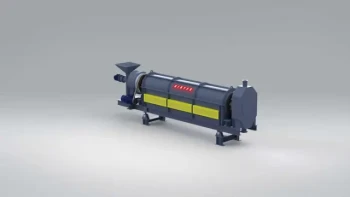
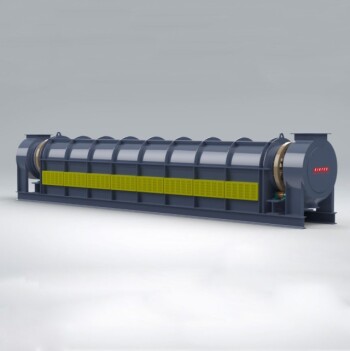
The significant advantage of a rotary reactor for micron-scale copper powders is its ability to mechanically agitate materials that are prone to clumping, ensuring a uniform coating even on complex particle shapes. Unlike fluidized bed reactors, which rely on high gas flow rates that can fail to separate sticky powders, rotary reactors use physical tumbling and vacuum evacuation to guarantee precursors reach every surface.
Core Takeaway Fluidized bed reactors often struggle with dendritic or cohesive powders because gas flow alone cannot prevent agglomeration. A rotary reactor solves this by decoupling agitation from gas flow, using mechanical rotation to expose particle surfaces and a vacuum system to efficiently clear residual gases.
The Mechanics of Effective Agitation
Overcoming Agglomeration
Micron-scale copper powders, particularly those with dendritic (branch-like) structures, have a high tendency to clump together (agglomerate).
In a rotary reactor, the continuous mechanical tumbling physically separates these particles. This ensures that the Atomic Layer Deposition (ALD) precursors can penetrate the powder mass and coat the entire surface area of the complex structures, rather than just the exterior of a clump.
Decoupling Agitation from Gas Flow
A major limitation of fluidized bed reactors is their reliance on high gas flow rates to keep particles suspended.
If the powder is heavy or sticky, the gas flow required to suspend it may be impractical or ineffective. The rotary reactor eliminates this dependency. It achieves agitation through rotation, allowing the chemical process to proceed without the need for excessive gas velocities to maintain particle suspension.
Process Efficiency and Control
Vacuum-Assisted Purging
Efficiency in ALD relies on effectively removing excess chemicals between cycles.
The rotary reactor system utilizes a vacuum pump to evacuate residual gases during pulse intervals. This differs from fluidized beds, which typically rely on continuous gas sweeping. The vacuum approach ensures that by-products and unreacted precursors are actively removed, preventing unwanted gas-phase reactions (CVD-like growth) and ensuring pure ALD growth.
Handling Complex Topologies
Dendritic powders possess intricate surface topologies that are difficult to coat uniformly.
Because the rotary reactor combines mechanical tumbling with vacuum-assisted gas transport, it is uniquely effective for these morphologies. The tumbling action constantly reorientates the particles, exposing deep crevices and irregular surfaces to the precursor gas.
Common Pitfalls to Avoid
The Risk of Static Beds
If you choose a reactor that does not provide sufficient agitation—such as a fluidized bed operating with cohesive powders—you risk creating a "static bed."
In this scenario, gas forms channels (rat-holing) through the powder rather than suspending it. This leads to non-uniform coatings where some particles are heavily coated and others are barely touched.
Misidentifying Powder Flowability
Do not assume all micron-scale powders will fluidize easily.
Dendritic copper powders are structurally different from spherical powders. Their interlocking shapes make them resistant to fluidization. Relying on gas flow alone for these materials is a frequent cause of process failure, making mechanical agitation the safer engineering choice.
Making the Right Choice for Your Goal
Based on the specific challenges of coating micron-scale copper powders:
- If your primary focus is preventing agglomeration: Choose the rotary reactor, as its mechanical tumbling physically breaks up clumps that gas flow cannot separate.
- If your primary focus is coating uniformity on dendritic shapes: Choose the rotary reactor to ensure precursors penetrate the complex topology through active agitation and vacuum evacuation.
Summary: For cohesive or dendritic powders where gas suspension is unreliable, mechanical rotation provides the necessary physical energy to ensure every particle is individually and uniformly coated.
Summary Table:
| Feature | Rotary Reactor | Fluidized Bed Reactor |
|---|---|---|
| Agitation Method | Mechanical tumbling (Decoupled from gas) | High-velocity gas flow (Dependent) |
| Handling Cohesive Powder | Excellent; physical separation of clumps | Poor; prone to 'rat-holing' and clumping |
| Coating Uniformity | High; exposes complex dendritic shapes | Variable; limited by gas channeling |
| Gas Management | Vacuum-assisted purging | Continuous gas sweeping |
| Ideal Morphology | Dendritic, interlocking, or heavy powders | Spherical, free-flowing powders |
Elevate Your Material Research with KINTEK Precision
Struggling with non-uniform coatings on dendritic or cohesive powders? KINTEK specializes in advanced laboratory solutions designed to overcome the most complex material challenges. From high-performance rotary and vacuum furnaces to specialized high-temperature high-pressure reactors, our equipment ensures your Atomic Layer Deposition (ALD) processes achieve perfect uniformity and repeatability.
Whether you are working with micron-scale copper powders or developing next-generation battery materials, our comprehensive portfolio—including crushing systems, hydraulic presses, and electrolytic cells—provides the reliability your research demands.
Ready to optimize your lab's efficiency? Contact KINTEK today to consult with our experts and find the perfect reactor solution for your specific application.
References
- Véronique Cremers, Christophe Detavernier. Corrosion protection of Cu by atomic layer deposition. DOI: 10.1116/1.5116136
This article is also based on technical information from Kintek Solution Knowledge Base .
Related Products
- Electric Rotary Kiln Small Rotary Furnace for Activated Carbon Regeneration
- Electric Rotary Kiln Continuous Working Small Rotary Furnace Heating Pyrolysis Plant
- Electric Rotary Kiln Pyrolysis Furnace Plant Machine Calciner Small Rotary Kiln Rotating Furnace
- High Pressure Laboratory Autoclave Reactor for Hydrothermal Synthesis
People Also Ask
- What is a rotary kiln electric furnace? Achieve Superior Uniform Heating for Your Materials
- What is the temperature of activated carbon regeneration? Unlock the 1000°F Process for Reuse
- What is the regeneration temperature of activated carbon? Optimize Your Process with the Right Method
- What are the characteristics of the slipping, slumping, and rolling modes of bed motion? Optimize Your Rotary Process
- What are the parts of a carbon regeneration kiln? A Guide to Its Core Components and Function