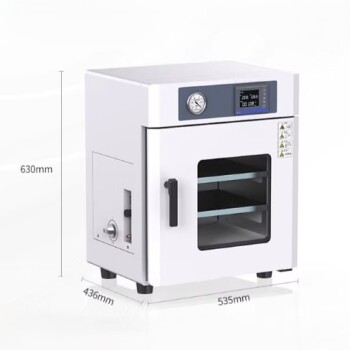
The primary purpose of pre-treating coal samples in a nitrogen-atmosphere drying oven is to eliminate moisture interference without chemically altering the sample. By maintaining a temperature of approximately 108°C, you effectively drive off physically adsorbed water to establish a consistent "dry basis" for your experiments.
Crucially, the inert nitrogen atmosphere protects the sample during this heating phase. Without it, the coal would begin to oxidize, fundamentally changing its composition before the actual pyrolysis experiment begins.
Core Takeaway: Accurate pyrolysis data requires a pristine, moisture-free starting material. Pre-treatment standardizes the sample by removing water weight while the nitrogen shield prevents oxidative degradation, ensuring your results reflect the coal's intrinsic properties rather than environmental artifacts.
The Mechanics of Moisture Removal
Targeting Adsorbed Water
Coal is naturally porous and hygroscopic, meaning it holds significant amounts of physically adsorbed water.
To analyze coal accurately, this water must be removed completely. Heating the sample to 108°C provides sufficient energy to break the physical bonds holding water molecules to the coal surface without initiating thermal decomposition of the coal structure itself.
Establishing a "Dry Basis"
In scientific analysis, consistency is paramount. If samples contain varying levels of moisture, comparing data between experiments becomes impossible.
This pre-treatment creates a standardized dry-basis sample. This ensures that any subsequent measurements—whether mass loss or energy release—are attributed solely to the coal matter, not to the evaporation of trapped moisture.
The Role of the Nitrogen Atmosphere
Preventing Premature Oxidation
Heat accelerates chemical reactions. If you dried coal in standard air (which contains oxygen) at 108°C, the surface of the coal would begin to react with the oxygen.
This oxidation alters the elemental composition of the sample. By displacing air with inert nitrogen, you create a safe environment where the sample can be heated to dry it out without chemically degrading or "aging" the fuel.
Ensuring Chemical Integrity
The goal of pyrolysis is to study how coal breaks down under high heat.
If the sample has already partially oxidized during the drying phase, your pyrolysis kinetics will be skewed. The nitrogen atmosphere preserves the coal in its original chemical state, ensuring the baseline for your experiment is accurate.
Impact on Data Accuracy
Refining Kinetic Analysis
Pyrolysis kinetics involve measuring reaction rates and activation energies.
Moisture evaporation absorbs energy and changes the mass loss profile. By removing water beforehand, you isolate the pyrolysis kinetics, ensuring the data reflects the decomposition of the organic matrix rather than the simple phase change of water.
Correcting Elemental Measurements
Accurate measurement of elemental content (Carbon, Hydrogen, Nitrogen, Sulphur, Oxygen) is impossible with a wet sample.
Water contains hydrogen and oxygen, which will inflate those values in your results. Pre-treatment ensures that the elemental content you measure belongs exclusively to the coal, allowing for precise stoichiometric calculations.
Understanding the Trade-offs
Temperature Sensitivity
While 108°C is the standard for removing water, strict temperature control is critical.
If the drying oven exceeds this temperature significantly, you risk releasing volatile matter along with the water. This would result in an underestimation of the coal's energy potential and volatile content.
Process Duration
The reference suggests a duration such as one hour for this process.
Shortcutting this time can lead to incomplete drying, leaving residual moisture that affects results. Conversely, excessive drying times (even under nitrogen) yield diminishing returns and delay experimental throughput.
Making the Right Choice for Your Goal
To ensure the validity of your pyrolysis data, apply these principles to your workflow:
- If your primary focus is Kinetic Modeling: Ensure the pre-treatment completely removes water, as moisture evaporation overlaps with low-temperature volatile release, creating "noise" in your kinetic data.
- If your primary focus is Elemental Analysis: Prioritize the integrity of the nitrogen purge to guarantee absolutely zero oxidation, as even minor surface oxidation will skew your Carbon and Oxygen ratios.
Summary: The nitrogen-atmosphere drying step is the foundation of experimental accuracy, converting a variable raw material into a standardized, chemically stable baseline for analysis.
Summary Table:
| Feature | Specification/Action | Purpose for Coal Analysis |
|---|---|---|
| Temperature | Approximately 108°C | Removes physically adsorbed water without decomposition |
| Atmosphere | Inert Nitrogen ($N_2$) | Prevents surface oxidation and preserves chemical integrity |
| Standardization | "Dry Basis" Creation | Ensures consistent data comparison across different samples |
| Duration | Typically 1 Hour | Guarantees complete moisture removal for kinetic accuracy |
| Key Outcome | Pristine Sample | Isolates pyrolysis kinetics from moisture interference |
Elevate Your Research with KINTEK's High-Precision Equipment
Don't let moisture interference or premature oxidation compromise your experimental results. KINTEK specializes in advanced laboratory solutions designed to meet the rigorous demands of coal and material research. From our high-performance nitrogen-atmosphere drying ovens to our comprehensive range of high-temperature furnaces (vacuum, tube, and atmosphere) and crushing systems, we provide the tools you need for a standardized, "dry-basis" workflow.
Whether you are refining kinetic models or conducting precise elemental analysis, KINTEK’s equipment ensures your results reflect the intrinsic properties of your samples. Contact us today to find the perfect thermal solution for your lab!
References
- Naoto Tsubouchi, Yasuo Ohtsuka. Fate of the Chlorine in Coal in the Heating Process. DOI: 10.2355/isijinternational.isijint-2017-302
This article is also based on technical information from Kintek Solution Knowledge Base .
Related Products
- 1400℃ Controlled Atmosphere Furnace with Nitrogen and Inert Atmosphere
- 1700℃ Controlled Atmosphere Furnace Nitrogen Inert Atmosphere Furnace
- Controlled Nitrogen Inert Hydrogen Atmosphere Furnace
- 1200℃ Controlled Atmosphere Furnace Nitrogen Inert Atmosphere Furnace
- 23L Laboratory Vacuum Drying Oven
People Also Ask
- How is oxygen (O2) used in controlled furnace atmospheres? Mastering Surface Engineering for Metals
- What is the necessity of controlled atmosphere furnaces for gas corrosion? Ensure Precise Material Failure Modeling
- What are the two primary purposes of using a controlled atmosphere? Master Protection vs. Material Modification
- What is a controlled atmosphere furnace? Achieve Purity and Precision in High-Temp Processing
- What is the function of a high-precision controlled atmosphere furnace for Alloy 617? Simulate Extreme VHTR Conditions