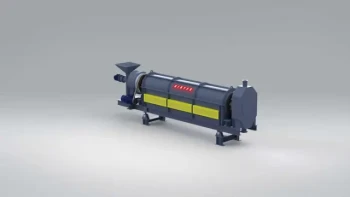
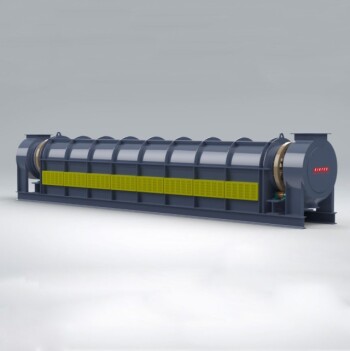
The decisive advantage of a rotary tube furnace lies in its dynamic handling of the material. Unlike a static box furnace where the powder remains stationary, a rotary furnace keeps the MoVOx catalyst in constant motion through tube rotation. This tumbling action ensures uniform heat distribution and maximum exposure to the inert gas flow, directly resulting in superior particle crystallinity and catalytic stability.
The core difference is mechanical agitation. While static furnaces risk uneven heating and trapped gases within the powder bed, the rotary tube furnace actively "stirs" the catalyst. This ensures every particle experiences the same thermal history and atmospheric contact, eliminating the "dead zones" common in static processing.
The Mechanism of Superior Crystallinity
Eliminating Thermal Gradients
In a static box furnace, heat must penetrate a stationary pile of powder. This often creates a temperature gradient where the outer layer is hotter than the core.
The rotary furnace solves this by constantly tumbling the catalyst. Because the powder is always moving, every particle is exposed to the heating elements equally. This dynamic mixing ensures that the entire batch reaches the target temperature of 400 °C uniformly, preventing inconsistent crystallization.
Preventing Local Overheating
Stationary particles are susceptible to localized hot spots, which can degrade the catalyst structure.
The rotation of the tube ensures that no single particle remains in contact with the hottest surface for too long. This dissipates heat evenly throughout the batch. By preventing local overheating, the furnace protects the delicate MoVOx structure, leading to a more stable and reliable final product.
Optimizing the Reaction Atmosphere
Maximizing Gas-Solid Contact
Heat treating MoVOx catalysts requires a controlled argon atmosphere. In a static process, the inert gas flows over the powder bed, often failing to penetrate deep into the pile.
The rotary motion ensures the entire surface area of the catalyst particles is exposed to the atmosphere. As the powder tumbles, it is lifted and cascaded through the gas stream. This enhances gas diffusion and ensures the inert environment is maintained around every individual particle.
Efficient Removal of Byproducts
During heat treatment, decomposition products are often released. In a static bed, these gases can get trapped between particles, potentially interfering with the catalyst formation.
The continuous movement of the rotary furnace effectively liberates these decomposition products. The tumbling action prevents gas pockets from forming within the powder, allowing the flowing argon to sweep away unwanted byproducts immediately. This results in a cleaner, purer catalyst material.
Understanding the Trade-offs
Mechanical Complexity vs. Simplicity
While the rotary furnace offers superior processing for powders, it introduces mechanical complexity. The need for rotating seals makes maintaining a perfect inert atmosphere slightly more technically demanding than in a sealed, static box.
Material Attrition Risks
The tumbling action is excellent for mixing, but it creates physical friction.
If the catalyst material is fragile or shaped into specific pellets, the continuous motion could cause attrition or breakage. While ideal for the MoVOx powders mentioned, this method must be evaluated carefully if the material form is sensitive to physical impact.
Making the Right Choice for Your Goal
To select the correct furnace for your application, consider your priority:
- If your primary focus is maximizing catalytic activity: Choose the rotary tube furnace to ensure high crystallinity, uniform heating, and effective removal of impurities.
- If your primary focus is preventing physical abrasion: A static box furnace may be preferable if the catalyst is in a fragile shape that cannot withstand tumbling, provided you accept lower thermal uniformity.
By switching to a rotary system, you transform the heat treatment from a passive baking process into an active, uniform synthesis.
Summary Table:
| Feature | Rotary Tube Furnace | Static Box Furnace |
|---|---|---|
| Material State | Dynamic (Constant Tumbling) | Stationary (Powder Bed) |
| Thermal Uniformity | Excellent (No Thermal Gradients) | Limited (Outer Layer Hotter) |
| Atmosphere Contact | Maximum Surface Exposure | Surface Flow Only |
| Byproduct Removal | Efficient (Gas Pockets Prevented) | Risk of Trapped Gases |
| Particle Integrity | Potential for Attrition | High Protection of Shapes |
| Best For | Maximizing Catalytic Activity | Fragile Pre-formed Pellets |
Optimize Your Catalyst Synthesis with KINTEK
Ready to transform your material processing from passive baking to active synthesis? KINTEK specializes in advanced laboratory solutions, offering a comprehensive range of rotary tube furnaces and atmosphere furnaces designed to ensure superior crystallinity and thermal uniformity. Whether you are working on MoVOx catalysts or complex battery research, our high-precision equipment provides the control you need.
Our Expertise Includes:
- High-Temperature Furnaces: Rotary, vacuum, CVD, and muffle systems.
- Processing Tools: Crushing, milling, and hydraulic presses (pellet, isostatic).
- Lab Essentials: High-pressure reactors, autoclaves, and cooling solutions.
Contact KINTEK today to find the perfect furnace for your lab!
References
- Adam Kubas, Dimitrios Maganas. A combined experimental and theoretical spectroscopic protocol for determination of the structure of heterogeneous catalysts: developing the information content of the resonance Raman spectra of M1 MoVO<sub>x</sub>. DOI: 10.1039/c7sc01771e
This article is also based on technical information from Kintek Solution Knowledge Base .
Related Products
- Rotary Tube Furnace Split Multi Heating Zone Rotating Tube Furnace
- Laboratory Vacuum Tilt Rotary Tube Furnace Rotating Tube Furnace
- Vacuum Sealed Continuous Working Rotary Tube Furnace Rotating Tube Furnace
- Inclined Rotary Plasma Enhanced Chemical Vapor Deposition PECVD Equipment Tube Furnace Machine
- Electric Rotary Kiln Small Rotary Furnace for Activated Carbon Regeneration
People Also Ask
- What are the process advantages of using a rotary tube furnace for WS2 powder? Achieve Superior Material Crystallinity
- Why is a rotary tube furnace preferred over a fixed tube furnace for the carbonization of asphaltenes? Superior Quality
- Why is a rotary tube furnace recommended for the calcination stage of potassium vanadium oxide catalysts? Optimize Purity
- What is a rotary tube furnace? Achieve Superior Uniformity for Powders and Granules
- What is a rotary furnace used for? Achieve Unmatched Process Uniformity and Control